Eddy Current Tube Testing: Detecting Pitting and Wall Loss in Shell & Tube Condensers
A single burst copper condenser tube can contaminate a multi-million-dirham chiller circuit with water. Eddy Current Testing detects tube thinning before rupture occurs.
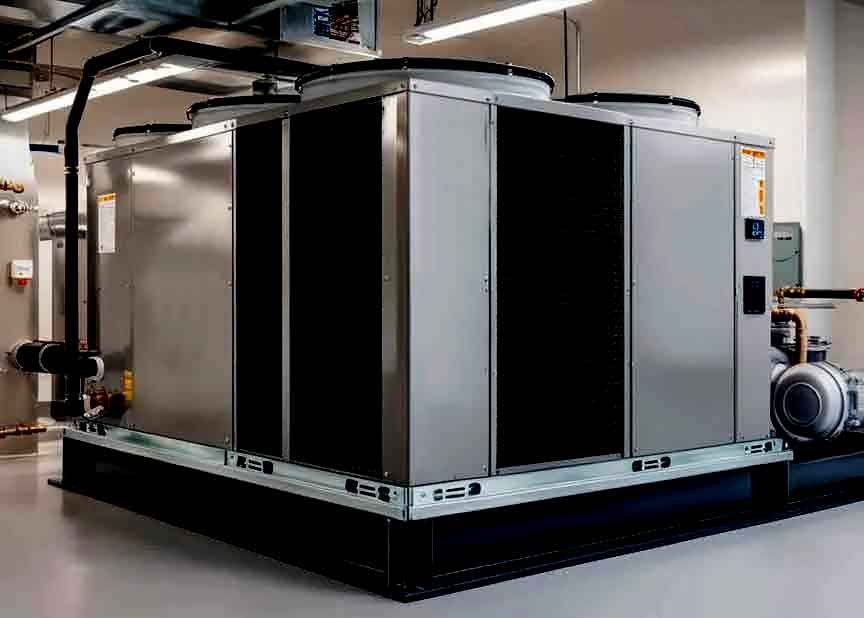
Centrifugal and water-cooled screw chillers across commercial towers and district cooling plants in the UAE utilize shell-and-tube heat exchangers containing thousands of internally enhanced copper or cupronickel tubes. Circulating cooling tower water contains dissolved mineral salts, sand particulates, and chemical biocides.
Over years of high-velocity water circulation, tubes suffer from erosion-corrosion, pitting, stress corrosion cracking, and baffle-fretting damage. If a single tube wall ruptures under operating pressure, cooling water floods into the refrigerant shell, destroying compressor motors and contaminating refrigeration circuits. Non-destructive Eddy Current Testing (ECT) provides precise electromagnetic wall-thickness mapping.
Engineering Principles & Technical Specifications
Eddy Current Testing uses high-frequency alternating current probes (differential and absolute bobbin probes) passing through each tube at 100 kHz to 400 kHz to measure phase angle shifts and signal amplitude, calculating percentage wall loss ($% \text{ Wall Loss} = \frac{t_{nom} - t_{act}}{t_{nom}} \times 100$).
| Wall Loss Defect Severity | Percentage Wall Loss (%) | Failure Risk Level | Recommended Engineering Action | Re-Test Interval |
|---|---|---|---|---|
| Class 1: Minor Wall Thinning | 10% – 20% Wall Loss | Low Risk | Record in baseline asset register | Re-test in 24 Months |
| Class 2: Moderate Erosion | 20% – 40% Wall Loss | Moderate Risk | Monitor water velocity & chemistry | Re-test in 12 Months |
| Class 3: Severe Pitting | 40% – 60% Wall Loss | High Risk | Schedule selective tube plugging | Annual Inspection |
| Class 4: Critical Thinning | >60% Wall Loss | Imminent Rupture | Mandatory mechanical brass plugging | Immediate Action |
Step-by-Step Technical Execution & Mobilization Protocol
To ensure seamless reliability under extreme UAE summer ambient conditions (reaching +50°C to +52°C), our engineering logistics teams implement the following structured workflow:
- Condenser End-Bell Removal & Hydro-Jet Cleaning: Unbolt heavy condenser water boxes and perform high-pressure rotary brush cleaning to remove all scale, slime, and debris from internal tube walls.
- Calibration Standard Tube Benchmarking: Calibrate the multi-frequency eddy current instrument (Olympus / Eddyfi) against an ASME standard calibration tube containing precision machined flat-bottom holes and circumferential notches.
- High-Speed Bobbin Probe Tube Scanning: Insert flexible eddy current bobbin probes down every individual copper tube, pulling probes at a steady rate of 0.5 to 1.0 m/s while recording multichannel impedance data.
- Color-Coded Tube Sheet Defect Mapping: Generate computerized 2D tube sheet maps color-coding each tube by defect type: external OD pitting, internal ID erosion, baffle wear, or denting.
- Selective Tapered Plug Installation: Hammer calibrated brass or bronze tapered plugs into both ends of any tubes exhibiting over 60% wall loss to prevent mid-season rupture.
Common Operating Pitfalls & Desert Condition Mitigation
Operating HVAC and power plant equipment across Dubai, Abu Dhabi, Sharjah, and coastal industrial zones like JAFZA presents severe thermodynamic challenges. The following table of risks must be actively managed:
- Testing Uncleaned Tubes Yielding False Flaw Signals: Never perform ECT on dirty tubes; scale deposits create magnetic permeability shifts that mask actual metal wall loss.
- Exceeding Maximum Permissible Plugged Tube Count: Keep total plugged tubes below 8% to 10% of total bundle count to prevent excessive water velocity and chiller capacity loss.
- Using Dissimilar Metals for Plugs Causing Galvanic Corrosion: Always match plug metallurgy to tube material: brass plugs for copper tubes, cupronickel plugs for CuNi bundles.
Turnkey Commercial Execution & SLA Guarantees
At HVAC Clinic, every deployment is backed by certified mechanical refrigeration technicians and electrical engineers. We maintain operational depot staging yards in Al Quoz (Dubai), Musaffah (Abu Dhabi), and Industrial Area (Sharjah), enabling guaranteed 60 to 120-minute emergency mobilization across all 7 Emirates.
Our temporary installations include turnkey high-pressure flexible hoses, Bauer quick-action couplings, variable primary pumping stations, double-walled fuel tanks, and round-the-clock telemetry monitoring. For specialized project sizing, explore our core Chiller Maintenance & Overhaul capabilities.
Frequently Asked Technical Questions
How often should Eddy Current Testing be performed on UAE chillers?▼
How many tubes can be plugged before a chiller loses cooling capacity?▼
What happens if a condenser tube bursts inside a chiller?▼
Looking for Chiller Maintenance?
Comprehensive industrial and commercial chiller maintenance services across Dubai, Abu Dhabi, Sharjah, and the UAE. Annual Maintenance Contracts (AMC), emergenc...