
In Dubai's fast-paced commercial construction and luxury real estate landscape, Wild Air Dubai cooling solutions play an indispensable role in safeguarding interior fit-outs, preventing catastrophic condensation damage, and keeping mega-developments on track for successful handover. From iconic skyscrapers in Downtown Dubai, Business Bay, and DIFC to expansive luxury retail destinations in Dubai Mall and Dubai Hills, turnkey wild air cooling provides vital temporary climate control before permanent DEWA power and district cooling networks are fully operational.
The Skyscraper Challenge: Managing Elevator Shaft Chimney Effect in Dubai High-Rises#
Constructing 40-to-90-story residential and commercial towers in Dubai introduces thermodynamic and aerodynamic phenomena rarely encountered in standard horizontal construction. The most critical of these is the chimney effect (also known as stack effect) within open vertical elevator shafts, MEP riser shafts, and central stair cores.
During Dubai's extreme summer months, outdoor ambient temperatures exceed 48°C with coastal relative humidity reaching 90% or higher. When unconditioned air enters lower building levels through loading docks, open facade sections, and construction hoist doors, the extreme temperature difference between outdoor air and partially shaded building cores creates powerful buoyancy forces. Warm air accelerates upwards through vertical shafts, generating negative pressure on lower floors that pulls massive quantities of hot, humid desert air into the structure continuously.
Standard spot coolers and commercial package units cannot overcome this vertical pressure differential. HVAC Clinic's wild air Dubai engineering packages deploy specialized high-static air handling units capable of generating between 600 Pa and 850 Pa of external static pressure. By introducing high-volume conditioned air directly into active work zones and vertical shafts, our systems establish positive building pressurization. This creates an engineered downward and lateral displacement barrier that suppresses upward drafts, seals off open elevator shafts, and maintains uniform 22°C temperatures across active fit-out floors.
Facade Thermal Shock and Solar Radiation Mitigation#
Modern Dubai towers feature floor-to-ceiling double-glazed or triple-glazed curtain walls. Prior to the installation of interior blinds and automated solar shading, direct solar radiation causes severe greenhouse heat buildup inside perimeter offices, with slab temperatures frequently exceeding 58°C. Our high-tonnage wild air systems utilize directional air cannons and temporary perimeter duct runs to create continuous convective wash along glass facades, neutralizing solar thermal spikes before heat transfers into interior joinery and ceiling drywall.
Managing Infiltration Through Construction Hoists and Loading Bays#
Active high-rise sites operate construction personnel and materials hoists attached to the exterior facade. Every time a hoist gate opens onto a fit-out floor, hundreds of cubic meters of ambient desert air enter the workspace. Without high-capacity positive pressurization and rapid thermal recovery, this continuous infiltration introduces moisture that condenses on cool floor slabs and freshly installed chilled water piping. Our high-CFM air handlers deliver between 6 and 10 air changes per hour (ACH) on active floors, rapidly purging infiltrated ambient humidity.
Fast-Track Luxury Retail Renovations in Premier Dubai Malls#
High-end retail fit-outs in premier retail destinations—such as The Dubai Mall, Mall of the Emirates, Dubai Marina Mall, and Dubai Hills Mall—operate under intense schedule pressure, stringent property management standards, and strict operational constraints:
- Delamination of High-Gloss Lacquers and Exotic Veneers: Luxury flagship boutiques incorporate bespoke Italian joinery, acoustic perforated timber paneling, and polished brass architectural trims. Unconditioned ambient humidity causes timber substrates to swell, resulting in veneer delamination, edge curling, and joint failure.
- Industrial Epoxy and Polyurethane Flooring Failures: Self-leveling floor epoxies and terrazzo screeds require tightly controlled ambient temperatures (typically 20°C to 24°C) and relative humidity strictly below 55% RH during application and curing. High humidity causes amine blushing, micro-porosity, and permanent adhesion failure.
- Avoiding District Cooling Flow Charges and Penalty Tariffs: Connecting to mall chilled water networks prematurely during construction creates severe hydraulic imbalances. Operating dirty construction air through mall fan coil units leads to coil fouling and triggers excessive delta-T penalty charges from district cooling providers such as Empower.
HVAC Clinic delivers fully autonomous, self-contained temporary cooling solutions that operate completely independently of the mall central chilled water infrastructure, guaranteeing optimal conditions for trades without utility risks.
District Cooling Network Integration & Delta-T Protection#
In Dubai, district cooling utilities enforce strict low delta-T penalty tariffs if return chilled water temperature drops below design thresholds (typically below 14°C when supply is 5.5°C). During building pre-commissioning, operating partially balanced permanent air handlers across unfinished floors causes bypass flow and low delta-T syndrome, resulting in massive financial penalties on the contractor's account.
By deploying an independent rental chiller in Dubai paired with temporary plate heat exchangers, contractors can circulate chilled water through building headers at full design flow rates without drawing chilled water from the district cooling main. This allows MEP engineers to flush, chemical-clean, and hydraulically balance secondary circuits while maintaining full wild air cooling across fit-out floors.
Dubai Municipality Green Building Regulations (Al Sa'fat) Compliance#
The Dubai Municipality Al Sa'fat Green Building System enforces rigorous indoor environmental quality (IEQ) requirements during both the construction and pre-occupancy phases of new developments. A key requirement is the implementation of an effective Construction Indoor Air Quality Management Plan.
Operating wild air air handling units fitted with multi-stage filtration—combining washable G4 metal mesh pre-filters with high-efficiency F7/F9 pocket filters—ensures that fine gypsum dust, silica dust from concrete grinding, and paint aerosols are continually scrubbed from indoor air. Furthermore, prior to building handover, our high-CFM air handlers perform the mandatory pre-occupancy flush-out, delivering continuous outdoor air changes that purge volatile organic compounds (VOCs) released by paints, adhesives, and sealants.
Engineered Technical Fleet Architecture for Dubai Projects#
Every wild air installation in Dubai is customized to match the unique logistical, structural, and power constraints of the site:
1. High-Static Modular Air Handling Units (AHUs)#
Equipped with premium-efficiency IE3 electric motors and backward-curved plug-fan impellers, our rental AHUs deliver between 10,000 CFM and 45,000 CFM against high external static resistance. Double-skin casing with 50 mm polyurethane foam insulation prevents external surface condensation sweating in hot, humid plant rooms.
2. Low-Noise High-Ambient Air-Cooled Chillers (50 TR to 1500 TR)#
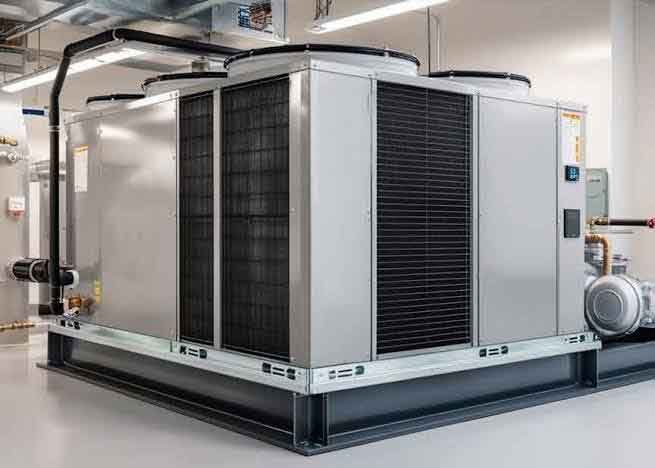
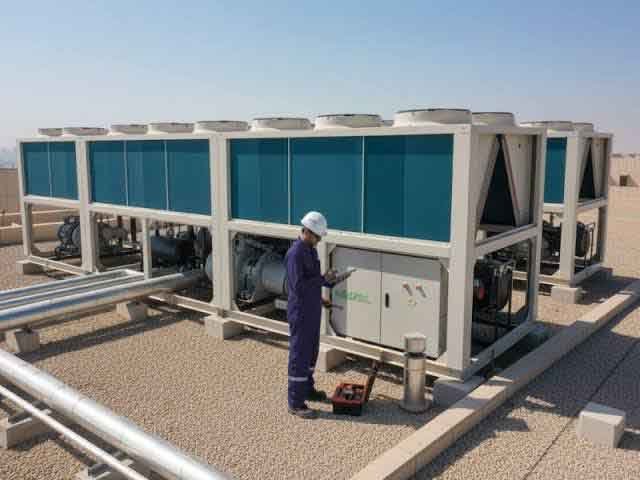
Engineered specifically for extreme GCC operating conditions up to 52°C ambient temperature. Our rental chillers incorporate multi-compressor semi-hermetic screw technology, electronic expansion valves, and acoustic compressor jackets paired with variable-speed low-noise condenser fans that maintain noise levels below 68 dBA at 10 meters—vital for noise-sensitive urban developments in DIFC, Downtown Dubai, and Jumeirah.
3. Lightweight Perforated Textile Ducting ("Sox")#
Suspended from lightweight high-tensile steel cables, flame-retardant fabric duct networks distribute conditioned air smoothly and evenly across open-plan floorplates without requiring rigid metal ductwork or creating localized cold drafts.
4. Skid-Mounted Secondary Pumping Systems with VFDs#
Variable-speed secondary pump skids automatically modulate chilled water flow rates to match fluctuating building thermal loads throughout the day, optimizing energy consumption and maintaining steady coil approach temperatures.
5. Turnkey Temporary Power Packages (100 kVA to 1250 kVA)#
When permanent DEWA electrical connections are pending, HVAC Clinic deploys super-silent diesel generators fitted with automatic transfer switches (ATS) and external double-walled bulk fuel tanks with automated refilling management.
Dubai Fit-Out Sizing & Capacity Engineering Matrix#
The following sizing matrix provides engineering guidelines for determining wild air cooling capacity and airflow across representative Dubai project categories:
| Dubai Project Typology | Floorplate Area | Required Airflow (CFM) | Cooling Tonnage (TR) | Target Space Conditions |
|---|---|---|---|---|
| DIFC Premium Financial Tower Floor | 18,000 sq. ft. | 10,000 – 14,000 CFM | 50 – 70 TR | 22°C ± 1°C / 50% RH |
| Dubai Mall Luxury Fashion Boutique | 28,000 sq. ft. | 16,000 – 22,000 CFM | 90 – 120 TR | 21°C ± 1°C / 48% RH |
| Downtown Hotel Multi-Floor Wing | 45,000 sq. ft. (3 floors) | 28,000 – 36,000 CFM | 140 – 180 TR | 22°C ± 1°C / 50% RH |
| Dubai South E-Commerce Logistics Hub | 80,000 sq. ft. | 48,000 – 65,000 CFM | 260 – 360 TR | 24°C ± 1.5°C / 55% RH |
| Palm Jumeirah Luxury Villa Renovation | 14,000 sq. ft. | 8,000 – 12,000 CFM | 40 – 55 TR | 21°C ± 1°C / 50% RH |
| Healthcare Clinic & Diagnostic Center | 22,000 sq. ft. | 14,000 – 18,000 CFM | 70 – 90 TR | 21°C ± 0.5°C / 45% RH |
Psychrometric Calculations & Coil Dehumidification Performance#
In Dubai's coastal summer, the latent cooling load often exceeds the sensible load. For example, entering air at 35°C dry bulb and 28°C wet bulb carries an enthalpy of approximately 90 kJ/kg dry air and a moisture content of 20 grams of water per kilogram of dry air. To deliver air at 13°C dry bulb and 12°C wet bulb (approx. 9.5 g moisture/kg dry air), our cooling coils extract over 10.5 grams of water for every kilogram of air circulated.
On a typical 30,000 CFM retail installation, this equates to condensing and removing over 450 liters of water per hour from the indoor air space. HVAC Clinic engineers install dedicated gravity drainage lines and condensate sump pumps to evacuate moisture safely, preventing puddling or water damage on active construction floors.
Step-by-Step Commissioning Checklist for MEP Fit-Out Contractors#
To ensure flawless operation and seamless coordination between trade contractors, HVAC Clinic adheres to an exhaustive commissioning checklist before handing over a wild air cooling installation:
- Envelope Infiltration Audit: Verify temporary sealant or polyethylene sheeting over open perimeter riser penetrations, hoist openings, and unglazed facade openings.
- Hydraulic Flush & Pressure Verification: Hydrostatically test all temporary PN16 flexible hose lines to 10 bar for 30 minutes to verify zero leak rate before opening chiller isolation valves.
- Chiller Approach Temperature Check: Measure chilled water supply (6°C) and return (12°C) to confirm minimum 5.5°C to 6.0°C delta-T across the plate heat exchanger.
- Air Handler Static Pressure & Fan Amperage: Measure fan running current against full-load amps (FLA) to ensure motors operate within safe thermal boundaries under high static duct backpressure.
- Thermal Imaging Floorplate Scan: Use FLIR thermal cameras to map temperature distribution across floorplates, adjusting fabric duct discharge nozzles to eliminate hot pockets along perimeter glazing.
- Telemetry Setup & Alarm Escalation: Verify continuous cloud connection of temperature, humidity, and pressure sensors with automated SMS alerts to site supervisors.
Turnkey Mobilization & Site Management Across Dubai#
Operating high-capacity cooling equipment in dense urban areas requires meticulous logistics, municipal permitting, and expert mechanical coordination:
- RTA and Dubai Municipality Permitting: We manage road closure permits, abnormal load transport notifications, and crane staging approvals for tight city street deployments in Downtown, DIFC, and Marina.
- Crane Rigging and Equipment Staging: Our certified rigging supervisors coordinate mobile crane lifts, positioning chillers on podium levels, parking basements, or ground staging bays with zero disruption to active city traffic.
- High-Pressure Camlock Fluid Connections: Certified PN16 multi-spiral flexible hoses connect external chillers to temporary vertical risers within hours, complete with pressure relief valves and air-bleed vents.
- Multi-Floor Pitot-Tube Air Balancing: Using calibrated digital anemometers and thermal imaging cameras, our commissioning engineers balance CFM delivery across each floor to eliminate hot pockets and drafts.
- Continuous 24/7 Remote Telemetry & Field Support: On-board IoT telemetry modules transmit real-time data on supply water temperature, return water temperature, ambient wet bulb, space relative humidity, and compressor suction/discharge pressures to our 24/7 central control dispatch.
Real-World Project Case Study: 45-Story Mixed-Use Tower in Business Bay#
During the fit-out of a 45-story commercial and luxury residential tower overlooking the Dubai Canal, substation energization delays threatened to push building handover by four months. Custom teak timber paneling on floors 25 to 38 was at immediate risk of swelling under 85% ambient relative humidity.
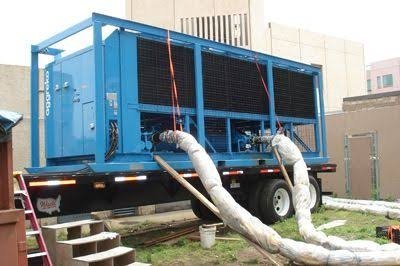
HVAC Clinic mobilized a 600 TR air-cooled rental chiller and four 20,000 CFM high-static AHUs staged on the podium parking deck. Temporary chilled water hoses were connected to a temporary vertical steel riser routed up the exterior service hoist mast. Conditioned air was delivered into each level via temporary flexible duct manifolds. Within 24 hours of operation, space conditions across all 14 fit-out floors stabilized at 22°C and 50% RH, allowing carpenters and painters to complete work on schedule without material defects.
Frequently Asked Questions About Wild Air in Dubai#
Q: How does wild air suppress elevator shaft chimney effects in Dubai skyscrapers?#
By injecting high-static conditioned air into active work floors, our systems establish positive room pressurization relative to vertical shafts. This pressure barrier prevents the buoyancy-driven influx of humid outdoor air through the building core.
Q: Are your Dubai wild air chillers compliant with night-time urban residential noise limits?#
Yes. Our urban chiller fleet features sound-attenuated acoustic compressor enclosures and variable-speed low-noise fans operating below 68 dBA at 10 meters, fully compliant with Dubai Municipality residential noise thresholds.
Q: Can temporary air handlers connect directly to permanent building ductwork?#
Yes, where approved by the project consultant. However, we typically recommend deploying temporary fabric or spiral ducting to ensure permanent duct acoustic liners remain completely free of construction dust and plaster debris.
Q: How quickly can HVAC Clinic mobilize wild air cooling equipment across Dubai?#
We maintain fully pre-commissioned rental chillers, high-static air handling units, and quick-connect hose kits staged at our central Dubai logistics depot, guaranteeing mobilization within 60 to 120 minutes.
Q: Do your temporary cooling solutions include turnkey fuel management?#
Yes. When rental generators are deployed to power wild air equipment, our automated fuel management team monitors diesel levels via telemetry and schedules timely refuels to guarantee 100% continuous cooling uptime.
Q: How does wild air prevent district cooling delta-T penalties during fit-out?#
By operating on autonomous rental chillers, contractors can test, flush, and balance secondary chilled water systems without pulling chilled water from the district cooling provider, avoiding low delta-T tariff fines.