
In the United Arab Emirates construction and MEP engineering sectors, Wild Air refers to the temporary supply of high-volume conditioned air and mechanical ventilation deployed during structural fit-out, joinery installation, and MEP pre-commissioning phases before the permanent central chilled water plant or District Cooling connection is energized. In the UAE's severe desert climate—where summer ambient temperatures regularly surpass 48°C with relative humidity spiking above 90% across coastal Dubai and Abu Dhabi—wild air cooling is essential to protect multi-million-dirham interior finishes, ensure architectural coatings cure properly, and maintain stringent indoor environmental quality standards.
What is Wild Air in UAE MEP Engineering?#
The engineering terminology “Wild Air” originated from commercial fit-out practices where high-tonnage conditioned air is circulated throughout unsealed, partially completed structural floors. Unlike permanent HVAC infrastructure designed for occupancy comfort and fine thermostatic zone modulation, wild air packages are engineered for massive sensible heat extraction, positive space pressurization, continuous moisture removal, and particulate containment.
Across commercial high-rise towers, luxury five-star hotels, retail malls, and airport terminals in Dubai, Abu Dhabi, and Sharjah, the permanent central chilled water network (supplied by district cooling utilities such as Empower, Tabreed, or Emicool) is typically among the final building systems energized. Operating permanent air handling units (AHUs) or variable refrigerant flow (VRF) equipment in an active construction zone carries catastrophic risks: cooling coils become fouled with gypsum dust, secondary duct insulation absorbs airborne moisture, and manufacturer warranties are rendered void. A turnkey wild air rental package bridges this critical operational gap without exposing permanent building assets to dust or contamination.
Bulk Thermal Extraction vs. Occupancy Comfort Cooling#
Conventional air conditioning is designed for closed, fully insulated envelopes with design sensible heat ratios (SHR) around 0.75 to 0.85. In contrast, an active construction site represents a dynamic, high-gain thermodynamic boundary:
- Uninsulated Building Envelopes: Unshaded curtain wall glazing and unfinished facade joints expose internal concrete slabs to intense solar radiation, creating internal temperatures exceeding 55°C.
- High Infiltration Rates: Open loading docks, construction hoist openings, and elevator shafts allow massive volumes of hot, humid ambient air to infiltrate the structure continuously.
- Internal Moisture Sources: Evaporating wet trades—including wet concrete screeds, plaster skim coats, tile adhesives, and water-based paints—release thousands of liters of latent moisture into the indoor air volume daily.
Wild air systems are engineered with heavy-duty dehumidification coils and high-static fans capable of extracting massive latent loads while displacing trapped thermal mass continuously.
Why Permanent HVAC Systems Must Remain Isolated During Construction#
Attempting to run permanent building HVAC equipment during active architectural fit-out introduces severe technical hazards that frequently lead to costly disputes between developers and MEP contractors:
- Coil Fin Fouling: Airborne silica dust and plaster particulates combine with condensate moisture on cooling coil surfaces, forming an insoluble cement-like coating that permanently reduces coil heat transfer efficiency by 30% to 50%.
- Internal Duct Microbial Contamination: Operating unfinished duct networks under high humidity allows moisture to settle into porous acoustic duct linings, promoting fungal spore growth and mold infestation before building occupancy.
- Premature Component Wear: Construction dust penetrates fan motor bearings, variable frequency drive cooling fans, and precision motorized volume control dampers, accelerating mechanical wear.
- Manufacturer Warranty Forfeiture: Leading HVAC equipment manufacturers (including Carrier, Trane, York, and Daikin) explicitly stipulate that operating equipment during construction without certified pre-filtration protocols voids all warranty coverage.
Critical Applications: Why Wild Air is Mandatory on UAE Construction Sites#
Omitting temporary wild air cooling during summer interior fit-out phases leads to catastrophic project delays, financial rework, and material degradation. The primary technical drivers include:
1. Protection of Architectural Millwork, Wood Veneers & Custom Joinery#
High-end hospitality suites, corporate boardrooms, and luxury residences incorporate custom solid timber wall paneling, acoustic slatted ceilings, and imported engineered parquet flooring. Wood is hygroscopic: in unconditioned ambient conditions exceeding 75% RH, timber cells absorb moisture, expanding across their grain. When permanent air conditioning is subsequently energized and relative humidity drops rapidly to 45% RH, the timber undergoes rapid moisture loss, leading to severe warping, surface veneer delamination, and joint splitting. Wild air maintains continuous ambient conditions below 55% RH throughout delivery, acclimation, and installation, safeguarding material warranties.
2. Gypsum Ceilings, Drywall & Partition Moisture Control#
Elevated relative humidity softens gypsum core boards, causing severe ceiling sagging between suspension channels, joint tape blistering, and micro-cracking across skim coats. Continuous wild air dehumidification maintains the structural rigidity of gypsum boards and ensures jointing compounds dry uniformly without re-absorbing ambient moisture.
3. Specialist Paint, Intumescent Coating & Epoxy Curing#
Industrial floor epoxies, intumescent fireproofing coatings on structural steel, and architectural wall paints require precise psychrometric envelopes (typically 20°C to 24°C and 45% to 60% RH) to cure correctly. High humidity causes amine blushing in epoxies, surface pinholing, and loss of adhesion, requiring complete floor scarification and re-application. Temporary cooling guarantees ideal curing conditions regardless of outdoor desert heatwaves.
4. Electrical Switchgear, BMS Automation & MEP Pre-Commissioning#
Medium-voltage switchgear, motor control centers (MCC), building management system (BMS) automation panels, and server racks cannot be powered up in unconditioned desert air. High humidity leads to condensation flashover across copper busbars and permanent circuit board corrosion. Wild air allows early electrical energization and testing without moisture risks.
5. Workforce Productivity & MOHRE Heat Stress Regulations#
Interior carpenters, plasterers, and MEP technicians working inside closed concrete shells face dangerous heat stress. Controlled wild air ensures compliance with UAE Ministry of Human Resources and Emiratisation (MOHRE) health standards, maintaining labor productivity and preventing heat exhaustion incidents.
6. Estidama, Dubai Municipality & LEED Indoor Air Quality Standards#
Estidama Pearl Rating System and Dubai Municipality Green Building Regulations mandate thorough air changes to purge volatile organic compounds (VOCs) released by paints and sealants before building handover. Continuous wild air mechanical ventilation purges airborne pollutants and prepares facilities for environmental certification.
Turnkey Technical Equipment Architecture for Wild Air Deployment#
An engineered wild air installation involves more than standalone spot coolers. HVAC Clinic deploys complete, balanced thermodynamic circuits engineered to match site floor plate geometry, building envelope leakage, and heat gain:
High-Static Air Handling Units (AHUs) with High External Static Pressure#
Engineered with backward-curved plug fans or heavy-duty centrifugal blowers, our temporary AHUs deliver static pressures between 500 Pa and 800 Pa. This elevated static capability allows air to overcome resistance through extended duct runs across vertical riser shafts, stairwells, and multi-floor distribution headers. Airflow capacities range from 5,000 CFM to 45,000 CFM per unit.
High-Ambient GCC Tropicalized Rental Chillers (50 TR to 1500 TR)#
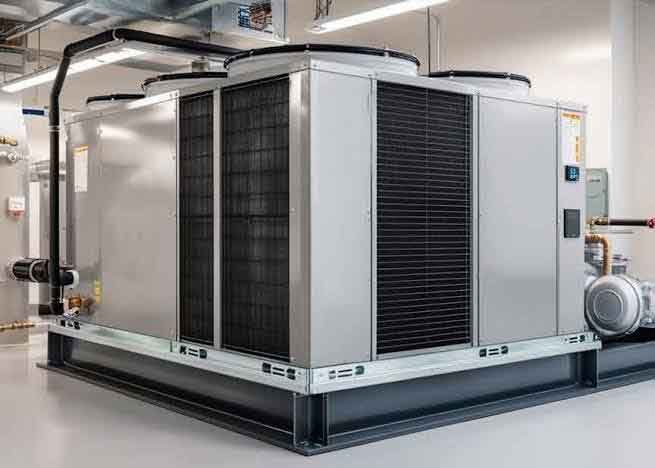
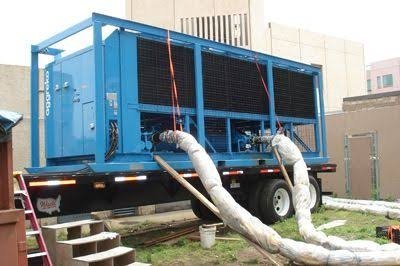
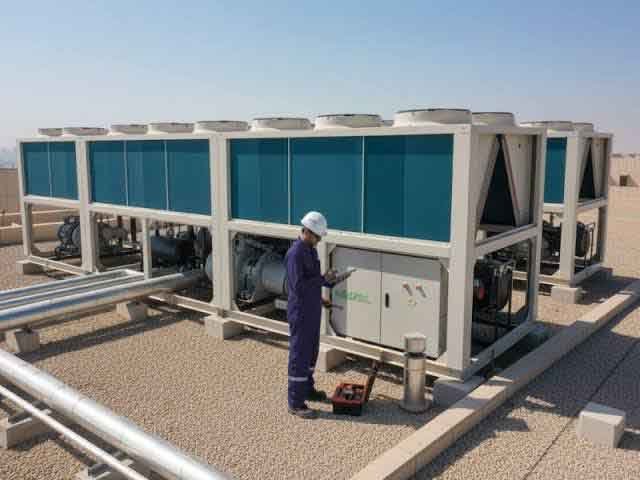
Temporary chilled water is generated using trailer-mounted or containerized rental chillers ranging from 50 TR to 1,500 TR. Engineered specifically for GCC high-ambient extremes up to 52°C, each chiller features dual semi-hermetic screw compressors, electronic expansion valves, and condenser coils protected with Blygold marine anti-corrosion coating to resist coastal salt mist in Dubai and Abu Dhabi.
Perforated Fabric Ducting ("Sox") & Flexible Spiral Duct Networks#
Conditioned air is delivered through fire-rated, flexible ducting or lightweight perforated fabric ducting (“sox”). Suspended from temporary ceiling cables, fabric duct networks distribute conditioned air evenly across expansive open spaces without creating localized cold drafts or condensation dripping.
Secondary Pump Skids, VFDs & PN16 Camlock Fluid Transfer#
Integrated variable-speed primary and secondary pump skids ensure steady chilled water flow through temporary distribution circuits. Certified PN16 flexible hoses equipped with quick-connect Camlock fittings allow rapid mechanical coupling to temporary risers or existing building headers with zero site welding.
Standalone Diesel Power Generation (100 kVA to 1250 kVA)#
When permanent site grid power from DEWA, ADDC, or SEWA is not yet available, HVAC Clinic supplies sound-attenuated diesel generators (100 kVA to 1,250 kVA) paired with external bulk fuel tanks and automatic transfer switches (ATS) for uninterrupted 24/7 continuous operation.
Psychrometric Design Targets & Engineering Load Calculations#
Determining the correct wild air capacity requires evaluating sensible cooling loads (solar transmission, internal heat gain from fit-out lighting and machinery) and latent loads (ambient air infiltration, moisture evaporating from fresh plaster and screed).
| Space Type | Approx. Floor Area | Required Airflow (CFM) | Chiller Tonnage (TR) | Target Conditions |
|---|---|---|---|---|
| Commercial Office Floor | 15,000 sq. ft. | 8,000 – 12,000 CFM | 40 – 60 TR | 23°C ± 1°C / 50% RH |
| Hotel Guestroom Typical Wing | 25,000 sq. ft. (40 rooms) | 15,000 – 20,000 CFM | 75 – 100 TR | 22°C ± 1°C / 50% RH |
| Retail Anchor Store / Mall Atrium | 50,000 sq. ft. | 30,000 – 40,000 CFM | 150 – 200 TR | 24°C ± 1.5°C / 55% RH |
| Exhibition Hall / Clear-Span Dome | 100,000 sq. ft. | 60,000 – 80,000 CFM | 300 – 500 TR | 23°C ± 1°C / 52% RH |
| Hospital Ward & Surgical Suite Floor | 30,000 sq. ft. | 20,000 – 26,000 CFM | 100 – 130 TR | 21°C ± 0.5°C / 48% RH |
Comparative Engineering Matrix: Wild Air vs. Alternative Cooling Methods#
Contractors often weigh the initial setup investment of wild air against operating permanent equipment prematurely or deploying small localized spot coolers. The comparative engineering trade-offs are outlined below:
| Evaluation Criteria | Engineered Wild Air Package | Running Permanent HVAC Early | Standalone Spot Coolers |
|---|---|---|---|
| Asset Warranty Risk | Zero risk to permanent plant | High risk of voiding warranty | Zero risk |
| Air Coverage & Uniformity | Full floorplate uniform distribution | Full (if ducting complete) | Localized cold spots, warm zones |
| Moisture & Humidity Control | High latent extraction (45-55% RH) | Moderate | Poor (condensate pans overflow) |
| Contamination Protection | Pre-filters isolate construction dust | Ducts & coils fouled with silica | Not applicable |
| Deployment Speed | 60 – 120 minutes dispatch | Dependent on utility substation | Immediate (limited capacity) |
| Utility Dependency | Autonomous with rental generators | Requires energized DEWA/ADDC grid | Requires local 230V sockets |
Turnkey Mobilization & Site Execution Workflow#
HVAC Clinic follows an engineered 5-stage deployment methodology to deliver wild air cooling with zero disruption to active trade contractors:
- Stage 1: Site Audit & Psychrometric Modeling: Our senior mechanical engineers visit the project site to inspect envelope tightness, calculate fresh air change requirements, measure floor-to-ceiling static lift, and designate positioning for external chillers and generator skids.
- Stage 2: Mobilization & Rigging Logistics: Chiller trailers, air handlers, and secondary pumps are dispatched from our centralized Dubai / Abu Dhabi storage depots via lowbed transport. Mobile crane lifting coordinates rooftop or ground staging safely.
- Stage 3: Fluid Piping & Power Connections: Chilled water manifolds are hooked up using PN16 flexible hoses and Camlock couplings. Pressure testing up to 10 bar verifies leak-free circulation prior to system charge.
- Stage 4: Temporary Duct Installation & Air Balancing: Flexible spiral or perforated fabric duct runs are suspended through shafts and across ceiling voids. Pitot-tube anemometer readings verify balanced CFM delivery across all zones.
- Stage 5: Continuous 24/7 Telemetry & Field Support: Systems operate with remote telemetry tracking supply/return water temperature, room RH, and compressor health. On-site certified technicians manage diesel fueling, filter change-outs, and periodic maintenance.
Real-World Project Case Study: 18-Story Commercial Tower in Dubai#
A prime commercial development in Business Bay faced severe project handover penalties due to delayed substation energization. The interior fit-out contractor was scheduled to install high-end American walnut wall paneling across 12 floors of corporate suites, but ambient humidity inside the building exceeded 82% RH with temperatures hovering around 46°C.
HVAC Clinic deployed a turnkey 400 TR air-cooled rental chiller paired with two 25,000 CFM high-static AHUs positioned on the ground staging area. Heavy-duty flexible duct risers were routed up through the central elevator shafts, discharging conditioned air into temporary perforated fabric duct headers across active floors. Within 36 hours of commissioning, internal space conditions stabilized at 22.5°C and 49% RH. The contractor completed the joinery installation without a single warped panel, avoiding over AED 1.4 million in rework and liquidated damages.
Frequently Asked Questions (FAQ)#
Q: How does wild air differ from conventional permanent air conditioning?#
Wild air is engineered specifically for active construction environments. It features disposable high-capacity pre-filtration to handle airborne plaster and sawdust, heavy-duty flexible distribution that accommodates changing site partitions, and operates independently of the permanent building electrical grid or district cooling plant.
Q: Can wild air cooling be deployed before DEWA / ADDC permanent power is energized?#
Yes. HVAC Clinic provides fully turnkey standalone configurations including sound-attenuated diesel generators (100 kVA to 1,250 kVA) and external bulk fuel storage tanks. This allows high-tonnage temporary cooling to run smoothly before municipal electrical substations are energized.
Q: Will using wild air protect joinery and flooring manufacturer warranties?#
Yes. International architectural joinery, hardwood, and acoustic ceiling manufacturers mandate that indoor temperatures be stabilized between 20°C and 25°C with relative humidity below 60% before material delivery and installation. Deploying wild air satisfies warranty pre-conditions and eliminates claims.
Q: How rapidly can HVAC Clinic mobilize wild air equipment across the UAE?#
We maintain fully pre-tested chillers, high-static air handling units, and quick-connect hose kits staged in Dubai and Abu Dhabi. Emergency dispatch occurs within 60 to 120 minutes of agreement confirmation across all seven Emirates.
Q: Can wild air systems integrate with existing building ductwork?#
Yes, where approved by the project consultant. However, we typically recommend deploying temporary fabric or spiral ducting to ensure permanent duct acoustic liners remain completely free of construction dust and plaster debris.