Selecting an engineered Wild Air Rental package is a decisive operational step for UAE main contractors, MEP engineering directors, and commercial interior fit-out firms. In modern commercial construction, temporary climate control bridges the high-stakes gap between structural shell completion and permanent building MEP plant energization. Without controlled temperature and humidity, moisture-sensitive architectural finishes—such as imported timber joinery, gypsum acoustic ceilings, decorative wall panels, and high-spec epoxy floors—suffer irreversible moisture damage. This definitive engineering guide details equipment fleet architectures, sensible versus latent psychrometric sizing formulas, closed-loop hydraulic distribution, commercial contract structures, and turnkey mobilization protocols across Dubai, Abu Dhabi, and the Northern Emirates.
Fleet Architecture: Core Equipment in an Engineered Wild Air Rental Package#
A high-performance wild air rental package is not simply an improvised blower or generic spot cooler. It is a tightly integrated thermodynamic and hydraulic circuit composed of industrial-grade mechanical components engineered specifically for GCC climatic conditions:
1. High-Static Air Handling Units (AHUs) (5,000 to 50,000 CFM)#
The primary air-moving asset in any temporary cooling configuration. Engineered with heavy-gauge galvanized steel casings and double-skin polyurethane insulation to eliminate surface condensation sweating in humid ambient conditions. Features high-efficiency backward-inclined plug fans driven by variable frequency drive (VFD) motors. Capacities range from 5,000 CFM to 50,000 CFM with external static pressure (ESP) ratings up to 800 Pa, capable of pushing conditioned air through long temporary duct runs and multi-floor vertical risers.
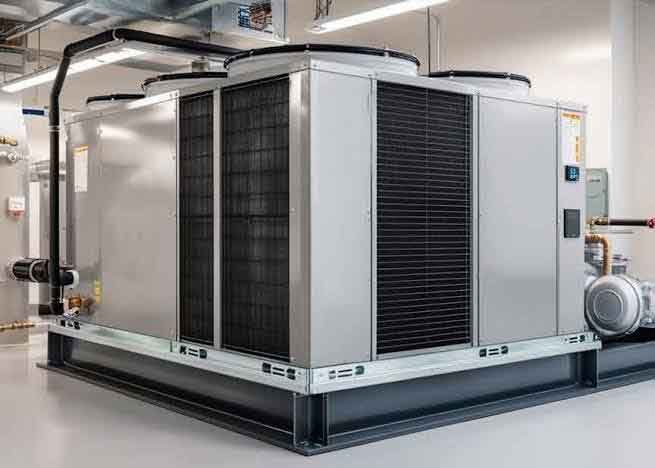
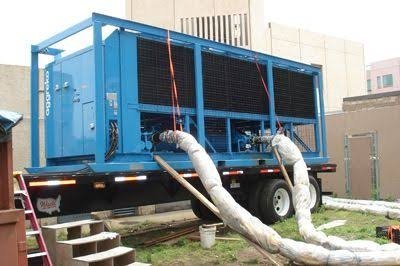
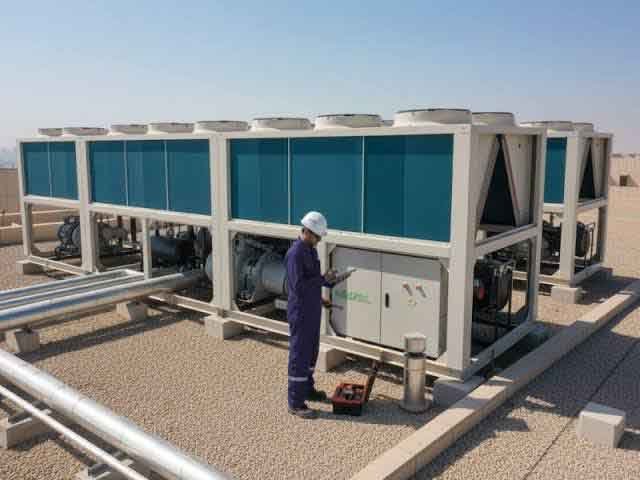
2. High-Ambient Air-Cooled Rental Chillers (50 TR to 1,500 TR per Aggregate)#
Ranging from compact 50 TR units to massive 1,500 TR modular aggregates, our high-ambient rental chillers are factory-certified to operate continuously in peak desert ambient temperatures exceeding 52°C. Equipped with dual semi-hermetic screw compressors, electronic expansion valves, environmentally friendly R134a or R410A refrigerants, and microchannel or copper-fin condenser coils coated with Blygold corrosion protection for marine and coastal deployments.
3. Skid-Mounted Dual Secondary Pumping Stations with Integrated VFDs#
Hydraulic circulation requires precision flow balancing. Our rental pumping skids feature duty-and-standby centrifugal pumps managed by smart VFD controllers. They automatically modulate chilled water flow rates (ranging from 150 GPM to over 3,000 GPM) in response to circuit differential pressure, ensuring uninterrupted fluid delivery to multi-floor air handlers without risk of pump cavitation or hydraulic lock.
4. Certified Industrial PN16 Flexible Hoses & Quick-Connect Manifolds#
Hydraulic loops are assembled using certified PN16 multi-layer flexible hoses with aluminium Camlock or Victaulic quick couplings. This modular assembly eliminates the extensive labor, hot-work permits, and fire hazards associated with welding temporary carbon steel piping on active construction sites, allowing mechanical connections to be made in hours rather than weeks.
5. Engineered Textile Fabric Air Dispersion Ducts ("Sox")#
Temporary air distribution through rigid sheet metal ducting is heavy, slow to erect, and labor-intensive. Our temporary fleet utilizes lightweight, flame-retardant engineered textile fabric ducting. Suspended via high-tensile stainless steel aircraft cables, these micro-perforated fabric tubes distribute high-velocity conditioned air uniformly across expansive floor plates without drafts, dead spots, or excessive structural point loads.
6. Skid-Mounted Dedicated Refrigerated Dehumidification Subsystems#
In high-humidity coastal zones such as Dubai Marina, Jumeirah, and Abu Dhabi Island, deep moisture removal is essential. When ambient dew points surpass 28°C, we integrate specialized low-temperature dehumidification coils and desiccant dryers that extract moisture independently of sensible cooling, driving interior relative humidity down to strict 45%–50% thresholds for moisture-sensitive finishes.
Engineering Sizing: Calculating Sensible vs. Latent Heat Loads in UAE Climates#
Correct equipment sizing is the difference between project success and catastrophic site failure. Under-sizing causes elevated humidity, swelling timber joinery, and mold outbreaks. Conversely, over-sizing leads to rapid compressor short-cycling, inadequate dehumidification, and excessive diesel fuel consumption.
Our thermodynamic engineering team calculates cooling demand using the classic ASHRAE sensible and latent heat balance equations:
Sensible Heat Load (q_sensible):
q_sensible = 1.08 × CFM × (T_ambient_db - T_target_db)
Latent Heat Load (q_latent):
q_latent = 4,840 × CFM × (W_ambient - W_target)
Where W represents the humidity ratio in pounds of moisture per pound of dry air.
In extreme Arabian Gulf summers—with ambient temperatures reaching 48°C dry bulb and 32°C wet bulb—latent heat accounts for 40% to 50% of the total thermodynamic load. Estimating cooling capacity purely on square footage inevitably causes severe under-sizing. Our engineers analyze envelope infiltration rates, building orientation, solar heat gain coefficients (SHGC), and internal contractor heat loads to specify exact refrigeration tonnage and air exchange volumes.
Wild Air Rental Equipment Sizing & Specification Reference Matrix#
The following technical matrix provides standard sizing guidelines for temporary climate control across common UAE commercial construction and interior fit-out typologies:
| Facility Type & Scope | Floor Area (Sq. Ft.) | Airflow (CFM) | Cooling Duty (TR) | Chilled Water Flow | Power Demand (kVA) |
|---|---|---|---|---|---|
| Luxury Retail Boutique / Restaurant Fit-Out | 5,000 – 12,000 | 6,000 – 14,000 CFM | 30 – 60 TR | 72 – 144 GPM | 60 – 100 kVA |
| Commercial Office Floor (Full Plate) | 20,000 – 35,000 | 22,000 – 38,000 CFM | 100 – 180 TR | 240 – 432 GPM | 160 – 280 kVA |
| Five-Star Hotel Guestroom Podium & Atrium | 50,000 – 90,000 | 55,000 – 100,000 CFM | 250 – 450 TR | 600 – 1,080 GPM | 400 – 700 kVA |
| Regional Shopping Mall Common Areas | 120,000 – 250,000 | 130,000 – 280,000 CFM | 600 – 1,200 TR | 1,440 – 2,880 GPM | 900 – 1,800 kVA |
| Airport Terminal Extension / Metro Station | 250,000 – 500,000+ | 300,000 – 600,000 CFM | 1,500 – 3,000+ TR | 3,600 – 7,200 GPM | 2,200 – 4,500 kVA |
Hydraulic Loop Engineering: Primary vs. Secondary Decoupled Pumping#
On multi-story and large-scale industrial projects, routing chilled water between ground-level rental chillers and upper-floor air handlers requires careful hydraulic design. Direct pumping frequently causes flow starvation at high elevations and over-pressurization on lower floors.
HVAC Clinic employs an engineered decoupled primary-secondary hydraulic circuit:
- Primary Circuit (Constant Flow): The primary pump set circulates chilled water directly through the evaporator barrel at a constant flow rate (typically 2.4 GPM per ton of refrigeration). This guarantees that compressor heat exchangers operate within certified fluid velocity limits, preventing low-flow freezing or laminar heat-transfer degradation.
- Hydraulic Decoupler (Low-Loss Header): A low-loss header separates the primary chiller loop from the secondary building distribution loop. This neutralizes hydraulic pressure fluctuations between the two circuits, ensuring that changes in building cooling demand do not disrupt chiller operation.
- Secondary Distribution Loop (Variable Flow): Skid-mounted VFD secondary pumps deliver chilled water across vertical riser shafts to air handling units distributed across project floors. Automated differential pressure sensors adjust pump speed in real time, matching water flow exactly to instantaneous cooling requirements while cutting electrical power consumption by up to 35%.
- Air Purging & Expansion Management: Closed-loop circuits incorporate automated air eliminators, pressure relief valves, and diaphragm expansion vessels to absorb thermal expansion and purge trapped air bubbles, preventing air locks in high-level cooling coils.
Air Distribution Engineering: Fabric Textile Sox vs. Rigid Ducts#
Selecting the air distribution medium determines installation speed, spatial obstruction, and airflow uniformity across the project footprint:
- Textile Fabric Sox: Constructed from lightweight, porous or micro-perforated polyester fabric. Installed rapidly using aircraft cable suspensions, fabric ducts deliver uniform, laminar air throw along their entire length. They eliminate drafts, reduce condensation sweating, and weigh less than 5% of conventional sheet metal ductwork, making them ideal for spaces with delicate ceiling structures.
- Heavy-Duty Spiral Flexible Ducting: Used primarily for vertical riser shafts, tight mechanical penetrations, and short-radius directional turns. Wire-reinforced flexible ducts resist crushing under negative static pressure and can be routed through elevator shafts, stairwells, and service penetrations without structural modifications.
- Custom Transition Adaptors: Where temporary air handlers must connect directly to permanent building duct headers, HVAC Clinic fabricates custom galvanized sheet metal transitions fitted with Class G4 pre-filters. This protects building ductwork from construction dust contamination while delivering high-volume air directly into permanent distribution pathways.
Commercial Rental Structures: Transparent, Flexible, and Fully Managed#
HVAC Clinic provides flexible commercial contract structures designed to align with contractor cash flows, milestone schedules, and construction handover dates:
1. Short-Term Rapid Deployment (Daily / Weekly Hire)#
Designed for emergency plant breakdowns, urgent floor screed drying, paint curing, or independent commissioning testing. Units are dispatched within 60 to 120 minutes with rapid-plug electrical and hydraulic hookups.
2. Project Fit-Out Milestone Rental (1 to 9 Months)#
The industry standard for commercial towers, hotels, and shopping mall fit-outs. Features fixed monthly rental rates that cover the complete mechanical package: rental chillers, secondary pumps, high-static AHUs, flexible piping, electrical switchgear, weekly air filter replacements, and scheduled technician preventative maintenance visits.
3. Long-Term Seasonal Protection Contracts (May to October)#
Extended summer season hire providing guaranteed climate control during peak ambient heat. Backed by legally binding Service Level Agreements (SLAs) guaranteeing 99.98% cooling uptime, four-hour on-site mechanical component replacement, and continuous remote IoT telemetry monitoring.
Financial Comparison: Turnkey Wild Air Rental vs. Equipment Purchase#
General contractors often evaluate whether to invest capital in purchasing used chillers or partner with an engineered rental provider. The financial and operational comparison is decisive:
| Key Evaluation Metric | Turnkey Wild Air Rental (HVAC Clinic) | Purchasing Used Chillers / AHUs |
|---|---|---|
| Capital Expenditure (CapEx) | Zero CapEx; 100% tax-deductible operational expense | Massive upfront capital outlay tied up in depreciating assets |
| Mechanical Breakdown Risk | 100% vendor risk; immediate 4-hour unit replacement | Full contractor liability for expensive compressor & motor repairs |
| Mobilization & Deployment | Same-day mobilization (60 to 120 minutes dispatch) | Weeks required for yard overhaul, testing, and transport staging |
| Sizing Scalability | Easily add or offload chillers and AHUs as project phases progress | Fixed capacity; unable to scale with changing project loads |
| Storage & Inter-Project Logistics | Zero storage costs; demobilized immediately upon handover | Requires expensive yard storage, ongoing maintenance, and security |
| Energy & Operational Efficiency | Modern Eurovent/AHRI-certified units with VFD power saving | Older technology with high kW/TR ratios and continuous power draw |
Turnkey 7-Phase Execution Methodology: From Sizing to Handover#
Our turnkey engineering process guarantees seamless integration without disrupting other active trades on site:
- Phase 1: Thermodynamic Site Audit: Senior mechanical engineers visit the job site to calculate internal volume, envelope air infiltration, solar gain through unglazed openings, and electrical tie-in availability.
- Phase 2: CAD Layout & Engineering Submittal: Preparation of detailed equipment placement plans, hydraulic single-line diagrams, duct routing drawings, and structural loading calculations for consultant approval.
- Phase 3: Logistics, Crane Rigging & Positioning: Coordinated heavy-haul transport, crane lift operations, and equipment positioning on anti-vibration pads in full compliance with municipal safety guidelines.
- Phase 4: Mechanical & Hydraulic Assembly: Rapid installation of PN16 flexible hoses, automatic air separators, pressure bypass manifolds, and hydrostatic testing to 10 bar before circuit charging.
- Phase 5: Electrical Distribution & Safety Interlocks: Termination of heavy-duty marine-grade power cabling, phase-rotation checks, ATS configuration, and synchronization with temporary diesel generators or site electrical boards.
- Phase 6: Commissioning, Air Balancing & TAB: System startup, refrigerant superheat and subcooling verification, anemometer velocity measurements across duct outlets, and calibrated thermal imaging documentation.
- Phase 7: 24/7 Telemetry & Preventative Maintenance: Continuous cloud-based IoT monitoring of supply air dry-bulb temperatures, return air RH, and compressor health with weekly filter swaps and round-the-clock emergency field service.
Contractor Due Diligence Checklist for Equipment Rental#
Before signing an agreement for temporary air handling and chiller equipment, ensure your hire partner verifies the following quality benchmarks:
- Certified Hydrostatic Test Logs: Confirm all flexible hose lines have undergone pressure testing within the last 90 days.
- AHRI 550/590 Rating: Verify that chillers deliver guaranteed kW/TR efficiency ratings without thermal tripping at 50°C ambient.
- Blygold Anti-Corrosive Coil Coating: Mandatory for coastal installations across Dubai, Abu Dhabi, and Sharjah to prevent salt-fog fin degradation.
- Variable Speed Drives: Ensure AHU fan motors and water pump sets feature VFD control for fine pressure balancing and energy conservation.
- Guaranteed Emergency Replacement: Contractual commitment to replace failed mechanical components or compressors within 4 hours.
- Comprehensive In-House Fleet: Partner with a provider who owns their chiller, AHU, and generator assets rather than sub-hiring from third parties.
Frequently Asked Questions About Wild Air Rental in the UAE#
Q: What information is needed to receive a fast, engineered wild air rental quote?#
Simply provide the floor area (sq. ft. or sq. m), ceiling height, project location, power availability (grid voltage or temporary diesel generator required), and target commissioning date. Our engineering estimators generate comprehensive psychrometric sizing and itemized commercial proposals within 15 to 30 minutes.
Q: Does HVAC Clinic provide temporary diesel power generation with chiller packages?#
Yes. We deliver fully integrated turnkey packages featuring sound-attenuated, low-emission diesel generators (ranging from 100 kVA to 2,000 kVA) complete with automated transfer switches (ATS), external bulk fuel tanks, and automated fuel replenishment services.
Q: Can temporary air handlers connect directly to permanent building duct risers?#
Yes. Our fabrication team custom-builds galvanized steel transitions that tie temporary AHUs directly into permanent vertical building shafts. We equip all inlet connections with disposable Class G4 pre-filters to prevent construction particulate from contaminating permanent ductwork.
Q: What is the typical lead time for wild air equipment mobilization across the UAE?#
For standard commercial fit-out packages (up to 500 TR and 30,000 CFM), equipment mobilization takes place within 60 to 120 minutes across Dubai, Abu Dhabi, and Sharjah. Multi-megawatt industrial packages are fully deployed and commissioned within 24 to 48 hours.
Q: Are preventative maintenance and filter replacements included in the monthly rental cost?#
Yes. All routine mechanical servicing, oil and refrigerant analysis, electrical inspections, and weekly air filter change-outs are 100% included in our turnkey commercial rental agreements with zero hidden labor charges.
Q: How does wild air cooling prevent mold and condensation on fast-track fit-out jobs?#
By continuously maintaining indoor air temperature below 24°C and relative humidity below 55%, the wild air system prevents interior surface temperatures from dropping below the ambient dew point, completely eliminating the conditions required for condensation formation, fungal growth, and wood veneer warping.
Q: Can temporary cooling packages be scaled up or down as the project progresses?#
Yes. Our modular equipment architecture allows contractors to add additional air handlers or chiller modules as higher floors are completed, or offload equipment as permanent HVAC systems come online, optimizing ongoing operational costs.
Q: What happens if an equipment component fails during peak summer construction?#
Our 24/7 service contracts include a guaranteed 4-hour on-site response time. In the event of a compressor or motor failure, our dedicated mobile response teams immediately dispatch a replacement unit or switch over to built-in N+1 redundancy systems to guarantee uninterrupted site cooling.