Emergency Cooling Equipment Rental in UAE
Cooling is not simply a comfort requirement for many businesses in the UAE. It can be an essential part of maintaining normal operations, protecting equipment, controlling indoor conditions, and keeping temperature-sensitive processes running. When a central chiller, air-conditioning system, or other cooling equipment suddenly fails, waiting days for permanent repairs or replacement may not be […]
Cooling is not simply a comfort requirement for many businesses in the UAE. It can be an essential part of maintaining normal operations, protecting equipment, controlling indoor conditions, and keeping temperature-sensitive processes running. When a central chiller, air-conditioning system, or other cooling equipment suddenly fails, waiting days for permanent repairs or replacement may not be practical.
This is where Emergency Cooling Equipment Rental in UAE becomes useful. Instead of purchasing a new permanent cooling system immediately, a business can bring in temporary cooling equipment for the period required to restore or supplement cooling capacity.
Rental providers in the UAE commonly supply temporary chillers, air-conditioning units, air-handling units, packaged systems, pumps and related accessories. Depending on the application, these systems can support commercial buildings, industrial facilities, warehouses, hotels, events, construction projects, data centres and other locations where maintaining temperature control is important. Current UAE rental providers specifically describe emergency rental cooling for breakdowns, planned shutdowns, seasonal demand and temporary capacity requirements.
Understanding how emergency cooling rental works is important because the solution is not simply about placing a chiller outside a building. The equipment must be selected according to the cooling load, operating conditions, available power, water requirements, connection points, physical access and the way cooling needs to be delivered to the affected area.
What Is Emergency Cooling Equipment Rental in the UAE?
Emergency Cooling Equipment Rental in UAE refers to the temporary supply of cooling equipment when a permanent cooling system cannot provide the required capacity.
The emergency requirement may result from an unexpected chiller breakdown, HVAC failure, compressor problem, planned maintenance, electrical or mechanical work, a sudden increase in cooling demand, or the need to bridge the period before a permanent replacement becomes available.
Depending on the situation, emergency cooling equipment may include air-cooled chillers, water-cooled chillers, packaged air-conditioning units, portable air conditioners, air-handling units and supporting equipment such as pumps, hoses and temporary connections.
The exact equipment depends on what needs to be cooled. A small enclosed space may require a portable or packaged air-conditioning unit, while a large commercial building or industrial process may require a temporary chiller connected to an existing chilled-water system.
For example, Atlas Copco’s UAE rental operation describes cooling equipment for emergency breakdowns, planned maintenance, peak demand, cooling backup and situations where customers are waiting for permanent equipment installation. Its rental offering includes chillers, heat pumps and air-conditioning equipment, with site assessment and installation support.
This makes emergency cooling rental different from simply hiring an air conditioner. It is a temporary cooling system designed around the actual requirements of the site.
Why Is Emergency Cooling Important in the UAE?
The UAE has a strong dependence on mechanical cooling across commercial, residential, industrial and infrastructure environments. For businesses operating large buildings or temperature-sensitive processes, loss of cooling can become an operational problem rather than just a comfort issue.
A cooling failure can affect employees and occupants, production processes, electrical rooms, IT equipment, storage environments and other temperature-sensitive operations. The consequences depend on the facility and its application.
A temporary cooling system provides a way to maintain required conditions while technicians repair the permanent installation.
This is particularly valuable during:
- Unexpected chiller breakdowns
- Major HVAC equipment failures
- Planned chiller maintenance
- Cooling plant upgrades
- Seasonal increases in demand
- Construction and refurbishment projects
- Temporary buildings and facilities
- Events and temporary venues
- Industrial process cooling
- Temporary replacement of failed equipment
- Waiting periods before permanent equipment arrives
Rental providers operating in the UAE specifically market temporary cooling for commercial, industrial, construction, event and emergency applications.
How Does Emergency Cooling Equipment Rental Work?
The process normally begins when a business contacts a cooling rental company with information about its problem and cooling requirement.
The rental provider then evaluates the application and determines what type and capacity of equipment may be required. Depending on the complexity of the project, this can involve reviewing the existing HVAC system, cooling load, available electrical supply, water connections, pipework, physical access and operating conditions.
A typical emergency cooling rental process follows several stages.
1. Identify the Cooling Problem
The first step is to establish why temporary cooling is required.
For example, the permanent chiller may have stopped operating because of a mechanical failure. Alternatively, the facility may be undergoing planned maintenance and needs temporary cooling while the primary system is offline.
The rental company needs to understand whether the requirement is for complete replacement capacity or additional cooling capacity.
This distinction matters because a facility that normally operates with several chillers may only need temporary capacity to replace one failed unit rather than replacing the entire cooling plant.
2. Assess the Required Cooling Capacity
The next step is determining how much cooling the site needs.
Cooling capacity should not be selected simply according to the size of the building. The actual requirement can depend on factors such as building use, occupancy, equipment loads, outdoor conditions, internal heat generation, process requirements and the performance of the existing system.
Rental Power, for example, identifies space size, heat generated by equipment or occupants and application type as factors affecting chiller sizing. Al Shola similarly states that cooling load, temperature, water flow, power, access and connection routes are considered when planning a temporary cooling package.
A professional assessment helps prevent two common problems: renting insufficient capacity or paying for substantially more capacity than the application requires.
3. Select the Appropriate Cooling Equipment
After assessing the requirement, the provider selects the appropriate equipment.
The equipment could be a temporary chiller, air-cooled chiller, water-cooled chiller, packaged air-conditioning unit, portable AC system, AHU or a combination of equipment.
For larger applications, the rental system may also require pumps, hoses, heat exchangers, temporary pipework, electrical connections and control equipment.
Atlas Copco describes complete temporary cooling configurations that can include chillers, pumps, buffer tanks, heat exchangers and power integration for industrial applications.
4. Deliver the Equipment to the Site
Once the equipment configuration is agreed, the rental company arranges transportation to the facility.
Emergency projects require careful logistics because equipment may need to reach the site quickly while still meeting site-access and safety requirements.
The provider may need information about delivery routes, available space, lifting requirements, connection points and operating location before dispatch.
5. Install and Connect the Temporary System
Delivery is followed by installation.
For a chiller-based solution, installation can involve connecting chilled-water supply and return lines to the existing system or a temporary distribution arrangement.
For direct air-conditioning equipment, the installation may instead involve positioning the units and arranging appropriate airflow, electrical supply and ducting or other connections where required.
Stout Energy describes its rental process as site assessment followed by deployment and installation, commissioning and ongoing operation and support.
6. Test and Commission the Equipment
Before the temporary cooling system is placed into normal operation, the equipment should be checked and commissioned.
The purpose is to confirm that the equipment is connected correctly and operating according to the required conditions.
Depending on the installation, checks can include water flow, temperatures, electrical supply, controls, connections and overall equipment operation.
The commissioning stage is particularly important in emergency applications because the objective is not merely to deliver equipment but to restore useful cooling.
7. Operate and Monitor the System
Once commissioned, the temporary cooling equipment operates for the agreed rental period.
Some rental providers include technical support, monitoring and maintenance as part of the service. Atlas Copco, for example, states that its cooling rental service includes 24/7 remote monitoring, while Stout describes operational support and maintenance throughout the rental period.
The level of support varies by provider and project, so businesses should confirm exactly what is included in their rental agreement.
8. Remove the Equipment When Cooling Is Restored
After the permanent cooling system is repaired, replaced or brought back into service, the temporary equipment can be disconnected and removed.
This allows the business to use temporary capacity only for the period it actually needs it rather than investing in equipment that may not have a long-term role.
What Types of Emergency Cooling Equipment Can Be Rented?
Emergency cooling does not always mean the same type of equipment. The appropriate solution depends on the size and nature of the cooling requirement.
Air-Cooled Chillers
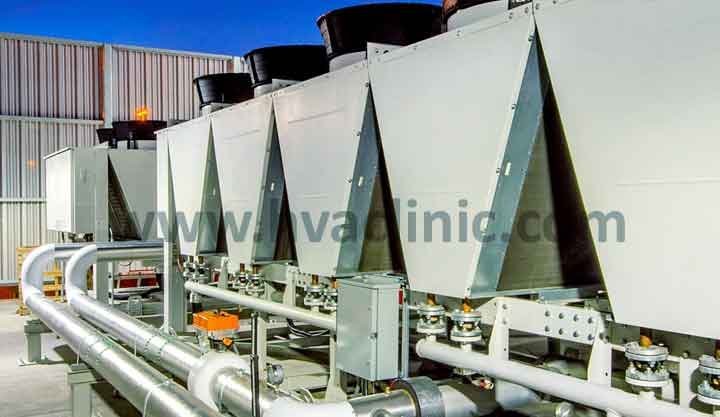
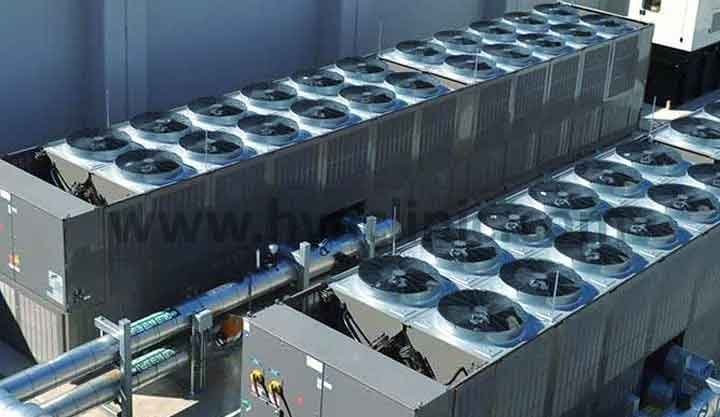
Air-cooled chillers are commonly considered for temporary cooling because they reject heat directly to outdoor air and do not require a cooling tower.
In a typical air-cooled chiller, refrigerant absorbs heat in the evaporator, the compressor raises the refrigerant pressure and temperature, and condenser fans move ambient air across the condenser to reject heat. The refrigerant then passes through an expansion device before returning to the evaporator.
The chilled water produced by the chiller can then circulate through cooling coils in AHUs or FCUs.
Air-cooled systems can be attractive for emergency applications because the absence of a cooling tower can simplify temporary deployment. However, outdoor ambient conditions affect air-cooled chiller performance, which is an important consideration in hot climates.
Water-Cooled Chillers
Water-cooled chillers reject heat through a condenser-water circuit, normally connected to a cooling tower.
They are widely used for large commercial and industrial applications where high-capacity, continuous cooling is required.
Water-cooled systems involve more supporting infrastructure than air-cooled chillers, including condenser-water pumps and cooling towers. Consequently, a temporary water-cooled installation requires careful assessment of the existing plant and available connections.
LG explains that water-cooled chillers use a separate condenser-water loop and cooling tower to reject heat, while air-cooled chillers reject heat directly to outdoor air.
Portable Air Conditioners
Portable AC units can provide localized cooling where a complete chilled-water system is unnecessary.
They may be suitable for smaller rooms, temporary offices, equipment areas, site cabins and localised hot spots.
The appropriate choice depends on the space, heat load, ventilation requirements and available electrical supply.
Packaged Air-Conditioning Units
Packaged AC systems can be used where temporary cooling is required for a larger area but a complete central chilled-water installation is not appropriate.
Rental providers in the UAE offer packaged units alongside chillers, AHUs and portable AC equipment for temporary HVAC applications.
Air Handling Units
AHUs are often part of a larger temporary cooling configuration.
An AHU can distribute conditioned air through ductwork to the required space. In a chiller-based installation, chilled water from the rental chiller can be supplied to the AHU cooling coil.
This can make AHUs useful for larger temporary spaces where controlled distribution of cooled air is required.
How Does a Rental Chiller Actually Produce Cooling?
Understanding the refrigeration cycle makes it easier to understand why a rental chiller can temporarily replace or supplement a permanent cooling system.
A typical vapor-compression chiller uses four principal stages: the compressor, condenser, expansion device and evaporator.
The process begins in the evaporator, where refrigerant absorbs heat from the chilled-water circuit.
The refrigerant then moves to the compressor. The compressor increases its pressure and temperature.
The high-pressure refrigerant then reaches the condenser, where heat is rejected. In an air-cooled chiller, condenser fans move outdoor air across the condenser coil. In a water-cooled system, heat is transferred to condenser water, which carries it toward the cooling tower.
After condensation, the refrigerant passes through an expansion device. Its pressure and temperature decrease before it returns to the evaporator and repeats the cycle.
On the building side, chilled water travels from the chiller to cooling coils in AHUs or FCUs. The water absorbs heat and returns to the chiller to be cooled again.
This basic sequence is consistent with technical explanations from LG and Trane.
Emergency Cooling Equipment Rental vs. Permanent Cooling
The biggest difference between emergency cooling rental and permanent cooling is the purpose.
A permanent HVAC system is designed as part of the long-term infrastructure of a building or facility. Its design, equipment selection, controls, pipework and electrical infrastructure are normally integrated into the building from the beginning.
Emergency rental cooling is designed to solve a temporary requirement.
It can therefore be useful when:
- A permanent chiller has failed
- A replacement unit is on order
- A facility is undergoing maintenance
- A building is being renovated
- Cooling demand temporarily exceeds installed capacity
- A temporary facility requires cooling
- A business wants backup cooling without purchasing additional equipment
Rental can also reduce the need for a business to make a large capital investment for a problem that may only last days or weeks.
When Should a UAE Business Consider Emergency Cooling Rental?
There are several situations where temporary cooling can make operational sense.
During an Unexpected Chiller Breakdown
This is one of the clearest emergency applications.
If a primary chiller fails and repairs are expected to take time, a temporary rental unit can help maintain cooling while technicians work on the permanent system.
The rental therefore acts as a bridge between failure and restoration.
During Planned Maintenance
Emergency cooling equipment is not limited to unexpected breakdowns.
Businesses can arrange temporary cooling before scheduled maintenance when they know the primary cooling plant will be offline.
This approach can make maintenance easier because the permanent equipment can be isolated without leaving the facility completely without cooling.
During HVAC Replacement
A business may need several weeks to obtain and install a new permanent chiller.
Instead of accepting a prolonged period with reduced cooling, temporary rental equipment can provide cooling during the replacement period.
Atlas Copco specifically identifies temporary cooling as a solution for customers waiting for permanent equipment installation.
During Seasonal Peak Demand
A facility may have sufficient cooling capacity under normal conditions but experience a temporary increase in demand.
Rental equipment can provide additional capacity without requiring the business to permanently expand its cooling plant.
During Construction and Refurbishment
Construction projects, temporary buildings and refurbishment projects can require cooling before the permanent HVAC system is ready.
Temporary cooling equipment can provide the required conditions during the construction or transition period.
For Events and Temporary Facilities
Events, temporary venues and tents may require substantial cooling for a limited period.
Rental equipment allows organisers to obtain cooling for the event duration rather than purchasing permanent HVAC equipment.
UAE rental providers list events, tents, construction sites, commercial buildings and industrial facilities among temporary HVAC applications.
What Factors Determine the Size of Emergency Cooling Equipment?
Selecting the right capacity is one of the most important parts of an emergency cooling project.
A rental company may consider:
Cooling load: The amount of heat that must be removed from the building or process.
Building size: Larger areas generally require greater cooling capacity, although floor area alone does not determine the requirement.
Occupancy: People generate heat, so occupancy can affect the cooling load.
Equipment heat: Machinery, computers, production equipment, lighting and other electrical systems may contribute significant internal heat.
Outdoor conditions: Solar gain and outdoor temperatures affect cooling requirements, particularly in the UAE.
Process requirements: Industrial processes may require specific water temperatures, flow rates or continuous cooling.
Existing HVAC system: The temporary equipment needs to work with the existing system where it is being used as a replacement or supplement.
Available power: Electrical requirements must be compatible with the site’s available supply.
Water availability: Water-cooled systems may require suitable water circuits and cooling tower infrastructure.
Connection points: Pipework, hoses, ducting and access routes can affect equipment selection.
Rental duration: A short emergency deployment may be configured differently from a long-term temporary installation.
Rental providers specifically identify cooling load, temperature, water flow, power, access and connection routes as important factors in system selection.
Air-Cooled vs. Water-Cooled Emergency Chillers
The choice between air-cooled and water-cooled equipment depends on the site and application.
Air-cooled chillers reject heat directly to the atmosphere using condenser fans. They generally avoid the need for a cooling tower and condenser-water circuit, which can simplify deployment.
Water-cooled chillers transfer heat to condenser water and normally use a cooling tower. This creates additional infrastructure but can be advantageous for large, continuous cooling requirements.
Neither type should automatically be considered the best emergency option for every UAE project.
The correct choice depends on cooling capacity, ambient conditions, existing infrastructure, water availability, site space, installation requirements and operating duration.
Trane notes that air-cooled systems do not require cooling towers or a constant water supply, while water-cooled chillers are commonly used for larger-scale commercial and industrial applications.
Where Is Emergency Cooling Equipment Used in the UAE?
Emergency and temporary cooling can support a wide range of applications.
Commercial Buildings
Offices, retail buildings and other commercial facilities may require temporary cooling when central HVAC equipment fails or undergoes maintenance.
Hotels and Hospitality
Hotels cannot easily tolerate extended loss of cooling because guest rooms, public areas, kitchens and other spaces may have different temperature-control requirements.
Temporary cooling can provide a bridge while permanent equipment is repaired.
Industrial Facilities
Factories and industrial plants may require process cooling as well as comfort cooling.
For these applications, rental equipment must be selected around the process temperature, flow and heat load rather than simply the size of the building.
Data Centres and Critical Environments
Temperature control can be particularly important in facilities containing heat-producing IT equipment.
Temporary cooling can be considered as part of a continuity or maintenance strategy, although the system should be engineered around the facility’s actual redundancy and cooling requirements.
Atlas Copco lists data centres among applications for temporary process and comfort cooling rental.
Warehouses
Warehouses may require temporary HVAC during construction, refurbishment, equipment failure or special temperature-control requirements.
Construction Sites
Temporary buildings, offices and project facilities can require cooling before permanent building services are available.
Events and Temporary Structures
Events and tents often need cooling for a defined period, making rental more practical than permanent installation.
What Are the Benefits of Emergency Cooling Equipment Rental in the UAE?
The main advantage is flexibility.
Faster Access to Temporary Capacity
A rental solution can provide cooling without waiting for the design, manufacture and installation of a new permanent system.
Reduced Capital Commitment
Businesses do not necessarily need to purchase a new permanent chiller to address a short-term requirement.
Support During Repairs
Rental equipment can maintain cooling while the permanent system is being repaired.
Flexible Rental Duration
Cooling equipment can be rented for a short emergency period, a planned maintenance window, a seasonal requirement or a longer project.
UAE rental providers advertise both short- and long-term cooling rental arrangements.
Scalable Cooling
Where multiple rental units can be combined, capacity can potentially be adjusted according to project requirements.
Professional Installation
A complete rental service can include equipment delivery, installation, commissioning, monitoring and technical support rather than leaving the customer to manage the equipment independently.
What Does Emergency Cooling Rental Cost in the UAE?
There is no single price for Emergency Cooling Equipment Rental in UAE because the cost depends heavily on the project.
Important factors include the required cooling capacity, equipment type, rental duration, location, delivery requirements, installation complexity, accessories and technical support.
A recent UAE rental-market guide similarly notes that commercial and industrial chiller rental prices are generally quoted according to project requirements rather than through one universal daily or monthly rate.
For example, renting a smaller temporary AC system for a localized requirement is fundamentally different from deploying several high-capacity chillers, pumps and AHUs for an industrial facility.
Businesses requesting a quotation should therefore provide as much technical information as possible. This allows the supplier to prepare a more realistic proposal rather than providing a price based only on a generic equipment category.
How to Choose an Emergency Cooling Rental Company in the UAE
Choosing the equipment is only part of the decision. The rental provider is equally important, particularly when the requirement is urgent.
Look for a company that can demonstrate experience with the type of cooling application involved.
Ask whether the provider can perform a site assessment, calculate or verify the required cooling capacity, provide installation and commissioning, and offer technical support throughout the rental period.
It is also important to ask about equipment availability, response arrangements, delivery coverage, maintenance, replacement procedures and collection after the rental period.
A supplier with a broad fleet can potentially provide different types and capacities of cooling equipment rather than forcing every project into one standard configuration.
For larger projects, businesses should also confirm how the temporary cooling system will connect to the existing HVAC infrastructure.
What Should You Tell a Rental Company Before Requesting Emergency Cooling?
Providing accurate information can help speed up the quotation and equipment-selection process.
Useful information includes the facility location, type of application, area or process being cooled, current cooling equipment, required temperature, existing chiller capacity, available electrical supply, chilled-water connection information and the expected rental duration.
If the permanent system has failed, information about the failed equipment and current operating condition can also help.
For an emergency request, photographs of the existing plant room, connection points, outdoor equipment area and relevant pipework may help the technical team understand the installation requirements before arriving at the site.
Is Emergency Cooling Rental Only for Complete Cooling Failure?
No.
Temporary cooling can also be used when a facility still has some cooling capacity but requires additional capacity.
For example, a facility with multiple chillers may lose one unit while the remaining units continue operating. If the remaining capacity cannot meet the current cooling load, a temporary rental chiller can potentially bridge the shortfall.
Rental cooling can also support seasonal demand, planned shutdowns, construction, commissioning and temporary increases in production.
This makes temporary cooling a broader business-continuity tool rather than simply an emergency response to total HVAC failure.
How Long Can Emergency Cooling Equipment Be Rented?
Rental duration depends on the provider and project.
Short-term rental can cover a few days or weeks, while longer arrangements may continue for months or more.
UAE rental providers advertise both short-term and long-term chiller and HVAC rental options.
The appropriate duration should be linked to the underlying reason for the rental.
For example, an emergency breakdown may require temporary cooling until a permanent repair is completed, whereas a construction project may need cooling throughout a defined project phase.
What Happens After the Rental Period?
Once permanent cooling has been restored or the temporary project has ended, the rental equipment is normally shut down, disconnected and collected by the provider.
For larger installations, removal may require the same planning considerations as delivery, including access, lifting equipment, electrical isolation and disconnection of temporary pipework.
A well-managed rental agreement should clearly identify responsibility for installation, operation, maintenance, disconnection and equipment collection.
Emergency Cooling Rental as a Business Continuity Solution
For many UAE businesses, the real value of emergency cooling rental is not simply lower temperature. It is continuity.
A permanent HVAC failure can create operational disruption. A temporary cooling system gives the facility another option while the underlying issue is resolved.
This is why rental cooling is increasingly positioned around emergency breakdowns, maintenance shutdowns, peak demand and temporary projects rather than only conventional air-conditioning hire. Current UAE rental providers explicitly describe temporary cooling as a bridge solution during equipment failures, maintenance and capacity shortages.
The best solution is therefore one that considers the complete cooling requirement: equipment, capacity, connections, installation, controls, monitoring, maintenance and eventual removal.
Frequently Asked Questions
What is Emergency Cooling Equipment Rental in UAE?
Emergency Cooling Equipment Rental in UAE is the temporary supply and installation of cooling equipment when a permanent HVAC or cooling system has failed, requires maintenance, cannot meet demand or is not yet available. Depending on the application, the rental package can include chillers, AC units, AHUs, pumps and other supporting equipment.
How quickly can emergency cooling equipment be installed?
Installation time depends on equipment availability, cooling capacity, site access, connection requirements and the complexity of the project. Emergency rental companies may maintain ready-to-deploy equipment and technical teams, but the actual deployment schedule should be confirmed for the specific site.
What equipment can be rented for emergency cooling?
Common options include air-cooled chillers, water-cooled chillers, portable AC units, packaged air conditioners and AHUs. Larger projects may also require pumps, hoses, heat exchangers and temporary power or other supporting equipment.
Is emergency chiller rental suitable for industrial facilities?
Yes. Industrial rental chillers can be used for process cooling as well as facility cooling. The system must be selected according to the actual process temperature, flow, heat load and operating requirements.
What is the difference between emergency cooling and temporary cooling?
The equipment may be similar, but the reason for deployment is different. Emergency cooling generally responds to an unexpected failure or urgent cooling requirement, while temporary cooling can also cover planned maintenance, construction, seasonal demand and temporary projects.
Should I rent an air-cooled or water-cooled chiller?
It depends on the application. Air-cooled chillers reject heat directly to outdoor air and do not require a cooling tower. Water-cooled chillers use a condenser-water circuit and cooling tower and can be appropriate for larger continuous loads. Site infrastructure, capacity, ambient conditions and water availability should be assessed before choosing.
Can rental chillers replace a failed permanent chiller?
They can potentially provide temporary replacement capacity while the permanent chiller is repaired or replaced. The rental system must be correctly sized and connected to the facility’s cooling distribution system.
Can emergency cooling equipment support planned maintenance?
Yes. Temporary cooling is commonly used during planned maintenance and shutdowns so that the permanent cooling system can be taken offline while the facility continues receiving the required cooling capacity.
How is emergency cooling equipment sized?
Sizing depends on the cooling load and operating conditions. Factors can include building size, occupancy, equipment heat, process requirements, outdoor conditions, required temperature, chilled-water flow, available power and the existing HVAC configuration.
Is emergency cooling rental available across the UAE?
Several UAE rental companies advertise cooling services across multiple Emirates, although coverage, equipment availability and emergency response times vary by supplier. Businesses should confirm availability for their exact location before placing an emergency order.
Final Thoughts
Emergency Cooling Equipment Rental in UAE provides businesses with a practical way to maintain temporary cooling when permanent HVAC capacity is unavailable or insufficient.
The process normally involves identifying the cooling problem, assessing the required capacity, selecting suitable equipment, delivering it to the site, connecting and commissioning the system, monitoring its operation and removing it once the permanent solution is restored.
The right rental solution is determined by more than cooling capacity alone. Equipment type, cooling load, ambient conditions, available power, water requirements, connection points, installation conditions and rental duration all influence the final configuration.
For a sudden chiller breakdown, planned maintenance shutdown, seasonal capacity increase, construction project or temporary facility, professional rental cooling can provide a bridge between the immediate requirement and the permanent HVAC solution.
When selecting a provider, businesses should look beyond equipment availability and consider technical assessment, installation, commissioning, monitoring, maintenance, emergency support and nationwide service capability. A properly planned temporary cooling system can help reduce disruption while giving the permanent HVAC team the time needed to complete repairs, replacement or upgrades safely and correctly.
Looking for Rental Cooling?
Engineered temporary cooling solutions across Dubai, Abu Dhabi, Sharjah, and Northern Emirates. High-efficiency air-cooled and water-cooled rental chillers from...