
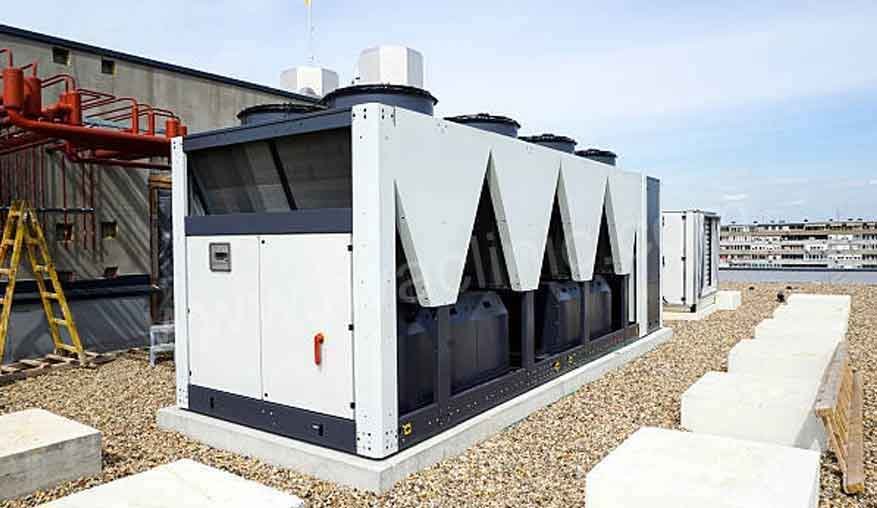

Dubai’s commercial and industrial sectors depend heavily on reliable cooling. Offices, hotels, shopping facilities, warehouses, manufacturing plants, data centres, and process industries can experience serious operational problems when cooling capacity becomes insufficient. A permanent chiller failure, planned maintenance shutdown, seasonal peak demand, or temporary expansion can all create a need for additional cooling capacity.
This is where rental chiller in Dubai solutions can provide a practical alternative to purchasing and installing permanent equipment.
Dubai’s cooling sector is particularly important because cooling accounts for almost half of the emirate’s total electricity demand, according to Dubai’s Regulatory and Supervisory Bureau (RSB). The authority also reports that district cooling supplies more than 20% of Dubai’s cooling requirements.
For businesses that cannot afford prolonged cooling interruptions, temporary chillers can provide additional capacity while permanent systems are repaired, upgraded, expanded, or commissioned.
What Is a Rental Chiller?
A rental chiller is a temporary cooling system supplied for a defined period rather than permanently installed as part of a building’s HVAC infrastructure.
Depending on the application, a rental package can include:
Chiller units
Pumps
Flexible hoses and water connectionsBuffer tanks
Heat exchangers
Air handling units
Fan coil units
Electrical equipment
Temporary pipework
Monitoring and control equipment
The exact configuration depends on the required cooling load and the existing system.
For example, industrial rental providers commonly design temporary cooling systems around factors such as cooling capacity, water flow, operating temperature, power availability, access to the site, and connection requirements.
Why Businesses in Dubai Use Rental Chillers
1. Emergency Cooling During Chiller Failure
A failed chiller can affect an entire building or production process. Waiting for major repairs or replacement equipment may not be practical, particularly during periods of high cooling demand.
A temporary chiller can act as an emergency cooling source while the permanent system is restored.
Rental cooling providers commonly position temporary chillers for emergency breakdowns and business-continuity applications.
2. Planned Chiller Maintenance
Commercial and industrial chillers require maintenance, refurbishment, and sometimes major component replacement. During this work, the permanent cooling system may have to be taken offline.
Instead of allowing the facility to operate without adequate cooling, businesses can install a temporary chiller before the shutdown.
This approach is particularly useful for:
Hotels
Office buildings
Shopping centres
Manufacturing facilities
Warehouses
Healthcare facilities
Data centres
Industrial plants
Temporary cooling can therefore serve as a bridge between planned maintenance and normal operation.
3. Additional Capacity During Peak Demand
A permanent HVAC system may be correctly sized for normal operating conditions but struggle when cooling requirements temporarily increase.
Additional cooling capacity may be required because of:
Increased building occupancy
Seasonal demand
Temporary production increases
Facility expansion
Special events
Additional equipment
Temporary process requirements
Rather than purchasing another permanent chiller that may remain underutilised later, businesses can use rental equipment for the period in which extra capacity is required.
4. Temporary Cooling for Construction and Fit-Out Projects
New commercial and industrial projects often require temporary cooling before the permanent HVAC system is fully commissioned.
Rental chillers can provide cooling during construction, fit-out, testing, commissioning, and phased handover.
This can be especially useful when different parts of a large development become operational at different times.
Rental Chillers for Commercial Buildings in Dubai
Commercial properties have different cooling requirements from industrial facilities, but temporary chillers can be useful in both environments.
A commercial building may require rental cooling when its main chiller is undergoing maintenance, when a cooling plant needs additional capacity, or when an HVAC system has unexpectedly failed.
Typical commercial applications include:
Office buildings
Hotels
Retail centres
Shopping malls
Restaurants
Exhibition venues
Educational facilities
Healthcare buildings
Large residential developments
For these applications, the rental solution may need to work alongside existing chilled-water pipework, air handling units, pumps, and building management controls.
The objective is not simply to supply a chiller. The temporary system must be compatible with the building’s cooling infrastructure.
Rental Chillers for Industrial Cooling
Industrial facilities often have more demanding cooling requirements because cooling may be connected directly to production processes.
Industrial rental cooling can support:
Manufacturing
Food and beverage processing
Pharmaceutical production
Chemical processing
Process-water cooling
Product storage
Data centres
Marine and offshore operations
Industrial rental specialists describe process cooling as an application where temporary chillers help maintain stable temperatures for production processes and temperature-sensitive operations. Complete systems may include chillers, pumps, buffer tanks, heat exchangers, and power integration.
For industrial users, the correct temperature and flow conditions can be just as important as the nominal cooling capacity.
Air-Cooled vs Water-Cooled Rental Chillers
The choice between air-cooled and water-cooled equipment depends on the site and application.
Air-Cooled Chillers
Air-cooled chillers reject heat directly into the surrounding air. They can be attractive for temporary applications because they generally do not require a cooling tower.
They can also simplify deployment where access to condenser-water infrastructure is limited.
Some rental fleets offer modular air-cooled chillers specifically designed for temporary and industrial applications. Current UAE rental offerings include units ranging from approximately 50 kW to 720 kW per unit, although available equipment varies by supplier and project.
Water-Cooled Chillers
Water-cooled chillers reject heat through a condenser-water system, normally involving cooling towers and associated pumps.
They can be suitable where appropriate permanent infrastructure already exists and where the project requires this type of configuration.
For temporary installations, however, the supporting equipment and site infrastructure must be considered as part of the overall solution.
How to Choose the Right Rental Chiller in Dubai
Choosing a rental chiller based only on its advertised capacity can lead to an unsuitable installation.
A proper assessment should consider:
Cooling Load
The required cooling capacity should be established from the building or process load rather than simply selecting the largest available machine.
Required Supply and Return Temperatures
The chilled-water temperature required by the existing system or industrial process should be confirmed before equipment selection.
Water Flow
The system must provide the required flow rate to the connected load. Insufficient flow can prevent the cooling system from performing as intended.
Ambient Conditions
Dubai’s hot climate makes high-ambient performance an important consideration. Equipment should be selected for the actual site conditions rather than relying only on standard laboratory ratings.
ASHRAE has highlighted the importance of chilled-water design optimisation in hot and humid climates, including the relationship between chilled-water supply temperature, dehumidification, cooling-coil performance, and energy consumption.
Electrical Supply
The available electrical infrastructure must be checked before installation. Depending on the project, the rental package may require additional electrical equipment or generator integration.
Site Access
Large chillers require appropriate access for delivery, positioning, lifting, connections, and eventual removal.
Connection Method
The temporary system must be connected safely to the building’s or process’s existing cooling infrastructure. Hoses, temporary pipework, pumps, valves, and other accessories may therefore be necessary.
What Should a Professional Rental Chiller Service Include?
A reliable rental solution should go beyond simply delivering a chiller to the customer’s site.
A complete service may include:
- Site assessment – reviewing the cooling requirement and available infrastructure.
- Load calculation – determining the appropriate capacity.
- Equipment selection – choosing suitable chiller and auxiliary equipment.
- Logistics – transporting the equipment to the site.
- Installation – connecting the temporary cooling system.
- Commissioning – checking operating conditions and system performance.
- Monitoring – tracking the equipment during operation.
- Maintenance and support – responding to operational issues.
- Decommissioning – disconnecting and removing the temporary installation.
Rental providers operating in the UAE advertise services that can include site assessment, installation, commissioning, remote monitoring, logistics, and decommissioning.
Rental Chillers and Energy Efficiency
Energy efficiency should not be ignored simply because a chiller is temporary.
Dubai’s RSB states that cooling represents nearly half of the emirate’s electricity demand and identifies energy-efficient cooling as an important part of Dubai’s sustainability objectives.
For businesses, efficient temporary cooling can help control operating requirements while maintaining the necessary indoor or process temperature.
Proper system design matters as well. Chiller efficiency is affected by operating temperatures, load conditions, pumping requirements, heat rejection, and system design. ASHRAE’s work on chilled-water systems in hot and humid climates highlights the importance of optimising these factors rather than considering the chiller as an isolated piece of equipment.
Rental Chiller vs Buying a Chiller
Buying a permanent chiller can make sense for facilities with predictable, long-term cooling requirements. However, purchasing is not always the best answer to a temporary problem.
| Requirement | Rental Chiller | Permanent Chiller |
|---|---|---|
| Emergency cooling | Highly suitable | Usually slower to implement |
| Planned maintenance | Suitable | Not applicable as a temporary solution |
| Seasonal capacity | Flexible | Fixed capacity |
| Short-term project | Suitable | May require unnecessary capital investment |
| Long-term operation | Depends on rental arrangement | Usually more appropriate |
| Temporary production increase | Suitable | May be excessive |
| Construction/commissioning | Suitable | Installed as part of permanent project |
The right choice ultimately depends on the duration, cooling load, capital plans, infrastructure, and operational requirements of the facility.
Dubai Cooling Regulations and Compliance
Businesses should distinguish between renting temporary cooling equipment and operating a regulated district cooling service.
Dubai’s Executive Council Resolution No. 6 of 2021 establishes the regulatory framework for district cooling services in the emirate. The RSB states that organisations operating district cooling or providing related billing services require the appropriate permits.
The regulatory framework is particularly relevant to organisations providing district cooling services rather than simply using temporary HVAC equipment for their own building or facility.
For a commercial or industrial rental project, the customer and rental provider should nevertheless ensure that installation, electrical connections, site safety, building requirements, and applicable approvals are addressed before commissioning.
When Is a Rental Chiller the Right Solution?
A rental chiller is worth considering when a business needs cooling for a defined period or needs to protect operations from an unexpected cooling failure.
It can be particularly useful when:
A permanent chiller has failed.
A chiller plant is undergoing major maintenance.
Cooling demand has temporarily increased.
A facility is being expanded.
A new HVAC system is awaiting commissioning.
Production requires additional process cooling.
A building needs temporary cooling during fit-out.
A business needs backup capacity during a critical period.
The strongest advantage is flexibility: the business can obtain additional cooling without necessarily committing to a permanent plant expansion.
Final Thoughts
For commercial and industrial facilities, cooling is not simply a comfort requirement. In many applications, it is directly connected to business continuity, equipment protection, production, product quality, and occupant safety.
A rental chiller in Dubai can provide temporary or supplementary cooling when permanent capacity is unavailable, insufficient, or undergoing maintenance. However, successful deployment depends on more than choosing a chiller with a particular capacity. Cooling load, water flow, temperatures, ambient conditions, electrical supply, site access, connection arrangements, and commissioning all need to be considered.
For this reason, businesses should work with an experienced rental provider that can assess the site and supply a complete temporary cooling solution rather than treating the chiller as a standalone machine.