
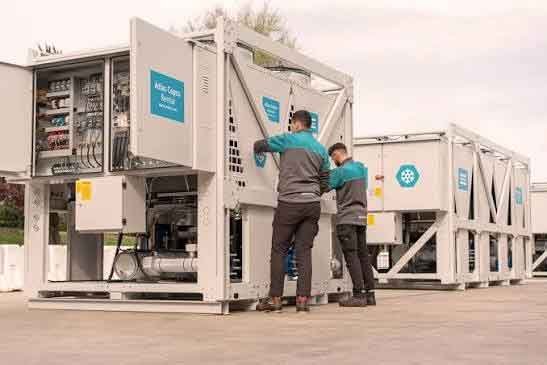

The UAE is a market where reliable cooling is not simply a matter of comfort. For many businesses, it is directly connected to productivity, equipment protection, customer experience, and continuity of operations.
The country’s official government portal describes the HVAC climate as desert, with summers that are hot and humid. In Abu Dhabi, for example, official planning documentation notes that summer temperatures regularly exceed 45°C and that summer humidity is generally high.
This creates a particular challenge for businesses that depend on chilled water systems. A chiller failure during a demanding period cannot always wait until the permanent equipment is repaired. Similarly, a company carrying out HVAC replacement, expanding a facility, starting a temporary project, or experiencing a seasonal increase in cooling demand may not want to purchase a permanent chiller for a temporary requirement.
This is where rental chillers in UAE become useful.
A rental chiller gives a business access to temporary cooling capacity for a defined period. Depending on the application, the equipment can support an existing HVAC system, provide backup during maintenance, supplement capacity during peak demand, or provide cooling where a permanent system is not yet available.
Industry providers operating in the UAE commonly identify emergency breakdowns, planned maintenance, seasonal demand, construction, temporary projects, and process cooling among the major applications for temporary chillers.
What Is a Rental Chiller?
A rental chiller is a temporary cooling machine hired instead of permanently purchased and installed.
A chiller removes heat from a fluid, commonly water, and produces chilled water that can be circulated through air-handling units, fan-coil units, process equipment, or other cooling infrastructure. The exact arrangement depends on the building or industrial application.
For a business, the important difference is not simply how the machine produces cooling. It is the flexibility of having cooling capacity available without making a permanent equipment purchase.
Rental chillers can therefore be used for:
- Emergency cooling after a chiller breakdown
- Planned HVAC maintenance
- Chiller replacement projects
- Seasonal cooling demand
- Temporary buildings and facilities
- Construction and fit-out projects
- Industrial process cooling
- Events and exhibitions
- Facility expansion
- Backup or standby cooling
UAE rental providers currently advertise both air-cooled and water-cooled temporary chiller systems, with the appropriate choice depending on factors such as cooling load, available space, water supply, site conditions, and project duration.
Why Are Rental Chillers Important in the UAE?
The biggest reason is straightforward: cooling requirements in the UAE can be substantial, while the consequences of losing cooling can be serious.
The UAE Government identifies the country as having a hot and humid summer climate. This means a cooling failure can become an operational problem rather than merely an inconvenience.
For a commercial building, inadequate cooling can affect occupants and customers. In a factory, cooling may be connected to production processes or equipment. In a data centre, continuous temperature control is fundamental to the facility’s operation. In a hotel or shopping mall, indoor environmental conditions directly affect visitors and staff.
That is why temporary cooling can be used as a bridge between a problem and a permanent solution.
Instead of waiting for a failed chiller to be repaired before restoring full cooling, a business may deploy a rental chiller while repair work continues.
The same principle applies to planned work. If a facility knows that its main chiller will be unavailable during maintenance, temporary cooling can be arranged in advance.
1. Rental Chillers Help Businesses Respond to Unexpected Chiller Breakdowns
Unexpected HVAC failures are one of the clearest reasons businesses consider temporary chiller rental.
A permanent chiller may require troubleshooting, replacement parts, mechanical work, electrical work, or a larger repair before it can return to service. Depending on the problem, the repair timeline may extend beyond the period a business can comfortably operate without adequate cooling.
A temporary chiller can provide an alternative source of cooling capacity while the permanent system is being restored.
This does not mean every chiller failure automatically requires a rental unit. The requirement depends on the affected load, available redundancy, repair duration, building conditions, and the consequences of reduced cooling.
However, for facilities where cooling continuity is important, having access to a temporary cooling solution can reduce the operational impact of an unexpected failure.
UAE rental providers specifically market temporary chillers for emergency breakdowns and rapid restoration of cooling capacity.
2. Businesses Can Continue Operations During Planned HVAC Maintenance
Maintenance is necessary for permanent cooling systems, but shutting down a major chiller can create a difficult situation for an occupied building or operating facility.
For example, a facility may need to:
- Service compressors
- Replace components
- Clean heat-transfer surfaces
- Repair chilled-water pipework
- Upgrade controls
- Replace an aging chiller
- Perform electrical work
- Carry out broader HVAC refurbishment
The challenge is that maintenance itself can temporarily reduce available cooling capacity.
Temporary chiller rental can act as a bridge during this period.
A UAE district-cooling example documented by Andrews Sykes shows temporary chillers being used during a planned maintenance and repair shutdown, with temporary equipment connected to support buildings while the cooling plant was unavailable.
The advantage of this approach is that maintenance can be planned around the availability of temporary cooling rather than simply accepting a prolonged loss of cooling.
3. Rental Cooling Helps During Chiller Replacement Projects
Replacing a large permanent chiller is not an instant process.
A project may involve equipment selection, procurement, delivery, site preparation, removal of the old unit, installation of the replacement, electrical and mechanical connections, testing, commissioning, and final handover.
During this period, the building may still need cooling.
A rental chiller can provide temporary capacity between the removal of the old equipment and successful commissioning of the new system.
This is especially useful when the facility cannot simply stop operating during the replacement project.
For businesses, the objective is not necessarily to make temporary cooling a permanent solution. The objective is to maintain the required operating conditions until the permanent system is ready.
That makes temporary chiller rental for HVAC replacement a practical project-management tool as well as a cooling solution.
4. Businesses Can Add Cooling Capacity During Peak Demand
Not every cooling problem is caused by equipment failure.
Sometimes the existing system simply cannot provide enough capacity for a temporary increase in demand.
A building might experience higher occupancy. A production facility may increase output. A new area may become operational before permanent HVAC upgrades are completed. A business may also experience unusually high cooling requirements during the hottest part of the year.
In these situations, purchasing a larger permanent chiller may not be the most practical immediate response.
Rental equipment can provide additional capacity for the period when it is needed.
This is one reason temporary cooling is often described as a scalable solution. Aggreko, for example, identifies seasonal peaks, planned maintenance, and unexpected demand as situations where businesses can adapt cooling capacity through rental equipment.
5. Rental Chillers Reduce the Need for Large Upfront Capital Spending
A permanent industrial chiller can represent a significant capital investment.
The purchase itself is only one part of the overall cost. Depending on the project, a permanent installation can also involve engineering, transportation, lifting, installation, electrical work, piping, controls, commissioning, maintenance infrastructure, and long-term ownership responsibilities.
If a business only needs additional cooling for a short project, making that entire investment may not make financial sense.
Rental changes the financial model.
Instead of purchasing equipment for a temporary requirement, the business pays for access to cooling equipment for the agreed rental period.
This does not automatically mean rental is cheaper in every situation. A permanent system may be more appropriate for a facility requiring the same cooling capacity continuously over many years.
The important point is that rental cooling converts a permanent equipment investment into a temporary operating requirement.
That flexibility can be valuable when the business needs cooling for days, weeks, months, or a specific project period.
Industry rental providers commonly identify reduced or avoided capital investment as one of the main advantages of temporary chiller solutions.
6. Flexible Rental Periods Suit Different UAE Projects
Businesses do not all need cooling for the same length of time.
An event may need temporary cooling for only a short period. A maintenance project could require cooling for several weeks. An industrial project may need temporary process cooling for months.
Rental allows the cooling requirement to be matched to the project timeline.
Current UAE rental providers advertise short-term and long-term arrangements, including daily, weekly, monthly, and longer rental periods depending on the supplier and application.
This flexibility is particularly useful when the end date of a project is known but the business does not want to purchase equipment that will become unnecessary after completion.
7. Temporary Chillers Can Support Construction and Fit-Out Projects
Construction projects can have cooling requirements before a permanent HVAC system is fully operational.
Temporary facilities, site offices, enclosed work areas, commissioning stages, and fit-out projects may require controlled indoor conditions before the final cooling infrastructure is ready.
A rental chiller can provide temporary cooling during these transitional phases.
Construction is also a sector where project schedules can change. Equipment installation may be delayed, building handover dates can move, and different parts of a development may become operational at different times.
Temporary cooling provides another option for managing these gaps.
UAE rental providers list construction projects and temporary facilities among applications for rental cooling equipment.
8. Industrial Facilities May Need Temporary Process Cooling
Chillers are not used only for comfort cooling.
Industrial processes can require controlled temperatures for equipment, machinery, production systems, or specific manufacturing processes.
When a permanent process-cooling system is unavailable, being able to provide temporary chilled water can help an industrial facility maintain operations while repairs, upgrades, or expansion work takes place.
The correct solution depends heavily on the process.
Industrial cooling may have different temperature, flow, redundancy, and operating requirements from a commercial office building. Therefore, a rental chiller should not be selected simply by looking at the building’s size.
The cooling load and process requirements need to be evaluated before selecting the equipment.
Rental providers in the UAE currently promote temporary chillers for industrial and process cooling applications, including large-capacity systems.
9. Rental Chillers Give Businesses More Flexibility Than Permanent Equipment Ownership
Equipment ownership can be sensible when a business has a predictable, long-term requirement.
But businesses do not always have predictable cooling requirements.
A company may be:
- Expanding a facility
- Moving into a temporary building
- Completing a renovation
- Testing a new production line
- Waiting for permanent equipment
- Managing seasonal demand
- Recovering from an equipment failure
In these situations, flexibility has real operational value.
Rental cooling allows a business to respond to the situation instead of committing immediately to a permanent installation.
This is particularly relevant to project-based industries where cooling demand changes over time.
10. Air-Cooled Chiller Rental Can Simplify Temporary Installation
Air-cooled and water-cooled chillers have different operating and installation characteristics.
An air-cooled chiller rejects heat directly to the surrounding air. Because it does not require the cooling-tower arrangement associated with a conventional water-cooled system, it can be attractive where fast deployment, limited space, or limited water infrastructure are important considerations.
The U.S. Department of Energy notes that air-cooled systems eliminate the need for a cooling tower, which can reduce installation and maintenance requirements, while water-cooled systems can provide higher efficiency under appropriate conditions.
UAE rental providers similarly highlight the logistical advantages of air-cooled temporary chillers, including quicker deployment and reduced dependence on a dedicated water source.
However, air-cooled does not automatically mean “better.”
The correct choice depends on the project.
11. Water-Cooled Chiller Rental Can Suit Large Cooling Requirements
Water-cooled chillers can be appropriate for larger applications where the required infrastructure is available.
They generally use a condenser-water loop and cooling tower to reject heat. This additional infrastructure means that installation is more involved than with a basic air-cooled setup.
However, water-cooled chillers can offer efficiency advantages in suitable applications.
The Department of Energy explains that water-cooled chillers are generally more efficient than air-cooled chillers when both are viable options at the same capacity.
Therefore, businesses should select the system based on the complete project rather than assuming that the largest or most efficient-rated machine is automatically the right rental choice.
12. Choosing the Correct Chiller Capacity Matters
One of the most important parts of a rental chiller project is selecting the appropriate cooling capacity.
Chiller capacity is commonly expressed in refrigeration tons (TR). The U.S. Department of Energy defines one refrigeration ton as 12,000 Btu/h of heat removal.
But building size alone does not determine the required tonnage.
The actual cooling requirement can depend on:
- Building area
- Outdoor design conditions
- Indoor temperature requirements
- Occupancy
- Equipment heat loads
- Solar heat gain
- Process requirements
- Existing chilled-water temperatures
- Chilled-water flow
- Operating schedule
- Required redundancy
- Future or temporary additional loads
An oversized chiller may not be an efficient choice, while an undersized system may fail to meet the required cooling load.
The Department of Energy’s guidance also emphasizes that chiller efficiency should be considered at both full and partial load because real systems do not necessarily operate at full capacity all the time.
For this reason, a proper technical assessment is more valuable than selecting a rental unit solely from a headline tonnage number.
13. Rental Chillers Can Help Protect Business Continuity
Business continuity is one of the strongest reasons for temporary cooling.
Imagine a facility that depends on chilled water every day. If its main chiller fails, the immediate question is not only “How do we repair it?”
The more urgent question may be:
“How do we keep operating while it is being repaired?”
A temporary chiller can potentially provide the bridge between failure and recovery.
This is particularly important in facilities where cooling affects:
- Production
- Employee working conditions
- Customer comfort
- Temperature-sensitive processes
- IT equipment
- Equipment reliability
- Building operations
Temporary cooling therefore becomes part of a wider continuity strategy.
Aggreko and other specialist rental providers position temporary chillers specifically around emergency cooling, planned maintenance, seasonal requirements, and operational continuity.
14. Businesses Can Avoid Buying Equipment They Only Need Temporarily
A common mistake in temporary projects is treating a short-term requirement like a permanent one.
Suppose a facility needs additional cooling for a six-month expansion period. Buying a complete permanent system may create a long-term asset that is no longer required after the project ends.
Rental gives the business another option.
The company can use the required equipment during the project and return it afterward.
This can be particularly useful for:
- Temporary factories
- Construction projects
- Events
- Seasonal facilities
- Temporary warehouses
- Renovation projects
- Equipment replacement periods
The decision should ultimately be based on the total project economics, expected duration, cooling demand, and long-term plans.
15. Rental Chillers Are Useful for Events and Temporary Venues
Events in the UAE can have substantial cooling requirements, particularly when large numbers of people gather in enclosed or semi-enclosed spaces.
Exhibitions, conferences, temporary venues, hospitality areas, and other events may need cooling for a defined period but have no reason to install a permanent chiller.
Temporary cooling equipment can be delivered for the event period and removed afterward.
This is one of the simplest examples of where renting can make more sense than owning.
The business or event organizer receives the required cooling capacity without having to purchase, store, maintain, and eventually dispose of permanent equipment that may have little use after the event.
UAE rental providers list exhibitions, events, and temporary venues among applications for rental cooling equipment.
Rental Chiller vs Buying a Chiller in the UAE
The choice between rental and ownership depends mainly on how long the cooling capacity is required.
| Consideration | Rental Chiller | Purchased Chiller |
|---|---|---|
| Short-term requirement | Usually more flexible | Often less practical |
| Temporary emergency | Suitable | Requires owned standby equipment |
| Planned maintenance | Useful as a bridge | Requires backup equipment |
| Seasonal extra capacity | Flexible | May create unused capacity |
| Long-term permanent demand | Can work, depending on economics | Often worth evaluating |
| Upfront equipment purchase | Not required | Required |
| Equipment ownership | No | Yes |
| Flexibility | High | Lower |
| End-of-project removal | Equipment returned | Asset remains with owner |
This is not a universal rule that rental is always better.
If a business needs the same cooling capacity continuously for many years, purchasing a permanent high-efficiency system may be more appropriate.
Rental becomes especially attractive when the need is temporary, uncertain, emergency-based, seasonal, or connected to a project.
What Industries Use Rental Chillers in the UAE?
Rental cooling is relevant to a wide range of industries.
Commercial Buildings
Offices, retail properties, hotels, and other commercial facilities can use temporary chillers during HVAC maintenance, breakdowns, or additional cooling requirements.
Industrial Facilities
Factories and industrial plants may require temporary process cooling during maintenance, production changes, or equipment replacement.
Healthcare Facilities
Hospitals and healthcare environments can have strict cooling requirements. Any temporary solution must be engineered carefully around the facility’s specific operational needs.
Data Centres
Data centres depend on continuous temperature management. Temporary chillers may be considered during maintenance, upgrades, or emergency situations, subject to the facility’s redundancy and engineering requirements.
Construction Projects
Construction and fit-out projects may use temporary cooling before permanent HVAC infrastructure is available.
Hotels and Hospitality
Hotels can require additional or backup cooling during high-demand periods or HVAC maintenance.
Shopping Malls
Large retail environments have substantial cooling requirements and may use temporary systems during maintenance or plant upgrades.
Events and Exhibitions
Temporary venues can use rental chillers because the cooling requirement ends with the event.
These applications are reflected across current UAE rental-chiller providers and specialist cooling companies.
How to Choose the Right Rental Chiller in UAE
Businesses should avoid choosing equipment based only on the lowest rental price.
A better process is to evaluate the complete requirement.
1. Determine the Required Cooling Load
Calculate or confirm the required cooling capacity before selecting the chiller.
2. Check the Required Chilled-Water Conditions
The required supply and return water temperatures can affect equipment selection and performance.
3. Evaluate the Site
Check access, installation location, available space, electrical supply, water availability, and connection points.
4. Decide Between Air-Cooled and Water-Cooled
Air-cooled systems can simplify temporary deployment, while water-cooled equipment may be appropriate for larger applications where the required infrastructure exists.
5. Consider the UAE Ambient Conditions
Make sure the selected equipment is suitable for the expected outdoor conditions.
6. Estimate the Rental Period
The rental duration can affect the overall commercial structure.
7. Check Accessories
The chiller alone may not be enough. Ask whether pumps, hoses, AHUs, cables, controls, or other components are required.
8. Consider Technical Support
Emergency cooling is only useful if the system can be supported properly throughout the rental period.
Why Rental Chillers Make Sense for Many UAE Businesses
The strongest argument for rental chillers is not that they replace permanent HVAC systems.
They do something different.
They give businesses flexibility when cooling requirements change.
A company may need temporary cooling because its main chiller failed. Another may need it because maintenance is scheduled. A construction project may need cooling before the permanent system is operational. An industrial facility may need additional process capacity for a defined period. An event may need high-capacity cooling for only a few days.
In each situation, purchasing a permanent chiller may not be the most practical immediate answer.
Rental provides a way to obtain the required cooling capacity without committing to permanent equipment ownership.
That is particularly relevant in the UAE, where the combination of hot, humid summers and cooling-dependent commercial and industrial activity makes reliable temperature control an important operational consideration.
Frequently Asked Questions
Why do businesses rent chillers in the UAE?
Businesses commonly rent chillers for emergency breakdowns, planned maintenance, HVAC replacement projects, seasonal demand, construction, industrial process cooling, events, and temporary additional capacity.
Is chiller rental cheaper than buying a chiller?
It depends on the project duration and requirements. Rental can be financially attractive when cooling is needed temporarily because it avoids purchasing equipment for a short-term requirement. For long-term continuous operation, purchasing may be more appropriate after a lifecycle-cost evaluation.
How long can a business rent a chiller?
Rental periods vary by provider and project. UAE providers advertise short-term and long-term arrangements, with some supporting periods ranging from days to years.
Are air-cooled chillers suitable for the UAE?
Air-cooled chillers can be suitable for UAE applications when correctly selected for the required load and ambient conditions. They can simplify temporary installation because they do not require a cooling tower or dedicated condenser-water system.
Are water-cooled chillers more efficient?
When both options are technically suitable, water-cooled chillers generally offer higher efficiency than air-cooled chillers at the same capacity, according to U.S. Department of Energy guidance. However, the complete installation, water requirements, operating conditions, and project economics must be considered.
What size rental chiller does a business need?
The required size depends on the actual cooling load rather than building area alone. Factors such as occupancy, equipment heat, outdoor conditions, chilled-water temperatures, process requirements, and operating schedules should be considered before selecting the chiller.
Can rental chillers be used during HVAC replacement?
Yes. Temporary chillers are commonly used to provide cooling while permanent HVAC or chiller equipment is being repaired, replaced, or commissioned.
Can rental chillers support industrial processes?
Yes. Rental chillers can be used for temporary industrial and process cooling, but the equipment must be selected according to the process temperature, flow, load, operating conditions, and required reliability. UAE suppliers currently offer temporary cooling solutions for industrial and process applications.