
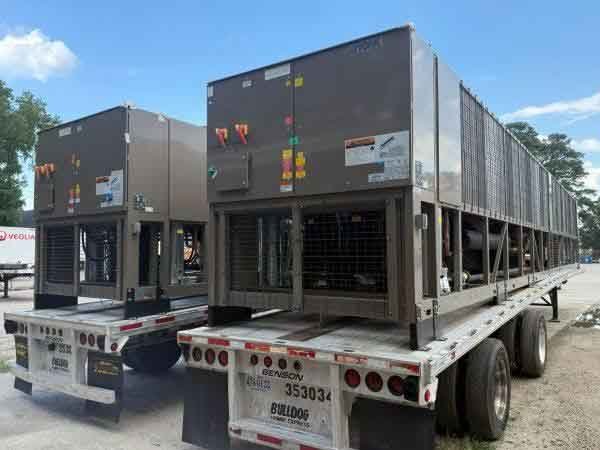

Choosing the right rental chiller in Dubai is not simply about selecting the machine with the highest cooling capacity. A suitable chiller must match the actual cooling load, required water temperatures, flow conditions, available power, installation environment, operating period, and the nature of the application.
This is particularly important in Dubai, where cooling is a major part of energy demand. The Regulatory and Supervisory Bureau for Electricity and Water Sector (RSB) states that cooling represents almost half of Dubai’s total electricity demand, making efficient and reliable cooling an important consideration for businesses and facilities.
Rental chillers can be useful when a permanent cooling system is under maintenance, additional capacity is required during peak demand, a facility is being commissioned, or temporary cooling is needed for construction, industrial operations, events, data centres, and other applications.
Here is how businesses can select the right rental chiller in Dubai.
1. Start With the Actual Cooling Load
The first and most important step is determining how much cooling the application actually needs.
Cooling requirements can vary significantly depending on the building or process. Factors such as building size, occupancy, equipment generating heat, insulation, lighting, outdoor conditions, desired indoor temperature, humidity requirements, and fresh-air requirements can all influence the cooling load.
Trane’s guidance for temporary cooling specifically recommends calculating the cooling load rather than relying on simple ton-for-ton or rule-of-thumb sizing.
For example, a commercial building requiring supplemental cooling may have very different requirements from a manufacturing process or data centre. Selecting a chiller based only on the floor area can therefore result in an unsuitable system.
A rental provider should ideally assess:
Required cooling capacity
Building or process heat load
Number of occupants
Equipment heat generation
Desired temperature
Humidity requirements
Outdoor ambient conditions
Operating hours
Required chilled-water temperatures
Existing HVAC system characteristics
The objective is to select a chiller that can meet the real load without unnecessarily oversizing the equipment.
2. Select the Appropriate Chiller Capacity
Chiller capacity is commonly expressed in refrigeration tons, kW, or BTU/h.
The required capacity should be determined from the calculated cooling load and the operating conditions at the site. A rental chiller that appears suitable by its nominal capacity may deliver different performance when operated at different entering-water, leaving-water, or ambient conditions.
Manufacturer technical documentation highlights that chiller performance and selection depend on specific temperature, fluid, and flow requirements.
For temporary applications, it can also be useful to consider whether the cooling requirement may increase during the rental period. A project experiencing a gradual increase in heat load may require additional capacity or a modular approach.
Rather than asking only, “How many tons do I need?”, businesses should provide the rental company with the complete operating conditions so the equipment can be selected correctly.
3. Decide Between Air-Cooled and Water-Cooled Chillers
One of the major decisions is whether an air-cooled or water-cooled rental chiller is more appropriate.
Air-Cooled Chillers
Air-cooled chillers reject heat directly into the surrounding air. They generally require fewer components than water-cooled systems and can be easier to deploy for temporary applications.
They may be suitable for:
Temporary commercial cooling
Construction projects
Events
Emergency cooling
Supplemental building cooling
Applications where cooling towers are impractical
Trane describes air-cooled rental chillers as options for temporary and emergency cooling, while noting that water-cooled systems are generally preferred for larger, heavy-duty applications.
Water-Cooled Chillers
Water-cooled chillers transfer heat through a condenser-water system, normally involving a cooling tower or another heat-rejection arrangement.
They can be appropriate for:
Large cooling requirements
Industrial facilities
Process cooling
Long-duration projects
High-capacity applications
Carrier notes that water-cooled chillers are commonly used for industrial and larger-tonnage applications because of their efficiency and the characteristics of the heat load being rejected.
The choice should therefore be based on the available infrastructure, capacity requirement, site conditions, and project duration rather than assuming that one type is always better.
4. Check Entering and Leaving Water Temperatures
A rental chiller must be compatible with the chilled-water temperatures required by the existing system or process.
Two important values are:
Entering water temperature (EWT)
Leaving water temperature (LWT)
The required temperature difference, or Delta T, should also be considered.
Chiller manufacturers specify operating ranges for these conditions. Carrier’s selection documentation, for example, identifies leaving-water temperature, entering-water temperature, evaporator flow rate, and other operating conditions as important selection parameters.
This means a rental company should not select equipment based solely on its advertised tonnage. The actual operating temperatures must be checked against the chiller’s performance data.
For applications with unusual temperature requirements, the rental provider may need to recommend a particular chiller configuration or fluid arrangement.
5. Verify Chilled-Water Flow Requirements
Water flow is another critical consideration.
The chiller’s evaporator needs to operate within its specified flow range. Insufficient flow can cause poor control and other operational problems, while excessive flow can increase pressure drop and potentially create equipment issues.
Trane’s technical documentation explains that water flow below the specified minimum can result in problems including poor control and freeze-up risks, while flow above the recommended range can create excessive pressure drop and tube erosion.
Before renting, confirm:
Required chilled-water flow
Existing pump capacity
Pipe size and connections
Pressure requirements
Available pump configuration
System Delta T
Whether additional pumps are required
This is especially important when connecting a rental chiller to an existing HVAC system.
6. Consider Dubai’s Outdoor Conditions
Dubai’s hot climate makes environmental conditions an important part of temporary chiller selection.
A chiller’s performance can vary depending on outdoor temperature and operating conditions. Therefore, equipment should be selected based on the conditions in which it will actually operate rather than relying only on nominal catalogue ratings.
The rental provider should understand:
Installation location
Expected outdoor temperature
Available ventilation
Equipment clearance
Exposure to direct sunlight
Heat-rejection requirements
Access for maintenance and servicing
Trane’s temporary cooling guidance recommends placing portable equipment on a level location with adequate airflow and avoiding obstructions that could interfere with heat rejection and efficiency.
For Dubai projects, site assessment is therefore an important part of the rental process.
7. Check the Available Electrical Supply
Electrical compatibility should be confirmed before the chiller arrives at the site.
The rental company should know the available:
Voltage
Phase
Frequency
Amperage
Electrical connection capacity
Generator availability, if applicable
A chiller may have the required cooling capacity but still be unsuitable if the site’s electrical infrastructure cannot safely support it.
If temporary power is also required, the chiller and generator should be evaluated as one system. This can help prevent compatibility problems during installation and operation.
8. Think About Installation Space and Access
A rental chiller needs more than enough physical space for the equipment itself.
The installation area should provide suitable access for:
Delivery vehicles
Lifting equipment
Piping connections
Electrical connections
Maintenance personnel
Air movement and heat rejection
For large equipment, transportation and lifting arrangements should be planned before delivery.
Service clearance is also important. Manufacturer documentation specifies clearance requirements around equipment to provide access for service and maintenance.
A site that looks large enough on paper may still be unsuitable if the chiller cannot be positioned correctly or serviced safely.
9. Match the Chiller to the Application
Different applications can have very different cooling requirements.
Commercial Buildings
Offices, retail facilities, hotels, and other commercial properties may require temporary cooling during HVAC maintenance, equipment replacement, renovations, or periods of increased demand.
Construction Sites
Temporary cooling may be needed for completed areas of a building while permanent HVAC systems are still being installed or commissioned.
Industrial Facilities
Industrial processes may require stable water temperatures and continuous cooling. In such situations, the rental provider needs detailed information about process temperatures, flow rates, operating hours, and load characteristics.
Data Centres
Data centres require careful planning because cooling interruptions can affect critical equipment. Temporary or supplemental chillers may be used during maintenance, expansion, commissioning, or emergency situations.
Events
Temporary cooling for events can require more than simply supplying chilled water. Air distribution, temporary ducting, operating hours, noise, access, and space limitations may also need to be considered.
The correct rental solution therefore depends on the application as much as the cooling capacity.
10. Check Whether Pumps and Accessories Are Included
A chiller alone may not be enough to complete the temporary cooling system.
Depending on the project, the rental package may need to include:
Chilled-water pumps
Flexible hoses
Temporary pipework
Cooling towers for water-cooled systems
Air-handling units
Fan-coil units
Heat exchangers
Electrical equipment
Controls
Monitoring equipment
Trane’s rental guidance describes temporary cooling as an engineered system in which equipment and accessories such as flexible ducting can be selected according to the application.
Before signing a rental agreement, clarify exactly what is included and what must be provided by the customer.
11. Evaluate Energy Efficiency
Energy consumption can become a significant part of the overall operating cost when a rental chiller runs continuously.
Efficiency should therefore be considered alongside cooling capacity.
Ask the rental provider about:
Full-load efficiency
Part-load efficiency
Compressor type
Control system
Operating conditions used for performance ratings
Expected power consumption
Monitoring capabilities
Dubai’s cooling regulations emphasize energy-efficient practices and improved operational performance in the cooling sector.
For longer rental periods, choosing efficient equipment can make a meaningful difference to operating expenses.
12. Consider Reliability and Backup Requirements
For critical applications, the cheapest rental option is not necessarily the best option.
If cooling is essential to production, IT equipment, healthcare operations, or another critical process, businesses should consider the consequences of a cooling failure.
Depending on the application, this may mean:
Additional standby capacity
Multiple smaller chillers instead of one large unit
Emergency response support
Remote monitoring
Preventive maintenance
Spare equipment or components
24/7 technical assistance
A properly planned rental solution should consider what happens if the primary unit stops operating.
13. Ask About Installation, Commissioning and Maintenance
A rental agreement should clearly explain who is responsible for installation, testing, commissioning, operation, and maintenance.
Professional rental support may include:
- Site survey
- Cooling-load assessment
- Equipment selection
- Delivery
- Positioning
- Pipe and electrical connections
- Commissioning
- Performance testing
- Routine monitoring
- Removal after the rental period
Trane’s rental service information describes temporary cooling as a process extending from planning and design through deployment and decommissioning, rather than simply delivering a piece of equipment.
This type of support can be particularly valuable when cooling is required urgently.
14. Check the Rental Company’s Technical Support
The equipment is only one part of a successful rental solution.
Before choosing a supplier, ask about:
Engineer availability
Emergency response
Maintenance support
Installation team
Replacement equipment
Monitoring
Troubleshooting
Delivery and collection
Experience with similar applications
For mission-critical cooling, response time can be just as important as the initial equipment specification.
15. Understand Dubai’s Regulatory Requirements
It is important to distinguish between a temporary rental chiller serving a customer’s own cooling system and regulated district cooling services.
Dubai’s district cooling framework is governed by specific regulations. Executive Council Resolution No. 6 of 2021 requires organisations providing district cooling or billing services in Dubai to obtain the relevant permits, while Dubai’s Building Code requires coordination with the relevant district cooling provider where a building connects to a district cooling system.
Therefore, businesses should confirm the applicable requirements for their specific project, building, and cooling arrangement rather than assuming that every temporary chiller installation follows the same process.
A Practical Checklist Before Renting a Chiller in Dubai
Before requesting a quotation, prepare the following information:
Required cooling capacity
Application type
Rental duration
Location of the project
Indoor or outdoor installation
Entering-water temperature
Leaving-water temperature
Required water flow
Available electrical supply
Existing pipe connections
Pump requirements
Space available for installation
Access for delivery and lifting
Operating schedule
Required temperature and humidity
Backup or redundancy requirements
Installation and commissioning requirements
Providing this information allows the rental company to recommend equipment based on actual operating conditions rather than simply quoting a standard unit.
Common Mistakes to Avoid
Choosing Only by Tonnage
A chiller’s nominal capacity does not tell the complete story. Temperature, flow, ambient conditions, and system requirements affect actual performance.
Ignoring Water Flow
Incorrect flow can affect system performance and equipment operation. Always verify the required flow range.
Forgetting Electrical Requirements
Confirm the site’s electrical capacity before delivery.
Selecting Equipment Without a Site Assessment
Physical access, clearance, ventilation, piping, and lifting requirements can affect which equipment can actually be installed.
Focusing Only on Rental Price
A lower rental price may not represent the lowest overall cost if the equipment consumes more energy, requires additional accessories, or provides inadequate technical support.
Not Planning for Failure
For critical operations, determine whether standby capacity or emergency support is necessary before the rental begins.
Final Thoughts
Choosing the right rental chiller in Dubai requires more than comparing equipment prices or cooling-tonnage figures. The best solution should match the actual cooling load, water temperatures, flow requirements, electrical supply, installation environment, application, and expected rental duration.
Air-cooled chillers can be practical where rapid deployment and simpler installation are priorities, while water-cooled systems can be suitable for larger and more demanding applications when the required heat-rejection infrastructure is available. Manufacturer guidance also shows why factors such as cooling load, airflow, water temperature, flow rate, and site conditions should be assessed before selecting temporary equipment.
For businesses looking for a rental chiller in Dubai, the safest approach is to provide the supplier with complete technical information and request an application-specific recommendation. This helps ensure that the temporary cooling system delivers the required performance, operates reliably, and integrates properly with the existing facility or process.