
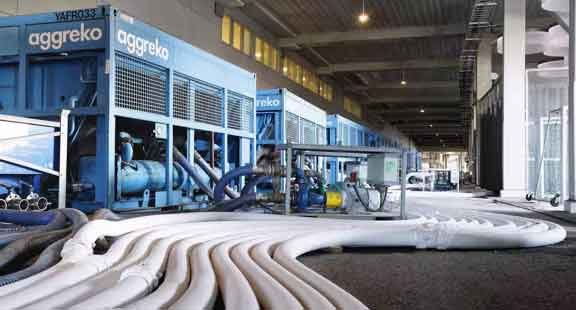

Factories and manufacturing facilities depend on stable operating conditions to keep production lines running efficiently. In many industrial processes, cooling is not simply used to make indoor areas comfortable. Chilled water can be required to remove heat from production equipment, maintain process temperatures, protect machinery, support product quality, or provide temporary cooling during maintenance and expansion projects.
This makes rental chillers for factories and manufacturing facilities in the UAE a practical option when existing cooling capacity is unavailable, insufficient, or temporarily out of service.
The need is particularly relevant in the UAE, where the hot season places additional demands on cooling systems. Government climate information describes the UAE as having a hot, dry desert climate, with average temperatures during the hotter months generally around 30–40°C and high summer humidity in some areas.
At the same time, the UAE is actively developing its manufacturing and advanced-industrial sectors. The Ministry of Industry and Advanced Technology’s industrial strategy focuses on increasing industrial productivity, adopting advanced technologies, and improving the efficiency and sustainability of production cycles.
Why Factories Need Reliable Cooling
Industrial cooling requirements are different from ordinary building air conditioning.
A manufacturing facility may generate substantial heat through machinery, production processes, compressors, hydraulic systems, injection moulding equipment, furnaces, refrigeration systems, or other industrial equipment. A process chiller works by circulating chilled water or a water/glycol mixture through heat exchangers to absorb heat from the process before rejecting that heat through the refrigeration system.
If the cooling system cannot remove heat effectively, the consequences can include:
Higher equipment operating temperatures
Reduced production efficiency
Process temperature fluctuations
Product-quality problems
Unplanned production interruptions
Increased stress on cooling equipment
Difficulty maintaining required process conditions
For manufacturers, therefore, cooling reliability can be closely connected with production continuity.
What Is a Rental Chiller?
A rental chiller is a temporary cooling system supplied for a defined period rather than permanently purchased and installed as part of a facility’s fixed cooling infrastructure.
Depending on the application, rental systems can include air-cooled or water-cooled chillers, pumps, heat exchangers, hoses, controls, and associated equipment. Commercial and industrial rental fleets are available in different capacities to address temporary, supplemental, emergency, and process-cooling requirements.
For a factory, the rental equipment can be connected to an existing chilled-water circuit or, where appropriate, directly to a process cooling arrangement through suitable heat-exchange and pumping equipment.
The exact configuration should be determined from the factory’s cooling load, operating temperatures, flow requirements, available utilities, site conditions, and process requirements.
When Should a UAE Factory Consider Chiller Rental?
There are several situations in which renting can make more sense than immediately investing in permanent cooling equipment.
1. Existing Chiller Failure
A failed chiller can create an urgent problem for a production facility. Waiting for a permanent replacement or major repair may not be practical if cooling is essential to production.
A temporary rental chiller can act as a bridge while the permanent system is repaired or replaced. Industrial rental applications are specifically used for temporary and emergency cooling requirements.
2. Planned Chiller Maintenance
Major maintenance can require equipment to be isolated or shut down.
Instead of stopping production completely, a temporary chiller may provide cooling during the maintenance period. This approach can help maintenance teams work on the permanent system while the production process continues, provided the temporary system is properly designed for the required load.
3. Factory Expansion
Manufacturing facilities often increase production capacity before their permanent cooling infrastructure is upgraded.
A rental chiller can provide additional temporary capacity during an expansion, commissioning, or phased installation project. This can help bridge the period between increased cooling demand and completion of the permanent plant.
4. Seasonal Cooling Demand
Cooling requirements can change significantly throughout the year. A facility may require additional capacity during periods of high ambient temperature or peak production.
Rather than permanently installing equipment that may be underutilized later, some facilities can use temporary cooling to address short-term increases in demand.
5. New Production Lines
When a new production line is being tested or commissioned, its final cooling requirements may not yet be fully established.
Temporary cooling can provide a practical solution during commissioning while engineers evaluate actual operating loads and finalize the permanent cooling design.
6. Emergency Production Support
Unexpected cooling failures can happen at inconvenient times. For a factory operating continuously, even a relatively short cooling interruption can create operational challenges.
Having access to emergency rental equipment can provide an alternative to waiting for permanent equipment procurement and installation.
Rental Chillers for Process Cooling
One of the most important applications in manufacturing is process cooling.
Unlike comfort cooling, which primarily focuses on maintaining suitable conditions for people, process cooling focuses on removing heat generated by manufacturing equipment or production processes.
Industrial process chillers can maintain a controlled temperature for materials, machinery, or production processes.
Depending on the industry, chilled water may be used for applications such as:
Plastics and injection moulding
Food and beverage production
Pharmaceutical manufacturing
Chemical processing
Machinery and equipment manufacturing
Electronics and electrical equipment
Metal-processing applications
Industrial heat exchangers
Production machinery
The suitability of a rental chiller depends on the required supply and return temperatures, flow rate, heat load, process fluid, operating schedule, and connection arrangement.
Air-Cooled vs Water-Cooled Rental Chillers
The choice between an air-cooled and water-cooled rental chiller depends heavily on the site.
Air-Cooled Chillers
Air-cooled chillers reject heat directly to outdoor air through condenser coils and fans. They generally do not require a cooling tower or continuous condenser-water supply, which can simplify temporary installations.
They may be suitable where:
Installation needs to be relatively straightforward
Water availability is limited
The facility does not have suitable cooling-tower infrastructure
The rental period is relatively short
Outdoor equipment placement is possible
However, ambient conditions matter. High outdoor temperatures can affect air-cooled chiller performance, which is particularly important when operating in the UAE’s hot climate.
Water-Cooled Chillers
Water-cooled systems reject heat through condenser water and normally require supporting equipment such as cooling towers and condenser-water pumps.
They can be appropriate for larger industrial cooling applications where the necessary water infrastructure is available.
The correct selection should be based on engineering calculations rather than simply choosing the largest available machine.
How to Select a Rental Chiller for a Factory
Choosing a rental chiller involves more than matching a chiller to the factory’s floor area.
1. Determine the Actual Cooling Load
The first step is understanding how much heat needs to be removed.
The load may come from production machinery, process fluids, indoor spaces, heat exchangers, or a combination of sources.
Oversizing and undersizing can both create problems. The rental provider should assess the actual operating requirements before recommending equipment.
2. Check Supply and Return Temperatures
The required chilled-water temperature is critical.
A process requiring relatively warm chilled water may have very different equipment requirements from an application requiring low-temperature fluid.
The provider should therefore know both the required supply temperature and expected return temperature.
3. Confirm Flow Requirements
The chiller must deliver the required chilled-water flow at the specified operating conditions.
Pumps, pipework, hoses, heat exchangers, and valves also need to be compatible with the required flow and pressure.
4. Consider UAE Ambient Conditions
A rental chiller operating outdoors in the UAE needs to be selected with local ambient conditions in mind.
A unit’s nominal capacity does not automatically mean it will deliver the same output under every operating condition. Ambient temperature, entering-water temperature, leaving-water temperature, fouling, airflow and other factors can affect performance.
5. Assess Available Space
Factories may have limited outdoor space around production buildings.
The installation area needs to accommodate the chiller and, where required, pumps, temporary pipework, electrical equipment, cooling towers and access for maintenance.
6. Review Electrical Requirements
Before mobilization, confirm:
Available voltage
Phase
Frequency
Electrical capacity
Connection requirements
Starting characteristics
Protection and isolation arrangements
Electrical compatibility is particularly important because rental equipment may come from different equipment fleets and may require specific site connections.
Why System-Level Planning Matters
A chiller cannot always solve a cooling problem by itself.
The entire temporary cooling system should be considered, including the chiller, pumps, pipework, heat exchangers, controls and heat-rejection equipment where applicable.
The U.S. Department of Energy’s Better Plants initiative recommends a system-level approach for process cooling because individual components interact and their configuration can have a significant effect on overall energy performance. Recommended measures include appropriate compressor staging, variable-speed drives, variable-flow chilled-water systems and suitable temperature setpoints.
This principle is particularly important for industrial rental projects because a correctly sized chiller can still perform poorly if the temporary pumping or distribution system is incorrectly designed.
Benefits of Rental Chillers for Manufacturing Facilities
Reduced Production Disruption
Temporary cooling can help factories maintain operations during planned maintenance, equipment failures, or infrastructure upgrades.
Faster Access to Cooling Capacity
Instead of waiting for a permanent chiller procurement and installation project, rental equipment can provide temporary capacity when suitable equipment is available.
Flexible Rental Periods
Factories can rent equipment according to project requirements, whether the need is associated with an emergency, maintenance shutdown, commissioning phase, or longer-term capacity gap.
Support During Expansion
Temporary chillers can bridge the cooling requirement while a factory expands its permanent cooling infrastructure.
Avoiding Premature Capital Investment
When additional cooling is only required temporarily, renting may avoid purchasing permanent equipment for a short-duration requirement. However, the financial decision should always consider the expected rental duration, operating costs, installation requirements and long-term cooling demand.
Energy Efficiency Should Still Matter
Temporary equipment should not be treated as an excuse to ignore energy performance.
The U.S. Department of Energy identifies measures such as variable-speed drives, improved chilled-water flow control, appropriate temperature setpoints and optimized chiller operation as opportunities for improving process-cooling performance.
Modern variable-speed chiller technologies can also improve efficiency under partial-load conditions. DOE research has found that variable-speed magnetic-bearing centrifugal compressors can be particularly efficient at partial loads compared with some conventional compressor technologies.
For UAE factories, efficiency should therefore be evaluated alongside cooling capacity, reliability and operating conditions.
Safety and Installation Considerations
Industrial chiller rental is an engineering project, not simply a matter of delivering a machine to a factory.
Before installation, the site team should consider:
Equipment placement
Electrical isolation and protection
Chilled-water connections
Pipe and hose routing
Pump requirements
Heat exchanger requirements
Drainage and condensate considerations
Access for servicing
Emergency shutdown procedures
Interaction with existing HVAC or process systems
Safe working clearances
For large installations, the temporary system should be designed and commissioned by suitably qualified personnel.
Rental Chillers and the UAE’s Growing Manufacturing Sector
The relevance of dependable industrial cooling is likely to remain significant as the UAE continues to expand its manufacturing and advanced-technology sectors.
The UAE’s Operation 300bn strategy aims to increase the industrial sector’s contribution to GDP to AED 300 billion by 2031 and places emphasis on industrial innovation, productivity, sustainability and advanced technology.
Abu Dhabi’s industrial strategy similarly emphasizes sustainable manufacturing, Industry 4.0, advanced technologies and stronger industrial infrastructure.
As factories become more automated and production processes become increasingly technology-driven, dependable temperature control can become an important part of maintaining operational performance.
Questions to Ask Before Renting a Chiller
Before choosing a rental provider, factory managers should have clear answers to questions such as:
- What is the required cooling load?
- What chilled-water supply temperature is required?
- What return temperature is expected?
- What flow rate and pressure are required?
- Is the application process cooling, space cooling, or both?
- Is an air-cooled or water-cooled system more suitable?
- What electrical supply is available?
- Is additional pumping equipment required?
- Is a heat exchanger required?
- How long will the equipment be needed?
- What happens if the rental unit develops a fault?
- Does the provider offer installation, commissioning and technical support?
Answering these questions before equipment selection can help reduce compatibility problems and unexpected downtime.
Final Thoughts
For factories and manufacturing facilities, cooling is often directly connected to production performance rather than simply employee comfort. When a permanent cooling system fails, requires maintenance, or cannot keep up with temporary demand, rental chillers for factories and manufacturing facilities in the UAE can provide a flexible way to maintain the required cooling capacity.
The best rental solution is not necessarily the biggest chiller available. It is the system that matches the factory’s actual cooling load, temperatures, flow requirements, electrical infrastructure, operating environment and project duration.
With the UAE continuing to strengthen its manufacturing and advanced-industrial sectors, temporary and supplemental cooling can be a valuable part of maintaining reliable industrial operations—particularly when planned carefully and supported by appropriate engineering, installation and monitoring.