
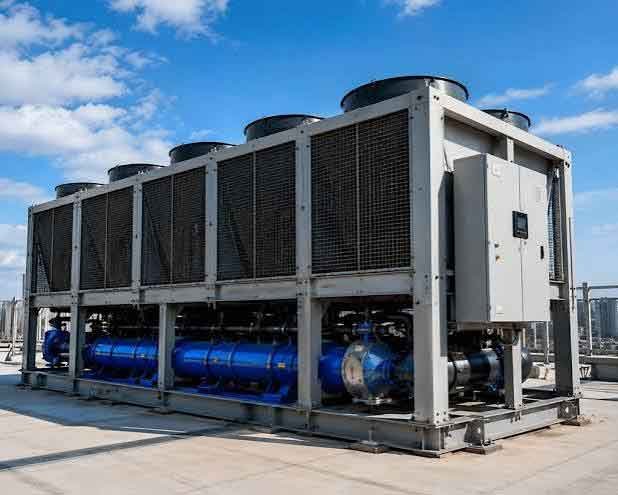

Cooling is not simply a comfort requirement in the UAE. For many commercial buildings, industrial facilities, warehouses, hotels, healthcare facilities, data rooms, retail properties, and temporary project sites, dependable cooling is part of keeping normal operations running.
The UAE has a desert climate, with summers described by the UAE Government as hot and humid. The combination of high outdoor temperatures, humidity and strong cooling demand means that an unexpected HVAC or chiller failure can become a serious operational problem. UAE climate-adaptation planning also recognises that increasing temperature and humidity can increase demand for electricity and place additional pressure on infrastructure.
This is where reliable emergency cooling solutions in the UAE become important.
Emergency cooling can provide temporary temperature-control capacity when a permanent chiller, air-conditioning system or cooling plant is unavailable, overloaded, undergoing maintenance or unable to meet the required cooling load. Depending on the application, the solution may involve rental chillers, temporary air-conditioning units, air-handling units, packaged systems, spot cooling or a combination of cooling equipment.
Major cooling solution providers operating in the UAE market describe temporary cooling as a solution for emergencies, planned maintenance and peak demand. Daikin UAE, for example, lists rental chillers, air-handling units, heat pumps and power solutions for temporary cooling requirements, while Atlas Copco describes temporary cooling for emergency breakdowns, planned maintenance, seasonal demand and process-cooling backup.
What Are Emergency Cooling Solutions?
Emergency cooling solutions are temporary cooling systems deployed when a building, facility or process suddenly loses sufficient cooling capacity.
The purpose is not necessarily to replace the permanent HVAC infrastructure forever. Instead, emergency cooling acts as a bridge between the cooling problem and the permanent solution.
For example, imagine that a commercial facility has two chillers and one develops a major fault during summer. The remaining equipment may not have enough capacity to maintain the required indoor temperature. A temporary rental chiller can potentially provide additional capacity while the damaged equipment is repaired.
A similar situation can occur when an entire cooling plant must be taken offline for maintenance. Instead of allowing the building to operate without sufficient cooling, a temporary system can be installed for the duration of the work.
Emergency cooling can therefore be viewed as a business-continuity measure.
The exact equipment required depends on the building, cooling load, existing chilled-water system, available electrical supply, available space, connection points and the length of time the temporary cooling system will be needed.
Why Is Emergency Cooling Important in the UAE?
The UAE’s climate makes reliable cooling particularly important. Government information describes the country as having a desert climate and hot, humid summers. Government climate-adaptation planning also identifies higher temperatures and humidity as factors that can increase demand for electricity.
For a business, this means that a cooling failure during a high-demand period should not always be treated as a routine maintenance issue.
In an office, insufficient cooling can affect employees and visitors.
In a hotel, it can affect guest comfort and operations.
In a retail environment, excessive indoor temperatures can affect customers, employees and temperature-sensitive areas.
In manufacturing, cooling may be directly connected to a production process.
In a server or technical environment, cooling may be required continuously because IT equipment produces heat during operation. Daikin’s technical material on infrastructure cooling explains that server rooms, telecom shelters and laboratories can require round-the-clock cooling because continuous cooling supports equipment and data protection.
The result is that the consequences of losing cooling capacity vary considerably from one facility to another.
When Do Businesses Need Emergency Cooling in the UAE?
Emergency cooling may be required when the existing cooling system cannot provide sufficient capacity for the facility’s immediate requirements.
One of the most obvious situations is a sudden chiller breakdown. A compressor failure, electrical problem, control fault, refrigerant issue or another major component problem can take a chiller out of service. If there is insufficient standby capacity, temporary cooling can help bridge the gap until permanent repairs are completed.
Another common situation is planned maintenance. A cooling plant may need to be shut down so engineers can carry out major servicing, component replacement or equipment upgrades. Temporary cooling can allow essential areas to remain operational during the maintenance period. Daikin specifically identifies planned maintenance as one of the applications for its cooling rental solutions.
Emergency cooling can also become useful when demand temporarily exceeds the installed cooling capacity. Seasonal demand, a temporary increase in occupancy, an expansion project or additional equipment can create a cooling requirement that the existing plant was not designed to handle.
Industrial businesses may require temporary process cooling when production equipment depends on controlled temperatures. Atlas Copco, for example, describes temporary cooling applications for process water and industries including chemical, pharmaceutical, food and beverage and manufacturing operations.
Temporary cooling may also be required while a permanent replacement chiller is being manufactured, delivered or installed. In that situation, the rental system acts as a bridge rather than a permanent replacement.
What Types of Emergency Cooling Solutions Are Available?
There is no single emergency cooling system suitable for every UAE project. The appropriate solution depends on the cooling load, application and existing infrastructure.
Emergency Chiller Rental
Rental chillers are among the most practical solutions for facilities that already use chilled-water systems.
A temporary chiller can be connected to an existing chilled-water circuit or a temporary cooling loop, depending on the site configuration. The system can provide additional or replacement chilled-water capacity while the permanent plant is unavailable.
UAE rental providers currently advertise air-cooled and water-cooled chillers for emergency, industrial, commercial and temporary applications. Rental Power, for example, lists air-cooled, water-cooled, portable and industrial chiller options and describes emergency use during breakdowns and unplanned increases in cooling demand.
The correct chiller capacity cannot be selected simply by looking at the building’s floor area. Cooling load, water temperatures, flow requirements, process requirements, operating conditions and existing system configuration all matter.
Air-Cooled Chillers
Air-cooled chillers reject heat directly to outdoor air rather than requiring a separate cooling tower system.
This can make them attractive for temporary applications where fast deployment and simpler installation are important.
Al Shola’s UAE rental offering, for example, lists high-ambient air-cooled chillers designed for GCC conditions, with capacities from 50 TR to 400 TR. The company also describes these systems for commercial buildings, construction sites, industrial facilities, district cooling plants and events.
However, equipment selection should always consider the actual ambient conditions expected at the site. A chiller’s nominal capacity does not automatically mean it will deliver the same capacity under every outdoor condition.
Daikin UAE has also highlighted air-cooled chiller technology designed for high Middle Eastern ambient temperatures, with one product range specified for operation up to 55°C ambient temperature.
Water-Cooled Chillers
Water-cooled chillers use a water-based heat-rejection system and are commonly associated with larger permanent or industrial cooling installations.
They can be appropriate for high-capacity applications where the necessary cooling tower, condenser-water system, pumps and connections are available or can be temporarily provided.
Because temporary water-cooled systems can require more supporting infrastructure than air-cooled equipment, the site assessment becomes particularly important.
The choice should be based on the total system rather than simply comparing the chiller itself.
Temporary Air-Handling Units
An air-handling unit, or AHU, can be used alongside temporary chillers to distribute conditioned air through a temporary or existing air-distribution arrangement.
This can be useful where a building or large temporary space needs a significant volume of conditioned air but cannot be served effectively by individual portable air conditioners.
Daikin’s UAE cooling-rental offering includes air-handling units alongside rental chillers, heat pumps and power solutions.
Portable and Packaged Air Conditioners
Portable AC and packaged air-conditioning systems can be useful when cooling is required for specific rooms, temporary structures, offices, events, workshops or smaller areas.
They may not be appropriate for replacing a large central chiller plant, but they can be effective when the cooling requirement is localised.
Spot Cooling
Spot cooling provides targeted cooling to a particular workstation, machine, room or area rather than attempting to condition an entire building.
This approach can make sense when the problem is concentrated in one location.
For example, a temporary technical room may require additional cooling while the rest of the building’s HVAC system continues to operate normally.
How Does Emergency Chiller Rental Work?
The process normally begins with an assessment of the cooling requirement.
The supplier needs to understand what failed, what equipment remains operational, what cooling capacity is required, how the temporary equipment can connect to the facility and how quickly the system needs to be operational.
A professional temporary cooling project therefore involves more than delivering a chiller to a site.
The first stage is usually requirement assessment. Engineers may review the existing cooling system, available drawings, chilled-water supply and return temperatures, flow requirements, electrical capacity, available installation area and access for delivery.
The second stage is equipment selection.
The rental provider determines the type and approximate capacity of the temporary system. Depending on the application, the package may include chillers, pumps, AHUs, hoses, electrical distribution equipment and other accessories.
The third stage is delivery and installation.
The equipment is transported to the site and positioned in an appropriate location. Connections are then made to the existing system or a temporary loop.
The fourth stage is testing and commissioning.
The system should be checked before normal operation. Engineers verify connections, flow, electrical requirements, controls and operating conditions.
The final stage is ongoing support.
Emergency cooling may be needed for hours, days, weeks or longer depending on the permanent repair or project schedule. A reliable rental arrangement should therefore include an appropriate maintenance and support plan.
Stout Energy describes its UAE rental process as site assessment, deployment and installation, followed by operation and support.
How Do You Choose the Right Emergency Cooling Solution?
Choosing the right emergency cooling system starts with understanding the actual problem.
A business should not simply order the largest available chiller.
Oversizing can increase equipment, transport and operating requirements, while undersizing can leave the facility without enough cooling capacity.
The first question is the required cooling load.
The next question is the type of cooling required.
A commercial building requiring comfort cooling may need a different arrangement from a factory requiring process cooling.
The existing infrastructure also matters. A facility with an existing chilled-water network may be able to integrate a rental chiller more efficiently than a site without chilled-water connections.
Electrical availability is another critical factor.
Temporary cooling equipment requires a suitable power supply. If sufficient electrical capacity is unavailable, the project may require a temporary generator or another appropriate power arrangement. Some rental providers offer power and cooling as coordinated services. Daikin UAE, for example, includes power solutions within its cooling rental offering.
Site access should also be considered.
Large chillers and supporting equipment require suitable access for transportation, positioning and installation. The available space around the equipment must also allow appropriate airflow and safe operation.
Finally, the operating period matters.
An emergency requirement lasting two days is different from a planned three-month temporary cooling project. Rental duration can influence the equipment configuration, commercial structure and support requirements.
Why High-Ambient Performance Matters in the UAE
A cooling system does not operate in laboratory conditions.
During the UAE summer, outdoor conditions can place substantial demands on air-cooled equipment. Equipment intended for high-ambient environments must be selected with the expected operating conditions in mind.
This is particularly important for temporary chillers because a system that appears adequate at a lower outdoor temperature may not deliver the same useful capacity under much hotter conditions.
Daikin has highlighted the importance of high-ambient chiller performance in the Middle East and has published specifications for equipment designed to operate at ambient temperatures up to 55°C.
This does not mean every project needs a chiller rated to 55°C.
Instead, the important point is that the selected equipment should be appropriate for the site’s expected ambient conditions and required cooling duty.
The UAE’s hot and humid summer climate is therefore an important part of emergency cooling equipment selection rather than an afterthought.
Emergency Cooling for Commercial Buildings
Commercial buildings can experience cooling emergencies for several reasons, including chiller failure, pump problems, control-system faults, planned maintenance or unexpected increases in cooling demand.
A temporary chiller can be particularly useful when a central chilled-water plant is affected.
For example, if one chiller in a multi-chiller plant fails, the remaining machines may continue operating but may not provide enough capacity during peak conditions. Temporary cooling can provide additional capacity while the failed machine is repaired.
The same approach can be useful during a major chiller replacement.
Rather than leaving the building dependent on reduced cooling capacity during the replacement project, a temporary system can bridge the period between removal of the old equipment and commissioning of the new equipment.
Emergency Cooling for Hotels and Hospitality
Hotels have a different cooling challenge because comfort is closely linked to the guest experience.
A major HVAC failure during a high-occupancy period can affect guest rooms, restaurants, public areas, kitchens and other operational spaces.
Temporary cooling can be planned around the affected zones rather than necessarily replacing the entire permanent plant.
Daikin has documented a hotel chiller replacement project where equipment was changed in stages so that one chiller could continue serving the building while the other was replaced. The case illustrates how redundancy and staged cooling capacity can help maintain service during equipment replacement.
For a hotel considering emergency cooling, the important consideration is therefore not just equipment availability but also how the temporary system can be integrated with the building’s existing cooling arrangement.
Emergency Cooling for Industrial Facilities
Industrial cooling requirements can be much more sensitive than ordinary comfort cooling.
Some production processes require cooling water to remain within a defined temperature range. A cooling failure can therefore affect production rather than simply indoor comfort.
Temporary industrial cooling is used for emergency breakdowns, maintenance shutdowns, seasonal capacity requirements and other process-cooling applications. Atlas Copco specifically describes temporary cooling for process-water applications across manufacturing, chemical, pharmaceutical and food-and-beverage industries.
For these applications, the emergency cooling assessment should focus on process requirements rather than simply estimating the amount of air-conditioning needed.
Flow rate, supply and return temperatures, heat rejection, operating hours and process sensitivity may all affect the required configuration.
Emergency Cooling for Data Centers and Technical Rooms
Technical environments can require continuous cooling because equipment generates heat continuously.
Daikin’s infrastructure-cooling documentation notes that server rooms, telecom shelters and laboratories may require round-the-clock cooling for equipment and data protection. It also explains that continuous operation increases the heat load generated by IT and server infrastructure.
For these environments, emergency cooling planning should consider redundancy and continuity rather than waiting for a complete cooling failure.
A temporary cooling arrangement may be used during maintenance, equipment replacement or an unexpected failure.
The system also needs to be carefully matched to the technical environment. Cooling capacity is important, but airflow distribution, temperature control and compatibility with the existing system can also matter.
Emergency Cooling During Planned Maintenance
Not every temporary cooling requirement is caused by an unexpected breakdown.
Planned maintenance can create an equally important need for temporary cooling.
A chiller may need to be removed from service for compressor work, heat-exchanger cleaning, controls replacement, major servicing or complete replacement.
If the facility cannot tolerate a cooling shutdown, temporary equipment can be installed before the permanent equipment is taken offline.
This approach turns an emergency response into a planned business-continuity strategy.
Daikin explicitly positions cooling rental as suitable for planned maintenance as well as emergencies and peak demand.
Emergency Cooling During Peak Summer Demand
Another reason to use temporary cooling is a temporary increase in cooling demand.
A building may have adequate cooling capacity during normal conditions but struggle during the hottest periods of the year.
Temporary capacity can be added without permanently expanding the plant.
This can be useful for facilities experiencing seasonal occupancy increases, temporary expansion, events or changes in production.
The advantage is flexibility.
Instead of purchasing permanent equipment that may only be required for a limited period, a business can use temporary capacity for the period when it is actually needed.
What Makes an Emergency Cooling Solution Reliable?
Reliability involves much more than the brand name of the chiller.
A reliable emergency cooling solution starts with correctly sized equipment.
The equipment should also be appropriate for the expected ambient conditions and application.
The installation should be professionally planned.
Connections should be checked carefully, and the system should be commissioned before being placed into normal operation.
Technical support is another major factor.
If the temporary system stops working during an emergency, the customer needs a clear support process rather than simply having a machine sitting on site.
Equipment condition also matters.
Rental units should be inspected, maintained and tested before deployment.
This is especially important for emergency applications because the customer is often operating under time pressure and has little tolerance for additional equipment problems.
How Much Does Emergency Cooling Cost in the UAE?
There is no single emergency cooling price that applies to every UAE project.
The total cost depends on the cooling capacity, equipment type, rental duration, site location, installation complexity, required accessories and technical support.
A small temporary cooling requirement may involve portable or packaged equipment, while a major industrial emergency may require high-capacity chillers, pumps, AHUs, temporary piping and electrical infrastructure.
Rental Power states that chiller rental pricing depends on factors including tonnage, rental duration, delivery distance, accessories, hoses, power requirements and installation complexity.
For that reason, a professional site assessment is generally more useful than relying on a generic advertised rental price.
Emergency Cooling vs Permanent Cooling
Emergency cooling should not automatically be considered a replacement for permanent HVAC infrastructure.
Permanent cooling is designed around the long-term requirements of a building or facility.
Emergency cooling is normally designed around a temporary requirement.
The biggest advantage of temporary cooling is flexibility.
It can provide additional capacity without requiring the customer to immediately purchase and install a new permanent plant.
This can be particularly valuable when a permanent replacement is already planned but cannot be completed immediately.
Temporary cooling can also reduce the pressure of making a rushed permanent equipment purchase after a breakdown.
Instead, the business can restore cooling first and then make a more considered long-term decision.
How Businesses Can Reduce the Risk of Cooling Emergencies
The best emergency cooling strategy often begins before an emergency happens.
Regular HVAC and chiller maintenance can identify problems before they become major failures.
Maintenance should include appropriate inspections, cleaning, controls checks and performance monitoring according to the equipment manufacturer’s requirements.
For cooling towers and water-cooled systems, water quality and heat-transfer surfaces also require attention. The U.S. Department of Energy notes that dirty or fouled coils can increase the load on chilled-water systems and increase electrical consumption.
Businesses can also prepare an emergency response plan.
This can include keeping equipment information available, identifying cooling-system connection points, documenting critical areas, determining minimum acceptable temperatures and establishing contacts for emergency cooling support.
This preparation can save valuable time when a failure occurs.
Why Emergency Cooling Planning Should Include Power
Cooling equipment needs a suitable power source.
If a building’s electrical infrastructure remains available, the temporary chiller can potentially be connected to the site’s electrical system subject to proper engineering checks.
If the required electrical capacity is unavailable, a temporary generator may need to be considered as part of the overall solution.
This is particularly relevant for construction sites, remote facilities and locations experiencing a broader power problem.
However, the power requirement should be calculated based on the actual equipment and electrical characteristics rather than using a simple rule of thumb.
The chiller, pumps, AHUs and other accessories may have different electrical requirements.
A coordinated cooling-and-power assessment can therefore help prevent a situation where a temporary chiller is available but cannot be operated because the site lacks adequate power.
Are Emergency Cooling Solutions Only for Large Businesses?
The appropriate equipment depends on the size and nature of the cooling requirement.
A large industrial plant may need several hundred tons of temporary cooling capacity.
A smaller office, technical room, event area or temporary structure may need a much smaller system.
The important consideration is matching the solution to the application.
This is why temporary cooling fleets generally include different equipment types and capacities.
UAE providers advertise everything from portable AC equipment to large industrial chillers and AHUs.
Emergency Cooling Solutions Across the UAE
Emergency cooling requirements can arise in Dubai, Abu Dhabi, Sharjah, Ajman, Ras Al Khaimah, Fujairah and Umm Al Quwain.
The logistics can differ between locations, particularly for industrial areas, remote sites, construction projects and facilities with restricted access.
A provider serving the UAE should therefore consider transportation, equipment availability, site access and technical support when planning an emergency deployment.
The actual cooling system should still be selected according to the project’s technical requirements rather than simply by emirate.
What Is the Best Emergency Cooling Solution for the UAE?
There is no single “best” emergency cooling system for every facility.
For a building already operating a chilled-water plant, a temporary rental chiller may be the most practical option.
For a smaller isolated space, portable or packaged AC equipment may be more appropriate.
For large indoor areas, a temporary chiller combined with AHUs may provide the required cooling distribution.
For industrial applications, the solution may need to be designed around process-water requirements.
For a facility without adequate electrical capacity, temporary power may need to be incorporated into the project.
The most reliable approach is therefore to begin with the cooling requirement and site conditions, then select the equipment.
Final Thoughts
Reliable emergency cooling solutions in the UAE provide businesses with a practical way to maintain temperature control when permanent cooling capacity becomes unavailable or insufficient.
The need can arise from a sudden chiller breakdown, planned maintenance, equipment replacement, seasonal demand, industrial process requirements or an unexpected increase in cooling load.
Because the UAE experiences hot and humid summers, cooling failures can become particularly challenging during periods of high demand.
Temporary chillers, air-cooled chillers, water-cooled systems, AHUs, packaged AC units and spot-cooling equipment can all have a role, but the right solution depends on the application.
A reliable emergency cooling project should therefore consider cooling capacity, ambient conditions, electrical availability, system compatibility, installation requirements, operating duration and technical support.
The strongest strategy is not simply to find the biggest available chiller. It is to identify the actual cooling problem, select equipment appropriate for the site and deploy it with proper engineering and support.
For UAE businesses where cooling is essential to comfort, production, equipment protection or continuity, having an emergency cooling plan in place before a failure occurs can make the difference between a manageable temporary problem and a major operational disruption.
Frequently Asked Questions
What are emergency cooling solutions in the UAE?
Emergency cooling solutions are temporary systems used when a permanent HVAC or chiller system cannot provide the required cooling. Depending on the application, they can include rental chillers, temporary AHUs, packaged AC units, portable AC systems and other temporary cooling equipment.
When should a UAE business consider emergency chiller rental?
Emergency chiller rental can be considered when a permanent chiller fails, during major maintenance or replacement work, when existing capacity is temporarily insufficient or when additional cooling is required for a limited period.
Are rental chillers suitable for the UAE summer?
They can be, provided the selected equipment is appropriately rated for the expected ambient conditions and the actual project load. High-ambient performance is particularly important when temporary chillers are operating during the UAE summer. Some UAE-market chiller equipment is specifically designed for high-ambient Middle Eastern conditions.
What is the difference between temporary cooling and emergency cooling?
Temporary cooling describes cooling equipment used for a limited period, whether planned or unplanned. Emergency cooling is a type of temporary cooling specifically deployed in response to an urgent cooling requirement such as an unexpected breakdown.
Can emergency cooling be used during chiller maintenance?
Yes. Temporary cooling is commonly used during planned maintenance and equipment replacement so that a facility can maintain required cooling while its permanent equipment is offline. Daikin identifies planned maintenance as one of the applications for its cooling rental solutions.
Can emergency cooling support industrial processes?
Yes. Industrial temporary cooling can be designed for process-water and other temperature-sensitive applications. The required configuration depends on the process temperatures, flow, heat load and operating requirements.
Do emergency chillers require a power supply?
Yes. Chillers and their supporting equipment require an appropriate electrical supply. If sufficient site power is unavailable, temporary power may need to be considered as part of the overall cooling solution.
How is emergency chiller capacity determined?
Capacity should be determined from the actual cooling load and system requirements. Factors can include building or process heat load, chilled-water temperatures, flow rate, operating conditions, equipment requirements and ambient conditions. A site assessment is preferable to selecting equipment from floor area alone.
How quickly can emergency cooling be installed?
Deployment time depends on equipment availability, site access, required capacity, transportation, connection requirements and installation complexity. Providers offering emergency rental services advertise rapid deployment, but an exact installation time should be confirmed for the specific project rather than assumed.
How much does emergency cooling cost in the UAE?
There is no universal emergency cooling price. Cost can vary according to equipment capacity, rental duration, equipment type, transportation, accessories, installation, power requirements and technical support.
Is air-cooled or water-cooled equipment better for emergency cooling?
Neither is automatically better. Air-cooled equipment can be attractive where rapid deployment and simpler installation are important, while water-cooled systems can be appropriate for larger applications where the required water-side infrastructure is available. The choice should be based on the site’s technical requirements.
Can emergency cooling be used for data centers?
Yes, temporary cooling can support technical environments such as server rooms and data centers during maintenance, equipment failure or temporary capacity shortages. Continuous cooling is particularly important in infrastructure environments because IT equipment continuously generates heat.
Why is professional installation important for emergency cooling?
Temporary cooling involves more than positioning a machine. Correct connections, water flow, electrical supply, controls, safety requirements and commissioning all affect system performance. Professional installation helps ensure that the temporary system is integrated correctly with the facility.