
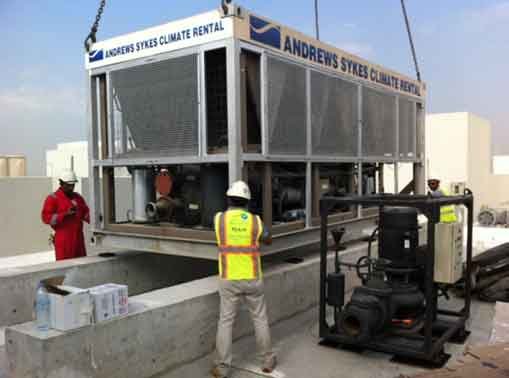

Cooling is not something Dubai buildings can afford to treat as an afterthought. The UAE has a hot, humid summer climate, while Dubai’s building regulations place emphasis on energy performance, mechanical systems, and sustainable building design. For facilities that need additional or replacement cooling capacity, renting a chiller can provide an alternative to purchasing permanent equipment.
However, not every project needs the same type of rental arrangement. A building undergoing a short shutdown may need a temporary chiller for several weeks, while a facility waiting for a permanent plant replacement may require cooling for many months. Choosing between temporary and long-term chiller rental in Dubai therefore depends on the building’s cooling requirements, project schedule, available infrastructure, and financial priorities.
What Is Chiller Rental?
A rental chiller is a cooling system supplied for a defined period instead of being purchased and permanently installed as part of the building’s HVAC plant.
Rental chillers can be used for applications such as:
Emergency replacement of failed cooling equipment
Planned HVAC maintenance and shutdowns
Temporary cooling during building refurbishment
Construction and commissioning projects
Additional cooling during periods of increased demand
Equipment replacement projects
Industrial and process-cooling requirements
Temporary or phased facility expansion
Established rental providers also offer air-cooled and water-cooled chillers for temporary operations, commissioning, contingency planning, and supplemental capacity.
The important point is that rental cooling does not necessarily mean a small or basic system. Depending on the application, rental equipment can be engineered to provide substantial cooling capacity while a permanent system is unavailable or insufficient.
Temporary Chiller Rental: When Does It Make Sense?
Temporary chiller rental is generally appropriate when the need for cooling has a defined end date.
For example, imagine a commercial building where the existing chiller plant must be shut down for major maintenance. The building may still need cooling for occupied areas while the work is being completed. Installing a permanent replacement solely for that short period would not normally be practical.
A rental chiller can bridge that gap.
1. Planned Maintenance and Shutdowns
Planned shutdowns are one of the clearest applications for temporary cooling.
Instead of allowing a building to operate without adequate cooling during maintenance, a temporary system can provide cooling while the permanent equipment is isolated or serviced.
This approach is particularly relevant for facilities where indoor temperature control is important to occupants, equipment, products, or operations.
2. Emergency Chiller Replacement
Unexpected chiller failure can create a very different situation.
When a major cooling system fails during Dubai’s hot season, waiting for a permanent replacement may not be practical. Rental equipment can act as an interim solution while technicians repair the existing system or the owner arranges a permanent replacement.
The broader HVAC rental industry identifies emergency replacement, planned outages, upgrades, and additional cooling as common applications for rental chillers.
3. Construction and Commissioning
New buildings and major developments may require cooling before the permanent mechanical plant is completely ready.
Rental chillers can provide temporary cooling during construction, commissioning, phased startup, or system testing. For example, Trane describes rental chillers as a way to support commissioning and phased startup while permanent infrastructure is still being completed.
This can help reduce the risk of delaying other parts of a project simply because the permanent cooling plant is not yet operational.
4. Events and Short-Term Occupancy
Temporary buildings, exhibitions, special events, and other short-duration facilities can also require significant cooling capacity.
In such cases, purchasing a permanent chiller may make little economic sense because the equipment will not be needed after the project or event.
Long-Term Chiller Rental: When Is It Better?
Long-term rental becomes more relevant when the building needs cooling for an extended but still defined period.
This can happen when a facility is:
Waiting for a permanent chiller replacement
Expanding its cooling capacity
Operating through a major renovation
Delaying capital expenditure
Using temporary equipment while a new HVAC plant is being designed
Experiencing a prolonged increase in cooling demand
A long-term rental arrangement can provide continuity without requiring the building owner to immediately purchase new equipment.
It is important, however, to evaluate the arrangement beyond the monthly rental rate. A longer rental period means that operating costs, maintenance responsibilities, energy consumption, installation requirements, and contract conditions can have a much greater effect on the overall cost.
Temporary vs Long-Term Chiller Rental: Key Differences
The main difference is not simply the length of the contract. It is the purpose of the cooling system.
| Factor | Temporary Rental | Long-Term Rental |
|---|---|---|
| Typical purpose | Emergency, shutdown, project, event | Extended replacement, expansion, refurbishment |
| Duration | Short and clearly defined | Several months or longer |
| Main priority | Fast deployment | Reliability and operating economics |
| Planning | Often urgent | Usually more structured |
| Equipment selection | Based on immediate load | Based on sustained requirements |
| Cost focus | Deployment and short-term rental cost | Total operating and rental cost |
| Maintenance planning | Short-term support | Ongoing service requirements |
| Best suited to | Temporary cooling gaps | Extended interim cooling |
The exact rental period and commercial structure vary by supplier and project, so building owners should compare proposals based on the complete scope rather than price alone.
How to Choose the Right Chiller for a Dubai Building
Whether the rental is temporary or long-term, selecting the correct cooling capacity is critical.
1. Determine the Required Cooling Load
A chiller should not be selected simply according to the building’s floor area.
Cooling demand can be influenced by:
Building size
Occupancy
Internal heat loads
Equipment
Outdoor conditions
Building envelope
Operating schedules
Existing HVAC configuration
Required indoor conditions
Dubai Municipality provides building-related AC unit schedules and calculation resources as part of its building requirements, highlighting the importance of proper technical assessment rather than relying on a simple rule of thumb.
A qualified HVAC professional should therefore assess the actual load and system requirements before equipment is selected.
2. Check the Existing Chilled-Water System
If the rental chiller will connect to an existing building system, compatibility matters.
The project team should verify items such as:
Chilled-water supply and return temperatures
Flow requirements
Pipe connections
Available electrical supply
Control requirements
Pumping arrangements
Available installation space
Access for delivery and removal
A chiller with sufficient nominal capacity may still be unsuitable if the surrounding system cannot support its operation.
3. Consider Air-Cooled vs Water-Cooled Equipment
The choice between air-cooled and water-cooled rental equipment depends on the site’s infrastructure and project requirements.
Air-cooled chillers can be attractive where water availability or cooling-tower infrastructure is limited. Water-cooled equipment may be suitable where the necessary condenser-water system and supporting infrastructure are available.
The correct choice should be made after evaluating the building’s existing system and site conditions rather than assuming one type is always better.
4. Evaluate Energy Performance
Energy consumption becomes increasingly important when a chiller operates for an extended period.
Dubai’s building framework includes requirements and initiatives focused on improving building performance and reducing energy consumption. The Al Sa’fat green building system, for example, emphasizes improved mechanical and electrical efficiency and reduced energy consumption.
For a short emergency rental, rapid deployment may be the dominant consideration. For a long-term rental, however, the efficiency of the equipment can have a much greater impact on the total cost of operation.
Don’t Ignore Installation and Logistics
A rental chiller is not simply delivered to the building and switched on.
The project may require:
Equipment transportation
Crane or lifting arrangements
Temporary electrical connections
Chilled-water hoses or piping
Pumps
Control connections
Ventilation clearance
Safe equipment positioning
Commissioning
Testing
Removal after the rental period
The logistics can be particularly important in dense commercial areas where access, parking, loading zones, and available plant space are limited.
For this reason, a proper site survey should ideally be completed before finalizing the rental solution.
What About Maintenance During a Long-Term Rental?
Maintenance should be clearly defined in the rental agreement.
Ask the supplier who is responsible for:
Preventive maintenance
Emergency breakdown support
Replacement parts
Routine inspections
Refrigerant-related service
Monitoring
Call-out response
Equipment replacement if a major fault occurs
This becomes especially important with long-term rentals because the equipment remains part of the building’s cooling strategy for a significant period.
Temporary or Long-Term: Which Is More Cost-Effective?
There is no universal answer.
A temporary rental may be the more economical choice when cooling is needed for a short, clearly defined period. Paying for equipment beyond the required period can unnecessarily increase project costs.
Long-term rental may make more sense when the building needs extended cooling but the owner does not want to purchase a permanent chiller immediately.
However, the correct comparison should include the total cost, not just the advertised rental price.
Consider:
Total rental cost = equipment rental + transportation + installation + energy + maintenance + accessories + removal
The actual commercial structure will vary between suppliers, so quotations should be compared on an equivalent scope.
When Long-Term Rental Can Be a Strategic Choice
Long-term rental should not necessarily be viewed as a temporary solution that has simply lasted longer.
For some facilities, it can be a deliberate operational strategy.
For example, a building owner may want to avoid committing capital to a permanent chiller while a larger HVAC upgrade is being planned. Renting can provide cooling capacity during the transition and allow the owner to delay a major capital purchase until the long-term system design is finalized.
Rental solutions can also provide scalability when cooling demand changes. Industry rental providers describe scalable cooling as useful for unusual situations, supplemental capacity, upgrades, and operational continuity.
Questions to Ask a Chiller Rental Company in Dubai
Before signing an agreement, building owners and facility managers should ask:
- What cooling capacity does the proposed chiller provide under the expected operating conditions?
- Is the equipment air-cooled or water-cooled?
- What electrical supply does it require?
- What accessories are included?
- Who handles installation and commissioning?
- Is emergency technical support available?
- What maintenance is included?
- What happens if the rental unit develops a major fault?
- Are transportation and removal included?
- Can the rental period be extended if the permanent system is delayed?
- What are the energy and operating requirements?
- Does the proposed installation comply with applicable site and building requirements?
These questions can reveal differences between quotations that may not be obvious from the monthly rental price.
Final Thoughts
The choice between temporary and long-term chiller rental in Dubai should begin with the building’s actual cooling requirement and the reason rental equipment is needed.
Temporary chiller rental is usually appropriate for emergencies, planned shutdowns, construction, commissioning, events, and other short-duration requirements. Long-term chiller rental can be more appropriate when a facility needs reliable interim cooling during an extended replacement, renovation, expansion, or transition to a permanent system.
Dubai’s focus on building performance and energy efficiency also means that equipment selection should consider more than cooling capacity.
The best rental solution is therefore not necessarily the cheapest chiller or the largest available unit. It is the system that provides the required cooling capacity, fits the building’s infrastructure, can be deployed safely, operates reliably, and remains economically sensible for the full rental period.
For Dubai facility managers, taking time to assess the cooling load, installation requirements, operating costs, support arrangements, and rental duration before signing a contract can make the difference between a temporary cooling fix and a dependable HVAC solution.