
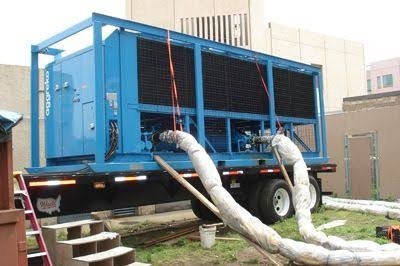

Cooling is a critical part of many commercial and industrial operations in the UAE. Offices, hotels, shopping centres, hospitals, manufacturing facilities, HVAC data centres, warehouses and other large facilities can depend on central chilled-water systems to maintain suitable indoor conditions or support temperature-sensitive processes.
When a permanent chiller stops working unexpectedly, the problem can become much larger than a routine HVAC repair. A failed cooling system can affect building occupants, production activities, equipment, stored materials and business continuity. In these situations, an emergency chiller rental in the UAE can provide temporary cooling capacity while the permanent system is repaired, replaced or brought back into service.
Unlike purchasing a new chiller, rental provides temporary equipment for a defined period. Depending on the application, a rental chiller can operate as a temporary replacement for failed equipment, provide additional capacity during periods of high demand, or support a facility during planned maintenance and system upgrades.
The UAE already has a substantial district-cooling and central-cooling infrastructure. DEWA has reported the continued growth of district cooling capacity in Dubai, while its published material describes central cooling as an important component of energy and demand management.
For businesses, this makes temporary cooling particularly relevant when existing cooling capacity becomes unavailable or insufficient.
What Is Emergency Chiller Rental in the UAE?
Emergency chiller rental is the temporary hire and deployment of a chiller system when a building, industrial process or facility suddenly requires additional or replacement cooling capacity.
A rental chiller can be connected to an existing chilled-water circuit or incorporated into a temporary cooling arrangement, depending on the equipment and site conditions. Rental providers commonly assess the required cooling capacity, application, connection requirements, available power, access conditions and rental duration before selecting equipment.
Current UAE rental providers describe temporary and emergency chiller applications for situations including unexpected equipment breakdowns, planned maintenance, seasonal cooling demand, temporary projects and replacement of failed chillers.
The important point is that emergency rental is not simply about delivering a machine to a site. A working temporary cooling solution requires appropriate capacity, compatible connections, installation, commissioning and ongoing technical support.
For this reason, the actual rental requirement can vary considerably from one facility to another.
How Does Emergency Chiller Rental Work?
The process normally starts with identifying why temporary cooling is required and how much cooling capacity has been lost or added.
A rental provider may need information about the existing chiller system, cooling load, chilled-water temperatures, flow requirements, electrical supply, pipework, available installation area and access for transporting the equipment.
The general process can involve several stages.
1. Identify the Cooling Problem
The first step is to determine whether the facility has experienced a complete chiller failure, partial capacity loss, planned shutdown, unexpected demand increase or another cooling problem.
For example, if one chiller in a multi-chiller plant fails, the facility may still have some available capacity. In another situation, the entire cooling plant may be unavailable.
The temporary solution therefore needs to be based on the actual cooling requirement rather than simply replacing the nameplate capacity of the failed equipment.
2. Assess the Required Cooling Capacity
The rental chiller must provide enough cooling for the intended application.
Capacity requirements can depend on the building size, heat load, occupancy, process requirements, equipment loads and operating conditions. Al Shola, for example, states that its temporary cooling arrangements are planned around factors such as cooling load, temperature, water flow, power, access and connection routes.
This is why selecting a rental chiller purely by building area can be misleading.
A commercial office and an industrial process may have completely different cooling requirements even if their physical areas are similar.
3. Select the Appropriate Chiller Configuration
Rental fleets can include different types and capacities of equipment.
Current UAE suppliers advertise air-cooled chillers, water-cooled chillers, portable chillers and industrial process-cooling equipment for temporary applications.
The appropriate configuration depends on the site.
An air-cooled chiller may be practical for an emergency installation where rapid deployment and a relatively straightforward setup are important. A water-cooled arrangement may be appropriate for certain larger or continuous-load applications where the required supporting infrastructure is available.
The choice should therefore be made according to the application and site conditions rather than assuming that one chiller type is suitable for every emergency.
4. Arrange Delivery and Site Installation
Emergency cooling equipment needs to reach the facility and be positioned where it can operate safely and effectively.
Site access is particularly important for large equipment. The installation team may need to consider equipment dimensions, lifting requirements, connection points, temporary pipework, electrical connections and available space.
The rental solution may also require flexible hoses, pumps, valves or other accessories depending on how it is connected to the existing cooling system.
5. Connect and Commission the System
After installation, the temporary chiller needs to be connected and checked before being placed into normal operation.
Commissioning can include checking connections, flow, electrical supply, controls and operating conditions.
This stage is important because a correctly sized chiller can still fail to deliver the expected cooling performance if the temporary installation does not match the facility’s requirements.
6. Operate the Chiller Until the Permanent System Is Restored
Once commissioned, the rental chiller can provide temporary cooling for the agreed period.
The duration can range from a short emergency repair period to several weeks or longer, depending on the project. UAE rental providers advertise both short-term and longer-term rental arrangements.
When the permanent cooling system is restored, the temporary equipment can be disconnected and removed.
When Do Businesses in the UAE Need Emergency Chiller Rental?
Emergency chiller rental can be relevant in several different situations. The most obvious is an unexpected chiller breakdown, but it is not the only reason businesses use temporary cooling.
Unexpected Chiller Breakdown
A sudden failure is one of the clearest reasons to consider emergency chiller rental.
A permanent chiller may require troubleshooting, replacement components, specialist repair or extensive maintenance before it can return to normal operation.
If the facility cannot remain without cooling for the entire repair period, temporary equipment can bridge the gap.
This can be particularly important for facilities where cooling is connected directly to business operations rather than simply occupant comfort.
Planned Chiller Maintenance
Temporary cooling does not always have to be arranged after something goes wrong.
Businesses can also use rental chillers before planned maintenance or major HVAC work.
If a permanent chiller needs to be shut down for servicing, inspection, refurbishment or replacement, temporary cooling can help maintain operations during the shutdown.
This approach allows facility managers to treat temporary cooling as part of planned business-continuity arrangements rather than waiting for an emergency.
Chiller Replacement Projects
Replacing a large commercial or industrial chiller can take time.
The old equipment may need to be removed before the new system can be installed and commissioned. There may also be procurement, transportation, site preparation and testing stages.
A temporary chiller can provide cooling during the transition.
This is particularly useful when the facility cannot simply stop operating while the replacement project is completed.
Seasonal Cooling Demand
The UAE’s climate creates significant cooling requirements, particularly during the hotter months.
A facility that normally has sufficient installed capacity may experience periods when additional temporary capacity is required.
Instead of permanently installing another large chiller for a seasonal requirement, some businesses may consider temporary rental capacity.
Rental providers in the UAE specifically identify seasonal demand increases as one of the applications for temporary chillers.
Temporary Capacity for Construction and Projects
Construction, fit-out and infrastructure projects can have temporary cooling requirements before permanent HVAC infrastructure becomes operational.
Temporary cooling may also be required for temporary buildings, project facilities or specific construction activities.
The exact application determines whether a chiller, packaged air-conditioning system, AHU or another temporary cooling arrangement is appropriate.
Industrial Process Cooling
Industrial facilities can have cooling requirements that are directly connected to production.
In such environments, the cooling system may support machinery, manufacturing processes or temperature-sensitive operations.
A failure can therefore affect production rather than simply making a building uncomfortable.
Rental providers operating in the UAE market advertise industrial and process-cooling applications alongside commercial emergency cooling.
Why Is Emergency Chiller Rental Important in the UAE?
The importance of temporary cooling comes from the consequences of losing required cooling capacity.
For a commercial building, inadequate cooling can affect indoor conditions and occupant comfort. For an industrial operation, the consequences can extend to production and equipment. For critical environments, maintaining the required thermal conditions may be part of normal operational requirements.
Dubai’s published energy information also demonstrates the scale of cooling demand in the emirate. DEWA reported a district-cooling project with an ultimate capacity of 451,540 refrigeration tons serving multiple buildings through a large chilled-water network.
This illustrates why cooling infrastructure is not a minor building service in the UAE. For many large facilities, it is a major part of the infrastructure required for normal operation.
Emergency chiller rental provides a temporary option when permanent cooling capacity becomes unavailable.
What Types of Businesses May Need Emergency Chiller Rental?
Emergency cooling requirements vary significantly between sectors.
Commercial Buildings
Offices, mixed-use developments and large commercial properties can require temporary chillers when central cooling equipment is unavailable.
A temporary system may help maintain usable indoor conditions while maintenance or replacement work takes place.
Hotels and Hospitality Facilities
Hotels can have substantial cooling requirements because guest rooms, restaurants, kitchens, meeting areas and other spaces may operate simultaneously.
A major cooling failure can therefore create operational difficulties across multiple areas of a property.
Temporary cooling may be considered during emergency repairs or planned plant shutdowns.
Shopping Malls
Shopping centres typically have large conditioned areas and significant internal heat loads from occupants, lighting, equipment and retail operations.
A cooling capacity shortage can affect large sections of a mall.
Emergency chiller rental can provide temporary additional capacity while permanent equipment is repaired or upgraded.
Manufacturing Facilities
Manufacturing plants can require cooling for both building environments and industrial processes.
A rental chiller may therefore need to meet a specific process requirement rather than simply provide comfort cooling.
This makes accurate load assessment especially important.
Data Centres and Technical Facilities
Some technical facilities have cooling requirements associated with sensitive equipment.
A temporary cooling arrangement can be considered during maintenance, infrastructure upgrades or unexpected loss of cooling capacity.
The precise redundancy and cooling requirements will depend on the facility design and operational standards.
Warehouses and Temperature-Sensitive Facilities
Certain warehouses and industrial spaces may require controlled environmental conditions.
The appropriate temporary cooling solution depends on the stored materials, required temperature conditions, building characteristics and heat load.
A rental chiller should therefore be selected according to the actual application rather than using a generic capacity assumption.
Air-Cooled vs Water-Cooled Chiller Rental
One of the common questions during an emergency is whether an air-cooled or water-cooled chiller should be used.
Air-Cooled Chillers
Air-cooled chillers reject heat directly to the surrounding air.
One advantage for temporary applications is that they do not require the same cooling-tower arrangement associated with conventional water-cooled systems.
UAE rental providers specifically market air-cooled chillers for temporary, emergency and outdoor applications. Al Shola currently lists air-cooled rental chillers from 50 refrigeration tons to 400 refrigeration tons.
However, the suitability of an air-cooled unit still depends on ambient conditions, required capacity, available electrical supply and the particular application.
Water-Cooled Chillers
Water-cooled chillers use a water-based heat-rejection arrangement and normally require supporting infrastructure such as a cooling tower or another suitable heat-rejection system.
For some large commercial and industrial applications, this configuration can be appropriate.
However, temporary deployment can be more involved when additional water-side equipment and connections are required.
Therefore, emergency chiller selection should consider the complete system rather than looking only at the chiller itself.
How Is Emergency Chiller Size Determined?
There is no universal chiller size that is correct for every commercial building or industrial facility.
Cooling capacity should be established from the actual cooling requirement.
Important considerations can include:
Existing cooling capacity: How much capacity has been lost?
Remaining capacity: Are other chillers still operating?
Building heat load: How much cooling does the facility require?
Process load: Does industrial equipment create additional heat?
Occupancy: How many people and operating areas need cooling?
Operating conditions: What chilled-water temperatures and flow conditions are required?
Equipment: What pumps, pipes, controls and electrical infrastructure are already available?
Site conditions: Can the selected rental equipment physically access and operate at the location?
Current rental providers also emphasise that chiller sizing should consider space, heat load and application rather than relying on one simple calculation.
For this reason, a professional assessment is preferable when the required capacity is uncertain.
What Factors Affect Emergency Chiller Rental Cost in the UAE?
There is no single emergency chiller rental price that applies to every UAE project.
Rental cost can vary according to several factors.
Cooling Capacity
A larger cooling requirement generally means larger or multiple rental units and potentially more supporting equipment.
Rental Duration
A short emergency rental can be priced differently from a monthly or long-term arrangement.
Delivery Distance
Transportation requirements depend on the project location and equipment size.
Installation Complexity
A straightforward connection can require less work than a complicated temporary installation involving additional pipework, pumps, electrical work or other accessories.
Accessories
The rental package may require hoses, pumps, valves, cables, temporary pipework or other equipment.
Technical Support
Some projects require ongoing technician support, monitoring or maintenance throughout the rental period.
UAE rental providers identify capacity, rental duration, delivery logistics and installation requirements among the factors that influence rental pricing.
For this reason, businesses should request a project-specific quotation rather than relying on a generic advertised daily price.
What Should Businesses Check Before Hiring an Emergency Chiller?
When a cooling failure occurs, speed is important, but selecting equipment without checking compatibility can create additional problems.
Before confirming an emergency chiller rental, businesses should establish:
- Required cooling capacity
- Chilled-water supply and return conditions
- Available electrical supply
- Connection sizes and locations
- Available installation area
- Access for delivery and lifting
- Required rental duration
- Operating schedule
- Need for temporary pumps or hoses
- Required technical support
- Any site-specific safety requirements
The rental supplier should understand the existing cooling arrangement before confirming the final equipment selection.
This is particularly important for industrial applications where the temporary system may need to integrate with a production process.
Can an Emergency Rental Chiller Replace a Failed Chiller?
In many situations, a rental chiller can provide temporary replacement capacity, but it should not automatically be assumed to be a direct one-for-one replacement.
The failed chiller may have been part of a larger system involving multiple chillers, pumps, cooling towers, controls and other equipment.
A rental system may therefore be configured differently from the permanent equipment.
The objective is to restore the required cooling function for the relevant period, subject to the available site infrastructure and the temporary system’s capacity.
Rental Power and HVACLINIC both describe emergency and temporary chiller rental as a solution for failed or unavailable permanent cooling equipment.
Emergency Chiller Rental During Chiller Replacement
A permanent chiller replacement can involve more than removing one machine and installing another.
Large projects can include equipment procurement, site preparation, mechanical modifications, electrical work, pipework changes, commissioning and testing.
During this period, the facility may still need cooling.
A temporary chiller can act as a bridge between the old system and the new system.
This is one reason rental cooling can be useful even when there is no emergency breakdown. A planned replacement can create a temporary capacity gap that needs to be managed.
Emergency Chiller Rental for Planned Shutdowns
A planned shutdown is easier to manage than an unexpected failure because the facility has time to prepare.
However, planned maintenance can still create a period when normal cooling capacity is unavailable.
Businesses can use this opportunity to determine the required temporary capacity, inspect connection points, prepare installation areas and arrange delivery before the shutdown begins.
Planning temporary cooling in advance can reduce the pressure associated with an emergency deployment.
What Makes a Good Emergency Chiller Rental Plan?
A good temporary cooling plan should consider the entire system rather than just the rental machine.
It should identify the required cooling capacity, connection method, power requirements, site access, installation sequence, operating period and contingency arrangements.
The plan should also establish who will be responsible for monitoring the equipment and responding if the temporary system develops a fault.
For larger industrial or commercial facilities, businesses may also want to maintain a documented emergency cooling procedure so facility teams know what information to provide when a permanent cooling system fails.
Emergency Chiller Rental vs Buying a New Chiller
Buying a new chiller and renting a temporary chiller solve different problems.
Permanent purchase can make sense when the facility needs additional long-term installed capacity.
Emergency rental is generally intended to address a temporary requirement.
Rental can therefore be relevant when a business needs cooling while:
- A permanent chiller is being repaired
- A replacement chiller is being manufactured or delivered
- Planned maintenance is underway
- Seasonal demand temporarily increases
- A construction project requires temporary cooling
- Additional capacity is needed for a limited period
The financial comparison should consider the total project duration, capital requirements, installation requirements, maintenance responsibilities and long-term cooling needs.
How Quickly Can Emergency Chiller Rental Be Deployed?
Deployment time varies from one project to another.
It depends on equipment availability, location, required capacity, site access, installation requirements and how quickly the technical requirements can be confirmed.
Some UAE rental companies advertise same-day or rapid emergency deployment, while others describe response services operating around the clock. These are provider-specific service claims rather than a universal UAE industry standard.
Businesses facing an urgent failure should therefore confirm the actual response time, equipment availability and installation scope with the rental provider before placing an order.
Why UAE Climate Conditions Matter for Temporary Cooling
Cooling equipment operating in the UAE must be selected with local ambient conditions in mind.
High outdoor temperatures can increase the challenge faced by air-conditioning and refrigeration equipment because heat rejection becomes more demanding as ambient conditions rise.
This makes equipment selection, maintenance and operating conditions important when arranging temporary cooling.
Some UAE rental providers specifically advertise equipment designed or configured for high-ambient GCC conditions. However, businesses should verify the manufacturer’s operating limits and the actual performance conditions of the proposed rental equipment rather than relying only on general marketing descriptions.
What Happens After the Emergency Is Over?
Once the permanent cooling system has been repaired or the temporary requirement has ended, the rental equipment can normally be disconnected and removed according to the agreed rental arrangement.
For a planned replacement, the temporary system may remain in operation until the new chiller has been commissioned and the facility confirms that permanent cooling is operating correctly.
This makes temporary rental useful as a transition solution rather than a permanent substitute.
Frequently Asked Questions
What is emergency chiller rental?
Emergency chiller rental is the temporary provision of chiller equipment when a business loses cooling capacity unexpectedly or needs temporary cooling during maintenance, replacement, seasonal demand or another short-term requirement.
When should a UAE business consider renting a chiller?
Businesses can consider temporary chiller rental after an unexpected chiller failure, during planned maintenance, while replacing permanent equipment, during temporary projects or when existing cooling capacity is insufficient for a limited period.
Can a rental chiller be used for industrial applications?
Yes. UAE rental providers advertise industrial and process-cooling applications as well as commercial cooling. The equipment must be selected according to the specific process load and operating requirements.
Can a rental chiller support a commercial building?
Yes. Temporary chillers can be used for commercial buildings when existing cooling capacity is unavailable or insufficient, subject to appropriate sizing and system compatibility.
Is an air-cooled chiller suitable for emergency rental?
It can be suitable for certain temporary applications because it does not require the same water-side heat-rejection arrangement as a water-cooled system. However, the correct choice depends on capacity, ambient conditions, electrical supply, application and site configuration.
How is emergency chiller rental cost calculated?
Rental cost can depend on cooling capacity, rental duration, transportation, installation complexity, accessories and technical support. A project-specific quotation is generally required for an accurate figure.
Can I rent a chiller during permanent chiller replacement?
Yes. Temporary chiller rental can provide cooling during the period between removal of the existing equipment and commissioning of the replacement system.
How long can a business rent a chiller?
The rental period depends on the provider and project. UAE rental providers advertise arrangements ranging from short-term hire to monthly, seasonal and longer project-based rentals.
Does emergency chiller rental include installation?
This depends on the rental package. Some providers offer delivery, installation, commissioning and technical support as part of their managed rental service. Businesses should confirm exactly what is included in the quotation before proceeding.
What information should I provide when requesting an emergency chiller?
Useful information includes the required cooling capacity, type of facility, reason for temporary cooling, existing chiller details, chilled-water connection information, electrical supply, site location, access conditions and expected rental duration.
Final Thoughts
Emergency chiller rental in the UAE is primarily a temporary cooling strategy for businesses that cannot afford to remain without required cooling capacity.
The need may arise from an unexpected chiller breakdown, planned maintenance, permanent equipment replacement, seasonal demand, construction work or an industrial process requirement. The appropriate solution depends on the actual cooling load, equipment configuration, available infrastructure and site conditions.
For commercial and industrial facilities, the most important step is not simply finding a chiller for rent. It is determining the required capacity and selecting equipment that can be integrated safely and effectively with the facility’s existing cooling arrangement.
UAE cooling infrastructure is extensive, and official Dubai information demonstrates the scale and importance of central and district cooling in the region. For facilities where cooling is essential to operations, having a practical temporary-cooling strategy can therefore be an important part of business continuity planning.
Businesses should obtain a site-specific assessment and quotation before selecting an emergency chiller, particularly for large commercial buildings, industrial facilities and process-cooling applications.