
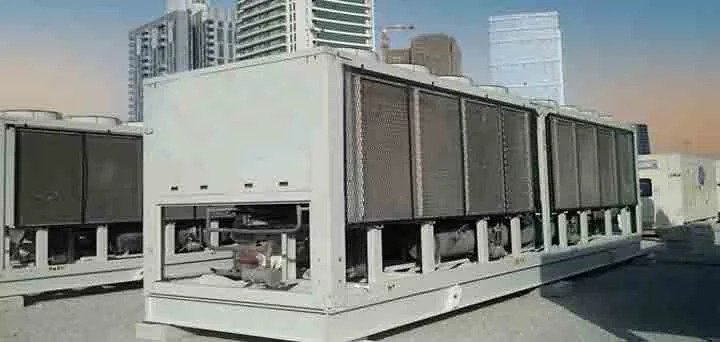

Choosing the right rental chiller for a Dubai building is not simply a matter of picking the largest machine available or selecting the lowest rental price. The chiller needs to match the building’s actual cooling load, operating conditions, available power, chilled-water requirements, installation space, and the period for which temporary cooling is required.
This is especially important in Dubai, where cooling is a major part of building energy demand. The Regulatory and Supervisory Bureau for Electricity and Water (HVAC) states that cooling represents almost half of Dubai’s total electricity demand, while district cooling currently provides more than 20% of the city’s cooling needs.
For a commercial building, hotel, shopping mall, office tower, residential property, warehouse, industrial facility, or other large facility, the wrong rental chiller can result in insufficient cooling, unnecessary electricity consumption, installation problems, or unexpected downtime.
A properly selected rental chiller in Dubai should provide enough cooling capacity while working safely and efficiently under the site’s actual conditions.
What Is a Rental Chiller?
A rental chiller is a temporary cooling machine supplied for a defined period instead of being permanently installed as part of the building’s original HVAC plant.
Businesses may use temporary chillers when an existing chiller fails, during planned HVAC maintenance, while a permanent chiller is being replaced, when additional cooling capacity is temporarily required, or when a project needs cooling before its permanent system becomes operational.
Rental chillers can be integrated with existing chilled-water systems when the site has suitable connections. Depending on the application, the rental arrangement may also require pumps, hoses or temporary pipework, electrical connections, heat exchangers, cooling towers, air-handling units, or other accessories.
Dubai rental providers currently advertise different temporary cooling configurations and capacities. For example, Al Shola lists air-cooled rental chillers from 50 TR to 400 TR and says selection is planned around factors such as cooling load, temperature, water flow, power availability, placement, and rental duration.
The important point is that rental chiller selection should be based on the application rather than capacity alone.
Why Choosing the Right Rental Chiller Matters in Dubai
Dubai’s climate makes temporary cooling a particularly important consideration for buildings and businesses.
A building may already have a central cooling system, but one or more chillers can become unavailable because of maintenance, mechanical failure, replacement work, or an unexpected increase in cooling demand.
During such situations, a temporary chiller can act as:
- Emergency cooling
- Backup cooling
- Supplemental cooling capacity
- Temporary replacement cooling
- Cooling during HVAC renovation
- Cooling during chiller replacement
- Seasonal cooling support
- Temporary project cooling
The wrong capacity can create problems in either direction.
An undersized chiller may not provide enough cooling during peak demand. An oversized system can increase equipment and operating costs without providing a useful benefit.
This is why the selection process should begin with the building’s actual cooling requirements.
Start With the Building’s Cooling Load
The first and most important step is determining the cooling load.
Cooling load is the amount of heat that the cooling system needs to remove to maintain the required indoor or process conditions.
A simple calculation based only on floor area may not accurately represent the building’s actual requirement.
For example, two buildings with the same floor area can require very different cooling capacities. An office with moderate occupancy and equipment loads will have different requirements from a data room, hotel, shopping mall, restaurant, or industrial process area.
A professional rental provider should therefore review the site’s cooling requirement before recommending equipment.
Competitor rental pages also emphasize this point. Rental Generator’s Dubai page describes reviewing factors such as building size, insulation, occupants, equipment, required temperature, electrical capacity, rental duration, and outdoor conditions when selecting chiller capacity.
Do Not Select a Chiller Based Only on Square Footage
Building area can be useful as an initial reference, but it should not be treated as the final sizing method.
The actual cooling load can be influenced by occupancy, equipment, solar exposure, ventilation, building envelope, operating hours, and other conditions.
For a temporary installation, the rental provider should ideally review the existing HVAC design information, equipment data, chilled-water requirements, and site conditions before finalizing the chiller.
Determine the Required Chiller Capacity
Rental chillers are commonly described in tons of refrigeration (TR) or kilowatts of cooling capacity.
One refrigeration ton is approximately 3.517 kW of cooling capacity.
However, the capacity stated on a chiller’s nameplate does not automatically mean the unit will provide that exact capacity under every operating condition.
Chiller performance can vary depending on:
- Outdoor ambient temperature
- Chilled-water supply temperature
- Chilled-water return temperature
- Water flow
- Condenser conditions
- Part-load operation
- Fouling and maintenance
- Electrical conditions
- Equipment configuration
This is particularly important in Dubai because high outdoor temperatures can affect the performance of air-cooled equipment.
For that reason, the selection should consider the actual design conditions at the Dubai site, rather than simply matching a nominal TR number.
Consider Dubai’s High Ambient Temperature
Dubai’s summer conditions make ambient temperature an important part of rental chiller selection.
Air-cooled chillers reject heat directly into the surrounding air. As outdoor temperature rises, the chiller may have to work harder to reject heat.
LG’s technical guidance notes that air-cooled chiller efficiency can be affected by high ambient temperatures, particularly in hot climates such as the Middle East.
This means a unit that appears suitable under a lower outdoor temperature may not provide the same performance during Dubai’s hottest operating conditions.
When requesting a rental chiller, ask the supplier for the equipment’s performance at the expected site ambient temperature.
A high-ambient-rated chiller may be more appropriate for a Dubai project than a unit selected only on nominal capacity.
Some Dubai rental providers specifically advertise equipment designed for high-ambient GCC conditions. Al Shola, for example, states that its listed air-cooled chillers are designed to operate at ambient temperatures up to 55°C.
The important lesson is not that every Dubai building needs a particular chiller model. Instead, the equipment should be selected and rated for the actual environmental conditions in which it will operate.
Choose Between an Air-Cooled and Water-Cooled Chiller
One of the biggest decisions is choosing the appropriate chiller type.
Air-Cooled Rental Chiller
An air-cooled chiller rejects heat through air and does not require a cooling tower for condenser heat rejection.
This can make air-cooled chillers attractive for temporary applications where:
- Installation needs to be fast
- Water availability is limited
- The site has restricted space
- A cooling tower is impractical
- The project is relatively short-term
- Simpler temporary installation is preferred
Air-cooled chillers are widely used for temporary commercial, industrial, construction, and emergency cooling applications.
However, high outdoor temperatures can affect their performance, so the unit’s high-ambient capability needs to be checked.
Water-Cooled Rental Chiller
A water-cooled chiller uses condenser water and normally works with a cooling tower or another heat-rejection arrangement.
Water-cooled systems can offer higher efficiency, particularly for larger installations, but they normally involve more equipment and infrastructure.
For a temporary project, these requirements can make installation more complex than an air-cooled system.
Which Is Better for a Dubai Building?
There is no universal answer.
The right option depends on the building’s cooling load, available space, water availability, electrical supply, existing HVAC arrangement, rental duration, and required operating conditions.
For many temporary applications, an air-cooled rental chiller can simplify installation. For larger or particular applications, a water-cooled solution may make more sense.
The decision should be made from the project’s technical requirements rather than the chiller type alone.
Check the Existing HVAC System
If the rental chiller is replacing or supplementing an existing building chiller, the temporary equipment needs to work with the existing system.
A chiller with sufficient TR capacity may still be unsuitable if the site’s hydraulic or electrical conditions do not match the equipment.
This is one reason site surveys are valuable before equipment delivery.
An Andrews Sykes Dubai case study demonstrates how temporary chillers can be integrated with an existing building system. In one residential-building application, two 682 kW high-ambient air-cooled chillers were lifted onto the roof and connected to existing pipework after a temporary cooling requirement developed.
The example also shows why logistics are part of chiller selection. The question is not simply “How many TR do we need?” It is also “How will the equipment physically connect to and serve the building?”
Check Chilled-Water Supply and Return Temperatures
Chiller capacity is closely connected with chilled-water operating conditions.
The rental chiller must be capable of operating at the required conditions.
If the temporary system does not match the existing building’s design conditions, the building may not receive the expected cooling performance even when the nominal chiller capacity appears adequate.
This is especially important for buildings using existing AHUs and fan-coil systems.
Verify Water Flow Requirements
Chilled-water flow is another critical consideration.
A rental chiller requires the correct water flow to transfer the intended amount of heat.
If temporary pumps are required, their capacity should be selected as part of the complete cooling solution.
A chiller should not be considered in isolation from the rest of the temporary system.
Check Electrical Requirements Before Delivery
Electrical requirements can become a major issue if they are not reviewed early.
A rental chiller may have sufficient cooling capacity but still be unsuitable if the building cannot provide the required electrical supply.
For this reason, electrical capacity should be checked before transportation and installation.
Consider Where the Chiller Will Be Installed
The available installation area can influence the type and size of rental chiller that can be used.
Potential locations include:
- Rooftops
- Service yards
- Ground-level plant areas
- Parking areas
- Temporary equipment zones
- Construction compounds
The location needs enough space for the equipment, service access, airflow, pipework, electrical connections, and safe operation.
For air-cooled chillers, airflow around the condenser section is particularly important.
If hot discharge air is recirculated into the equipment, the effective ambient temperature around the condenser can increase and performance can suffer.
The site should therefore be checked for ventilation and equipment clearances before installation.
Think About Delivery and Access
A large rental chiller cannot simply be delivered to every location without planning.
The Andrews Sykes Dubai residential-building project mentioned earlier required the temporary chillers to be lifted onto the roof by crane.
This is a good example of why logistics should be considered before equipment selection.
A technically suitable chiller can still create delays if it cannot be transported or positioned safely.
Decide How Long You Need the Rental Chiller
Rental duration affects the type of solution that makes sense.
You might need temporary cooling for:
- A few days
- Several weeks
- Several months
- A complete HVAC replacement period
- A planned maintenance shutdown
- An emergency repair
- A seasonal cooling requirement
- A construction phase
If the rental period changes because a building project is delayed, check whether the provider allows the agreement to be extended.
Temporary cooling projects can sometimes last longer than originally planned. The Andrews Sykes Dubai case study, for example, initially required temporary equipment for a shorter period but the hire was eventually extended to three months because additional complications delayed the original situation.
A flexible rental agreement can therefore be useful for building projects where the final completion date is uncertain.
Compare the Total Rental Cost, Not Just the Daily Rate
When comparing chiller rental Dubai quotations, the lowest equipment rental price is not necessarily the lowest total project cost.
A quotation that appears inexpensive can become more expensive if major accessories and installation services are excluded.
For example, some rental packages may supply only the chiller while others provide a complete temporary cooling system.
Always compare quotations on a like-for-like basis.
Consider Energy Efficiency
Energy consumption can become a significant part of the operating cost, especially when a temporary chiller runs continuously.
Efficiency depends on factors such as:
- Chiller design
- Ambient temperature
- Cooling load
- Part-load operation
- Chilled-water temperatures
- Maintenance condition
- Condenser performance
- Controls
Do not judge efficiency solely from a marketing statement.
Ask for relevant equipment performance information at the operating conditions expected at your Dubai building.
This is particularly important for high-ambient applications because equipment performance can change as outdoor temperature increases.
Dubai’s energy authorities also emphasize improving cooling efficiency in buildings, including during planning, construction, and retrofit projects.
Check Noise Requirements
Noise can matter when a rental chiller is installed near occupied areas.
This is particularly relevant for:
- Hotels
- Residential buildings
- Hospitals
- Offices
- Schools
- Retail facilities
- Event venues
Ask the rental provider for the equipment’s sound information and determine whether additional measures are required.
The physical location can also affect perceived noise. A unit installed close to bedrooms or occupied offices may create more disturbance than the same unit positioned farther away.
Consider Redundancy for Critical Buildings
Some buildings cannot afford a complete loss of cooling.
Examples may include:
- Data centres
- Healthcare facilities
- Critical industrial processes
- Certain commercial operations
- Facilities storing temperature-sensitive products
For these applications, simply matching the expected load may not be enough.
The project team may consider multiple rental chillers instead of relying on a single large unit.
Multiple units can provide operational flexibility and may allow some cooling capacity to remain available if one unit is taken offline.
The appropriate redundancy strategy depends on the building’s risk tolerance and technical requirements.
For critical applications, the rental provider should be involved in planning the complete temporary cooling arrangement.
Make Sure the Rental Chiller Can Handle Part-Load Conditions
Buildings do not necessarily operate at maximum cooling demand all day.
Cooling demand can change according to:
- Time of day
- Occupancy
- Outdoor temperature
- Building usage
- Equipment operation
- Seasonal conditions
A rental system should therefore be able to operate effectively when the building load decreases.
For larger installations, using multiple chillers can sometimes provide greater flexibility because units can be staged according to demand.
The correct approach depends on the building’s load profile.
Ask About Installation and Commissioning
A professional rental chiller supplier should not simply drop equipment at the site and leave the building team to figure everything out.
Installation may involve:
- Site inspection
- Cooling-load assessment
- Equipment selection
- Delivery planning
- Positioning
- Pipe or hose connection
- Electrical connection
- Pump installation
- System testing
- Commissioning
- Performance verification
- Handover
The exact scope varies by project.
Rental providers in Dubai advertise turnkey temporary cooling services that can include equipment supply, installation, commissioning, and technical support.
Check Maintenance and Emergency Support
A rental chiller is temporary equipment, but it still needs proper maintenance and technical support.
Before renting, ask:
- Who provides maintenance?
- Is technical support available outside normal working hours?
- What happens if the chiller trips?
- How quickly can an engineer attend?
- Is a replacement unit available?
- Who monitors operating performance?
- Are routine inspections included?
For emergency cooling or critical facilities, response time can be just as important as the equipment specification.
A rental chiller that is technically excellent but unsupported during a failure may not provide the reliability the building requires.
Make Sure the Chiller Is Suitable for the Building’s Application
Not every cooling application has the same requirements.
Offices
Office buildings generally require comfort cooling and stable indoor temperatures. Occupancy, working hours, fresh-air requirements, and existing AHUs should be considered.
Hotels
Hotels can have highly variable cooling demand because rooms, restaurants, kitchens, meeting spaces, and public areas may operate at different times.
Shopping Malls
Malls can have substantial cooling requirements because of their large occupied areas, lighting, retail equipment, entrances, and high visitor numbers.
Residential Buildings
Residential properties may require temporary cooling during central plant maintenance, equipment replacement, or unexpected breakdowns.
Warehouses
Warehouse requirements depend heavily on the goods stored, ventilation, building envelope, occupancy, and required temperature.
Industrial Facilities
Industrial applications may require process cooling rather than ordinary comfort air conditioning. The required supply temperature and operating conditions may therefore differ significantly.
Data Centres
Data centres can have continuous and highly critical cooling requirements. Redundancy, monitoring, power availability, and precise operating conditions can be particularly important.
Check Whether Your Building Uses District Cooling
Dubai has extensive district-cooling infrastructure, so some buildings do not operate a conventional standalone chiller plant.
The RSB states that Dubai’s district-cooling framework covers district cooling systems, plants, networks, and single-building district cooling systems.
If your building is connected to district cooling, a temporary chiller cannot necessarily be connected in the same way as a conventional standalone building system.
The temporary solution may need to work through the building’s energy transfer station or another approved arrangement.
This should be reviewed by the building’s facilities team, consultant, district-cooling provider, and rental-chiller contractor before installation.
Dubai’s Executive Council Resolution No. 6 of 2021 also establishes regulatory requirements around district cooling services, including permits and technical requirements.
Therefore, do not assume that a standard rental chiller can simply be connected to every Dubai building.
Ask for a Site Survey Before Final Selection
One of the best ways to reduce installation problems is to arrange a technical site survey before the equipment is finalized.
During the survey, the rental provider can review:
- Building cooling requirements
- Existing chiller plant
- Pipe connections
- Electrical supply
- Equipment location
- Access routes
- Crane requirements
- Pump requirements
- Chilled-water temperatures
- Flow rates
- Control requirements
- Safety considerations
The information gathered can then be used to develop a temporary cooling plan.
This approach is much more reliable than choosing a chiller solely from a phone conversation based on building area.
Common Mistakes When Choosing a Rental Chiller in Dubai
Choosing the largest available chiller
Bigger is not automatically better. The equipment should be matched to the actual cooling requirement and operating conditions.
Choosing based only on price
A low rental price may exclude installation, pumps, hoses, cables, commissioning, or technical support.
Ignoring high ambient conditions
A chiller’s performance at high outdoor temperatures should be verified before it is selected for Dubai summer operation.
Ignoring electrical requirements
The building must have adequate electrical capacity for the selected equipment or an appropriate temporary power arrangement.
Forgetting installation access
A large chiller may require a crane or specialized lifting arrangement.
Ignoring water flow
The chiller must receive the required chilled-water flow under the system’s operating conditions.
Not checking the existing HVAC system
Compatibility with existing pipework, pumps, AHUs, controls, and temperature requirements is essential.
Selecting one unit for a critical application
Critical facilities may require redundancy rather than a single point of failure.
Failing to plan for project delays
If the rental is connected to a building renovation or permanent chiller replacement, allow for possible extensions.
How to Choose a Rental Chiller Company in Dubai
The equipment itself is only one part of the solution. The rental company also matters.
Look for a provider that can demonstrate:
Technical assessment
The company should understand cooling loads, chilled-water systems, pumps, electrical requirements, and site conditions.
Suitable equipment
The provider should have equipment appropriate for your required capacity and operating conditions.
Installation capability
A complete rental solution may require pipework, pumps, electrical connections, lifting, testing, and commissioning.
High-ambient experience
Dubai’s climate makes experience with high-temperature operation valuable.
Responsive support
For emergency or critical cooling, technical support should be available when the equipment is operating.
Flexible rental periods
The rental term should match your project and ideally accommodate reasonable extensions.
Transparent quotations
Make sure the quotation clearly identifies equipment, accessories, delivery, installation, commissioning, maintenance, and collection.
When Is Rental Chiller a Better Option Than Buying?
Rental cooling is particularly useful when the need is temporary or uncertain.
For example, purchasing a permanent chiller may not make sense when:
- The existing chiller is undergoing short-term maintenance.
- A permanent replacement is already on order.
- A building renovation is in progress.
- Seasonal cooling demand has increased temporarily.
- A construction project needs temporary cooling.
- A temporary facility needs air conditioning.
- An emergency breakdown requires immediate backup.
- A business needs additional cooling only for a limited period.
Rental allows the building operator to obtain temporary capacity without permanently committing to equipment that may not be required after the project is completed.
Choosing the Right Rental Chiller for Your Dubai Building
Finding the right rental chiller for your Dubai building starts with understanding the building rather than simply selecting a machine.
The most important factors include cooling load, required chiller capacity, Dubai’s high ambient temperature, chiller type, chilled-water temperature, water flow, electrical supply, installation location, access, rental duration, energy efficiency, redundancy, and technical support.
Air-cooled and water-cooled chillers can both be suitable, but the correct choice depends on the project’s conditions. A high-capacity chiller is not automatically the best option, and the cheapest rental quotation is not necessarily the most economical solution.
A proper site assessment can help identify the required cooling capacity and determine how the temporary system should connect to the existing building HVAC infrastructure.
For buildings connected to district cooling, additional technical and regulatory considerations may also apply. Dubai’s district-cooling sector is regulated by the RSB, so the building’s existing cooling arrangement should be established before planning a temporary connection.
Ultimately, the best rental chiller in Dubai is the one that provides the required cooling under the actual site conditions, integrates properly with the building’s HVAC system, can be installed safely, and is supported throughout the rental period.
Frequently Asked Questions
What size rental chiller do I need for my Dubai building?
The required size depends on the building’s actual cooling load rather than floor area alone. Occupancy, equipment, insulation, solar heat gain, outdoor temperature, required indoor conditions, chilled-water temperatures, and operating schedules can all affect the required capacity.
Is an air-cooled or water-cooled rental chiller better in Dubai?
Neither is universally better. Air-cooled chillers can simplify temporary installation because they do not require a cooling tower, while water-cooled systems can offer advantages for certain larger applications. The selection should consider cooling capacity, water availability, installation space, efficiency, ambient conditions, and project duration.
Can a rental chiller connect to an existing building HVAC system?
Yes, a temporary chiller can be connected to a suitable existing chilled-water system, but compatibility must be checked first. Pipework, flow rate, supply and return temperatures, pumps, controls, electrical supply, and connection points all need to be reviewed.
Can I use a rental chiller during HVAC replacement?
Yes. Temporary chillers are commonly used as bridge cooling while permanent equipment is being repaired, replaced, or upgraded. Dubai case studies demonstrate temporary chiller installations being used to maintain building cooling while permanent issues are resolved.
Does Dubai’s heat affect rental chiller performance?
Yes. Outdoor temperature can affect chiller performance, particularly for air-cooled systems. Equipment should therefore be evaluated against the expected high-ambient operating conditions at the site.
How long can I rent a chiller in Dubai?
Rental periods depend on the supplier and project requirements. Temporary chillers may be rented for short emergency periods, planned maintenance, seasonal requirements, or several months during a larger HVAC project. The rental agreement should clearly state extension terms.
What should be included in a chiller rental quotation?
Ask whether the quotation includes the chiller, transportation, installation, pumps, hoses or pipework, electrical cables, commissioning, maintenance, technical support, dismantling, and collection. Comparing the complete package gives a more accurate picture of the total rental cost.
Do I need a site survey before renting a chiller?
A site survey is strongly recommended for building-scale temporary cooling. It allows the supplier to verify cooling requirements, equipment location, access, electrical supply, pipework, water flow, and connection requirements before delivery.
Can rental chillers be used for high-rise buildings in Dubai?
They can be, depending on the building’s cooling system and the technical requirements of the temporary installation. High-rise applications may require careful planning of pressure, pipework, pumps, lifting, access, and connection to the existing cooling infrastructure.
Can a rental chiller provide emergency cooling after a breakdown?
Yes. Emergency chiller rental is one of the common applications for temporary cooling. The practical response time depends on equipment availability, site access, installation requirements, and the complexity of the connection.
What is the biggest mistake when choosing a rental chiller?
Choosing equipment based only on nominal capacity or price is a common mistake. The chiller needs to be evaluated against the actual cooling load, high-ambient conditions, water flow, electrical supply, existing HVAC system, installation requirements, and required rental period.
How can I get the right rental chiller for my Dubai building?
Start by collecting the building’s cooling-load information, existing chiller specifications, chilled-water temperatures, flow requirements, electrical details, installation location, and required rental period. A qualified rental provider can then use this information to recommend an appropriate temporary cooling configuration.