
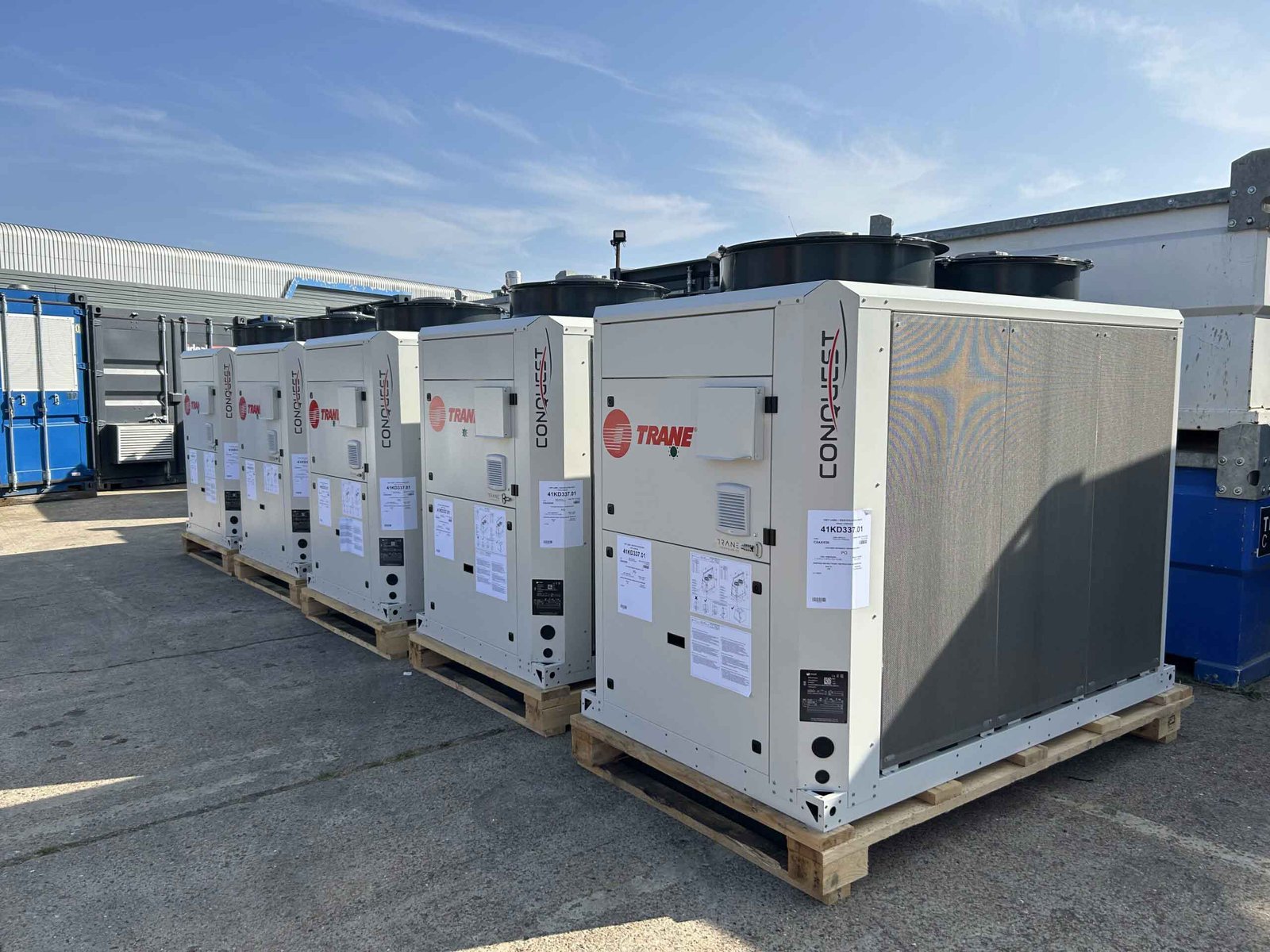

Construction projects in the UAE often have cooling requirements that change as work progresses. A project may need temporary cooling for site offices, worker accommodation, enclosed work areas, equipment rooms, commissioning activities, or partially completed buildings before the permanent HVAC system is operational.
In these situations, a temporary chiller for construction projects in the UAE can provide the required cooling capacity without waiting for a permanent system to be installed. However, selecting the right unit involves more than comparing chiller capacities or rental prices.
The chiller must match the project’s cooling load, required chilled-water temperatures, operating conditions, available power, installation arrangement, site access and expected rental period. ASHRAE guidance specifically stresses the importance of accurately determining cooling load when selecting chillers and warns that unnecessary oversizing can increase equipment and operating costs.
For UAE construction sites, environmental and worker-safety requirements also make effective temporary cooling an important consideration. The UAE’s Occupational Heat Stress Prevention Policy requires appropriate cooling arrangements and other heat-safety measures at applicable work sites during the summer period.
Why Construction Projects May Need Temporary Chillers
A temporary chiller is generally used when cooling is required for a limited period or when the project’s permanent cooling system is unavailable.
Common situations include:
Cooling temporary site offices
Providing air conditioning to enclosed construction areas
Supporting worker welfare facilities
Maintaining suitable temperatures during building fit-out
Providing cooling while a permanent HVAC system is being installed
Supporting HVAC testing and commissioning
Providing backup during temporary equipment failure
Supplying additional cooling during periods of unusually high demand
Supporting phased construction projects
Maintaining cooling for sensitive equipment or temporary technical areas
Construction requirements can also change quickly. A project may initially require a relatively small amount of cooling but need additional capacity later as more floors, rooms or systems become operational.
This makes rental equipment particularly useful because capacity can potentially be increased, reduced or replaced as project requirements develop.
1. Start by Calculating the Cooling Load
The first and most important step is determining how much cooling the construction project actually requires.
Cooling capacity is commonly expressed in tons of refrigeration (TR) or kilowatts (kW). The required capacity depends on the actual heat entering and being generated within the area being cooled.
Factors can include:
Area and volume of the space
Outdoor design conditions
Indoor temperature requirement
Solar heat gain
Number of workers or occupants
Lighting loads
Electrical equipment
Construction machinery
Fresh-air requirements
Building envelope and insulation
Operating hours
Heat generated by equipment
Number of areas requiring simultaneous cooling
ASHRAE identifies cooling-load size as a major factor in chiller selection and recommends accurate load calculation rather than simply adding a large arbitrary capacity margin. Oversizing can increase equipment costs, energy consumption and operating problems at low loads.
Therefore, choosing the biggest available rental chiller is not automatically the safest option.
An undersized chiller may fail to maintain the required conditions, while an unnecessarily oversized unit may consume more power and operate inefficiently.
2. Consider the UAE’s Outdoor Conditions
A chiller installed on a UAE construction site has to operate in demanding outdoor conditions, particularly during summer.
The selected equipment should therefore be checked for its rated operating conditions rather than relying only on its nominal capacity.
Ask the rental provider:
At what ambient temperature is the stated capacity achieved?
What is the expected capacity at the project’s actual outdoor design temperature?
Is the unit suitable for continuous summer operation?
What are the manufacturer’s operating limits?
How will high ambient temperatures affect performance?
This distinction is important because a chiller’s advertised capacity does not necessarily represent the capacity it will deliver under every operating condition.
For a construction project in Dubai, Abu Dhabi or another UAE location, the technical proposal should be based on the actual site conditions and required chilled-water temperatures.
3. Define the Required Chilled-Water Temperatures
Before selecting a temporary chiller, establish the required chilled-water supply and return temperatures.
For example, the project team should know:
Required chilled-water supply temperature
Expected return-water temperature
Required temperature difference
Required water flow
Pressure requirements
Type of air-handling or fan-coil equipment being served
These parameters influence the chiller’s actual performance.
A rental provider should therefore receive more information than simply a request for a “200 TR chiller.” The required operating conditions should be specified so the proposed equipment can be evaluated properly.
4. Calculate the Required Water Flow
Cooling capacity alone does not define a complete temporary chilled-water system.
The system also needs an appropriate flow rate.
A simplified relationship between cooling capacity, water flow and temperature difference is:
Cooling capacity ≈ water flow × specific heat × temperature difference
The exact engineering calculation should be completed by a qualified HVAC professional based on the project’s design conditions.
The selected chiller, pumps, hoses and distribution system should work together. If the flow requirement is not properly matched, the chiller may not deliver the expected cooling performance even when its nominal TR rating appears sufficient.
5. Choose Between Air-Cooled and Water-Cooled Chillers
One of the major decisions is whether an air-cooled or water-cooled temporary chiller is appropriate.
Air-Cooled Chillers
Air-cooled chillers reject heat directly to the surrounding air through condenser coils and fans.
They can be attractive for construction applications because they generally do not require a cooling tower or the same level of condenser-water infrastructure associated with water-cooled systems.
Potential advantages include:
Simpler installation
No cooling tower requirement
Easier deployment at many temporary sites
Reduced water-management requirements
Suitable for projects where temporary infrastructure needs to remain relatively straightforward
However, performance depends heavily on outdoor ambient conditions, so high-temperature operation should be evaluated carefully.
Water-Cooled Chillers
Water-cooled chillers reject heat through condenser water and normally require supporting equipment such as cooling towers, pumps and associated piping.
They can be appropriate for larger or specific applications where the required infrastructure is available and the project economics justify it.
For a temporary construction project, the additional installation and water-management requirements should be considered before selecting this arrangement.
The correct choice depends on the project’s cooling capacity, available infrastructure, space, water availability, operating duration and technical requirements.
6. Check the Available Electrical Supply
A technically suitable chiller may still be unsuitable if the construction site cannot provide the required electrical supply.
Before ordering the equipment, confirm:
Available voltage
Phase
Frequency
Available electrical capacity
Generator capacity, if generator power will be used
Starting and operating requirements
Distribution-board requirements
Cable and protection requirements
If the site relies on rental generators, the generator and chiller should be evaluated as one system.
The power requirement of the complete temporary cooling installation may include:
Chiller
Chilled-water pumps
Condenser-water pumps, where applicable
Cooling tower, where applicable
Control equipment
Other associated loads
A professional supplier should be able to provide the electrical specifications required for site planning.
7. Consider Site Space and Access
Construction sites change constantly. Equipment that can be delivered easily during the early stages may become difficult to access once structures, scaffolding and other temporary facilities are installed.
Before selecting a temporary chiller, check:
Available installation area
Delivery route
Crane or lifting requirements
Truck access
Equipment dimensions
Service clearances
Ventilation requirements
Distance from the area being cooled
Hose and pipe routing
Noise considerations
This is especially important for air-cooled chillers because adequate airflow around the condenser section is necessary for effective heat rejection.
A site survey before delivery can identify practical problems that may not appear on a capacity calculation.
8. Select the Right Temporary Chiller Configuration
Construction cooling requirements can vary significantly.
Some projects may require one large chiller, while others may benefit from multiple smaller units.
For example, multiple chillers can provide greater flexibility when different parts of a construction project become operational at different times.
A modular approach may also make it easier to:
Add cooling capacity
Remove unused capacity
Maintain individual units
Continue operation if one unit is unavailable
Match changing project loads
For critical applications, project managers should discuss redundancy requirements with the HVAC contractor or rental provider instead of assuming that a single chiller provides sufficient protection against equipment failure.
9. Don’t Forget Pumps, Hoses and Distribution Equipment
Renting the chiller itself is only one part of a temporary cooling system.
Depending on the installation, the project may also require:
Chilled-water pumps
Flexible hoses
Temporary pipework
Valves
Strainers
Flow meters
Buffer tanks
Expansion arrangements
Electrical cabling
Control systems
Air-handling units
Fan-coil units
Cooling towers for water-cooled configurations
A low rental price for the chiller may not represent the lowest total project cost if essential accessories are excluded.
For this reason, request a complete quotation that clearly identifies what is included in the rental package and what must be provided by the contractor.
10. Check the Chiller’s Rental Support Package
Construction projects operate against schedules, and cooling failures can affect several other activities.
When comparing rental providers, ask about:
Delivery
Installation
Commissioning
Preventive maintenance
24/7 emergency support
Spare parts availability
Technician response time
Replacement equipment
Monitoring
Equipment removal after the rental period
Technical support can be particularly important during UAE summer conditions, when cooling equipment may operate under demanding loads.
A supplier offering a lower rental rate may not necessarily provide the same level of service as another supplier with stronger technical support.
11. Consider the Project Schedule
Temporary cooling should be planned around the construction programme.
Identify:
When is cooling required?
How much capacity is needed at each stage?
Will the cooling load increase as construction progresses?
When will the permanent HVAC system become operational?
How long will commissioning take?
Is backup cooling required during the transition period?
ASHRAE guidance emphasizes understanding load profiles and operating schedules when selecting chilled-water systems.
For construction projects, this means the rental plan should not necessarily be based on the peak requirement for the entire project if the load changes significantly from one phase to another.
12. Account for UAE Heat-Safety Requirements
Cooling equipment can form part of a broader site heat-management strategy, but it does not replace compliance with UAE occupational health and safety requirements.
For 2026, the UAE’s Occupational Heat Stress Prevention Policy applies from 15 June to 15 September, with outdoor work under direct sunlight and in open areas prohibited from 12:30 pm to 3:00 pm during the applicable period. MoHRE also states that employers should provide shaded areas, adequate cooling devices, sufficient drinking water and first-aid equipment.
Abu Dhabi City Municipality also highlighted the importance of appropriate cooling facilities, rest areas and hydration solutions when discussing heat-stress prevention for construction workers in 2026.
Therefore, if temporary cooling is being used for worker welfare areas, site offices or rest facilities, the cooling system should be incorporated into the project’s overall heat-management and occupational-safety plan.
13. Compare Total Cost, Not Just Rental Price
When comparing temporary chillers, avoid choosing a supplier solely because its quoted monthly rental is lower.
Consider the complete cost, including:
Chiller rental
Delivery
Installation
Transportation
Pumps
Hoses
Piping
Electrical installation
Commissioning
Fuel or electricity consumption
Maintenance
Technician support
Emergency replacement
Dismantling
Collection
A more efficient or better-matched chiller may have a higher rental rate but lower operating and support costs.
The goal should be to compare the total cost of providing reliable cooling, rather than simply comparing the advertised rental rate.
Temporary Chiller Selection Checklist
Before finalising a temporary chiller for a UAE construction project, confirm the following:
Required cooling capacity in TR or kW
Actual project cooling load
Peak and expected operating load
Required chilled-water supply temperature
Return-water temperature
Required water flow
Outdoor design conditions
Air-cooled or water-cooled configuration
Available electrical supply
Pump requirements
Pipe or hose requirements
Installation location
Equipment access
Noise restrictions
Rental duration
Maintenance arrangements
Emergency response
Backup or redundancy requirements
Delivery and collection arrangements
Total project cost
Applicable site and safety requirements
Final Thoughts
Choosing the right temporary chiller for construction projects in the UAE requires more than selecting a unit based on tonnage or rental price.
The most reliable approach is to begin with the actual cooling load, establish the required chilled-water conditions and then evaluate the chiller type, ambient operating conditions, electrical supply, pumps, distribution system, site access and support requirements.
ASHRAE’s guidance reinforces the importance of accurate load calculation and appropriate equipment sizing, while UAE authorities continue to emphasise effective heat-stress prevention measures at construction sites.
For construction managers, the best temporary cooling solution is therefore the one that provides the right capacity under actual UAE operating conditions, can be installed safely, fits the project schedule and comes with dependable technical support.
Before signing a rental agreement, provide the supplier with the project’s cooling-load information, chilled-water requirements, site conditions and expected operating schedule. This gives the rental provider the information needed to recommend equipment that is technically appropriate rather than simply offering the largest available chiller.