
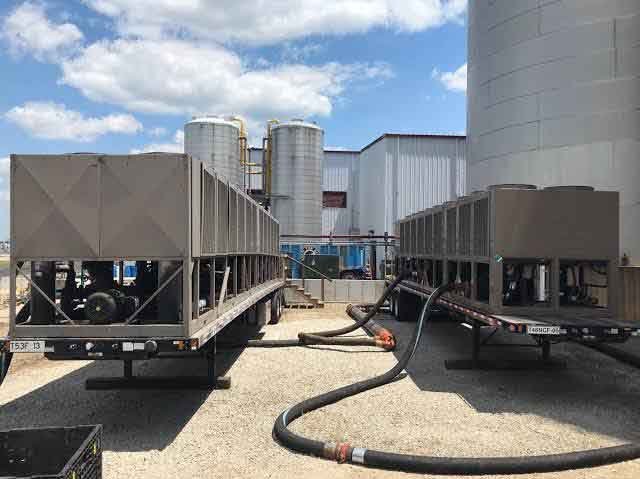

Large industrial projects often require dependable cooling throughout construction, commissioning, production, maintenance, and expansion. In many facilities, cooling is not simply used for indoor comfort. It can be part of the manufacturing process itself, helping control equipment temperatures, production conditions, storage environments, and other temperature-sensitive operations.
This is where rental chillers can provide a practical temporary cooling solution. Industrial chiller rental allows a project to add cooling capacity without waiting for a permanent chiller plant to be designed, purchased and installed. Depending on the application, rental systems can provide temporary, supplementary, emergency or process cooling.
ASHRAE explains that chillers are commonly used not only for air conditioning but also for industrial processes where water, brine or another secondary coolant needs to be chilled. This makes chilled-water systems relevant to a wide range of industrial applications.
Why Large Industrial Projects Need Temporary Cooling
Large projects rarely operate under completely static conditions. Cooling requirements can change as different areas of a facility become operational, production capacity increases or permanent HVAC equipment is being installed.
A new industrial facility, for example, may need cooling during commissioning before its permanent cooling infrastructure is fully operational. An existing plant may also need additional capacity while its main chiller is undergoing maintenance or replacement.
Rental cooling can bridge these gaps. Trane describes rental chillers as solutions for temporary, emergency and supplemental cooling, including situations where businesses need to keep operating while existing equipment is repaired, replaced or upgraded.
Supporting Industrial Processes
In many industrial environments, temperature control directly affects the process. Manufacturing equipment, production lines and certain materials may require controlled temperatures during operation.
A rental chiller can provide chilled water or another cooling medium to the required system. The exact arrangement depends on the process, required temperatures, cooling load and existing site infrastructure.
Industrial rental fleets can include different chiller configurations for different applications. Aggreko, for example, lists air-cooled, water-cooled and low-temperature chillers for industrial temperature-control requirements and identifies manufacturing among the applications they serve.
This flexibility is particularly useful when a project has a temporary process-cooling requirement rather than a reason to invest in another permanent chiller.
Maintaining Production During Chiller Maintenance
Planned maintenance is an important reason industrial facilities use temporary cooling.
Taking a primary chiller offline can affect production if there is no alternative cooling capacity. Instead of shutting down an entire operation, a rental chiller can be connected to provide temporary capacity while maintenance or replacement work takes place.
This approach can also be useful when an older chiller needs to be replaced. The rental system can provide cooling during the period between removing the old equipment and commissioning the new system.
Trane specifically identifies temporary rental equipment as a way to maintain operations during repair, replacement and upgrading of existing systems.
Handling Unexpected Cooling Requirements
Industrial facilities can also experience unplanned cooling problems. A chiller failure, unexpected increase in production or infrastructure problem can create an immediate need for additional capacity.
Emergency rental chillers are designed to address these situations. Aggreko notes that temporary industrial chillers can be used for emergency cooling as well as planned maintenance and other temporary requirements.
For a large industrial operation, the value of this type of solution is not simply the cooling equipment itself. Fast mobilisation, correct system selection, installation and technical support can all influence how quickly the facility can return to normal operation.
Flexible Cooling Capacity for Changing Projects
Cooling demand can change considerably during a large industrial project.
During early construction, there may be limited cooling requirements. During commissioning, however, equipment testing and operational areas may create a much larger demand. Once permanent systems become available, the temporary equipment can be removed.
Rental therefore provides a level of flexibility that permanent equipment ownership does not always offer. Industrial projects can select equipment based on the current requirement and rental period instead of permanently installing capacity that may no longer be required after the project is completed.
Large rental fleets can also provide different capacity ranges and chiller types. Trane, for example, lists rental equipment ranging from smaller process chillers to large-capacity systems intended for major commercial and industrial applications.
Supporting Construction and Commissioning
Cooling can be required before an industrial facility reaches full production.
During construction and commissioning, temporary cooling may be needed for occupied areas, equipment testing, process systems or staged commissioning activities. Providing temporary cooling can help prevent the cooling system from becoming a constraint on the wider project schedule.
The same principle is used in other critical facilities. Trane’s temporary cooling solutions for data-centre construction and commissioning are designed to provide cooling before permanent infrastructure is fully ready and to support testing and startup activities.
The specific requirements differ between industries, but the underlying concept is similar: temporary cooling can bridge the period between project stages.
Air-Cooled or Water-Cooled Chiller?
Choosing between an air-cooled and water-cooled rental chiller depends on the project rather than simply the required capacity.
Air-cooled chillers reject heat directly to the surrounding air and can be comparatively straightforward to deploy where suitable electrical capacity and space are available. Water-cooled systems use a condenser-water circuit and may require additional equipment such as cooling towers.
For large industrial applications, the site assessment should therefore consider available space, electrical supply, water availability, ambient conditions, required leaving-water temperature, heat load and the existing chilled-water system.
Trane’s rental fleet includes both air-cooled and water-cooled chillers for industrial and commercial applications, while its guidance notes that water-cooled chillers are generally suited to larger, high-capacity applications and air-cooled units can offer easier installation.
What Should Be Checked Before Renting?
Selecting a rental chiller should start with the actual cooling requirement rather than choosing a machine based only on its tonnage.
The project team should establish the expected heat load, required chilled-water temperature, flow rate, operating schedule and connection requirements. Site conditions also matter. Available electrical power, pipe connections, access for delivery, installation space and heat-rejection requirements should all be reviewed before equipment is selected.
Trane recommends beginning the sizing process by calculating the total heat load and considering factors such as equipment, space and insulation.
For industrial process cooling, the required temperature range can be especially important. A chiller designed for ordinary comfort cooling may not be suitable for a process requiring lower fluid temperatures.
Installation and Technical Support Matter
A rental chiller is only part of a temporary cooling system. Depending on the project, the installation may also require pumps, hoses or piping, cooling towers, heat exchangers, electrical connections and control equipment.
The rental provider should therefore understand the complete application rather than simply delivering a chiller to the site.
Some industrial rental providers offer engineering, installation, monitoring and technical support as part of the rental solution. Aggreko, for example, describes its industrial chiller service as including technical support and equipment designed for different industrial temperature-control applications.
For a large project, having one coordinated team responsible for equipment and deployment can simplify the temporary cooling process.
Why Rental Can Make Sense for Temporary Industrial Needs
Buying a permanent chiller involves equipment procurement, installation and long-term ownership responsibilities. Those commitments may not make sense when cooling is required only for a defined project period.
Rental allows a company to obtain cooling capacity for the period it actually needs it. This can be particularly useful for construction projects, planned shutdowns, temporary production requirements, equipment replacement and emergency situations.
UAE rental providers also commonly structure chiller hire around project requirements rather than one universal price. Factors such as capacity, rental duration, chiller type, installation and technical support can affect the final quotation.
Rental Chillers for Industrial Projects in the UAE
The UAE’s industrial sector includes manufacturing facilities, warehouses, processing operations, construction projects and other applications where dependable temperature control can be important.
For these projects, a rental chiller can provide temporary or additional cooling without requiring the facility to commit to another permanent cooling plant.
A suitable rental solution should be selected according to the project’s actual cooling load, required temperature, duration, site conditions and operational requirements. For larger installations, planning the equipment, connections, power requirements and installation logistics in advance can help ensure a smoother deployment.
Final Thoughts
Rental chillers can support large-scale industrial projects in several ways. They can provide temporary process cooling, maintain operations during maintenance, supply additional capacity during peak demand, support construction and commissioning, and provide emergency cooling when permanent equipment becomes unavailable.
The key is to treat chiller rental as a complete temporary cooling solution rather than simply hiring a piece of equipment. Proper load assessment, chiller selection, installation planning and technical support all play an important role in achieving dependable cooling.
For industrial projects where cooling requirements are temporary, changing or time-critical, a properly specified rental chiller can provide the flexibility needed to keep the project moving while permanent cooling infrastructure is installed, upgraded or restored.