
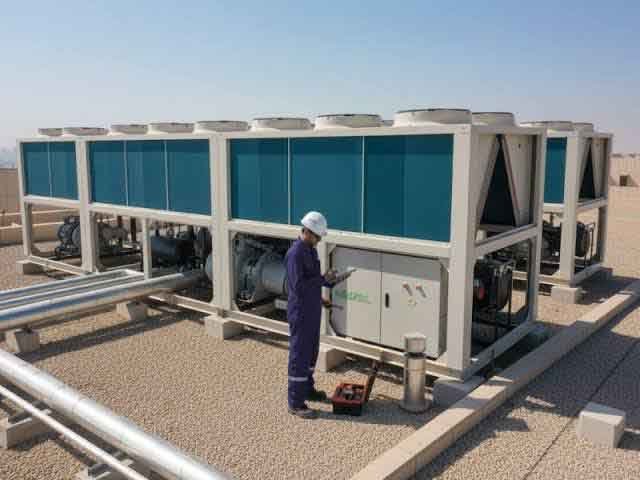

Cooling is not simply a comfort requirement in the UAE. For many commercial and industrial facilities, reliable cooling is part of keeping daily operations running. Offices, hotels, shopping centres, warehouses, factories, healthcare facilities, construction projects and data centres can all depend on properly sized cooling systems. The UAE’s climate and expanding commercial infrastructure make temporary cooling particularly useful when permanent systems cannot provide the required capacity.
Temporary chiller rental is therefore becoming a practical option for businesses that need cooling for a limited period, additional capacity during peak demand, or a replacement while their existing equipment is being repaired or upgraded. UAE rental providers currently market temporary chillers for applications ranging from emergency breakdowns and planned maintenance to construction, industrial processes and seasonal demand.
What Is Temporary Chiller Rental?
A temporary chiller is a cooling unit hired for a specific period rather than purchased as a permanent part of a building’s HVAC system. Depending on the project, the equipment can operate alongside an existing chiller system or provide replacement capacity while permanent equipment is unavailable.
Rental arrangements can cover a few days, several weeks, months or longer project periods. The exact setup depends on the cooling load, available power, site conditions, connection requirements and duration.
For businesses, this provides flexibility. Instead of purchasing equipment for a temporary requirement, they can bring in cooling capacity when it is actually needed and remove it when the project or requirement ends. UAE rental providers advertise both short-term and long-term arrangements for commercial, industrial, construction and emergency applications.
UAE’s Climate Makes Reliable Cooling Essential
The UAE’s hot climate places considerable demands on building cooling systems. This is particularly important during the summer months, when outdoor temperatures can become extremely high and cooling equipment has to work harder to maintain indoor conditions.
The importance of cooling can also be seen in UAE building requirements. UAE green-building guidance requires additional electrical sub-metering for buildings with a cooling load of at least 1 MW or a gross floor area of 5,000 square metres or more, reflecting the significance of cooling-related energy consumption in larger buildings.
This environment creates situations where existing cooling systems may require additional support. A facility may have adequate cooling under normal conditions but need extra capacity during an unusually high load or when part of its cooling plant is unavailable.
That is where temporary chiller rental can provide a practical bridge.
Planned Maintenance Is a Major Reason for Renting
Regular maintenance is necessary for large HVAC systems, but shutting down a chiller can create operational problems for a facility.
A commercial building, hotel, factory or warehouse may not be able to stop operations simply because its main chiller needs servicing. Removing a chiller from operation without a replacement can affect indoor temperatures and, in some industrial environments, production processes.
A temporary chiller can be installed before the planned shutdown and used while maintenance or replacement work takes place. Once the permanent system is ready, the temporary equipment can be disconnected and removed.
This approach allows facility managers to schedule maintenance without automatically treating the shutdown as a complete cooling outage. Rental providers specifically identify planned maintenance and HVAC replacement as common temporary-chiller applications.
Emergency Cooling After a Chiller Breakdown
Unexpected equipment failure is another important reason businesses turn to rental chillers.
A failed compressor, electrical problem, control-system fault or other major chiller issue can leave a facility with insufficient cooling. Depending on the application, waiting for spare parts or permanent replacement equipment may not be practical.
Temporary cooling can provide an interim solution while technicians diagnose and repair the permanent system. Instead of keeping the entire facility without adequate cooling during the repair period, a rental unit can provide additional or replacement capacity.
This is especially relevant for facilities where temperature control affects operations, equipment or stored products. Rental providers in the UAE promote emergency chiller services specifically for situations involving breakdowns and unexpected cooling requirements.
Construction and Fit-Out Projects Need Flexible Cooling
Construction and building fit-out projects are another area where temporary cooling can be useful.
A new building may require cooling before its permanent HVAC plant is fully commissioned. During construction or interior fit-out, temporary offices, enclosed work areas and certain site activities may also require controlled temperatures.
The UAE construction market continues to include major residential, hospitality, logistics, industrial and data-centre developments. Market research identifies warehouses, data centres and other specialised developments as important parts of the country’s expanding construction activity.
For project managers, temporary cooling can help bridge the period between construction activity and final HVAC commissioning. Instead of installing permanent equipment earlier than necessary, a temporary system can be used according to the project’s schedule.
Growing Data Centre Activity Adds Cooling Requirements
Data centres are another sector where cooling has become increasingly important.
The UAE data centre construction market is expanding alongside cloud computing, digital services and AI-related infrastructure. According to Mordor Intelligence’s 2026 market analysis, cooling systems represented 55.9% of the UAE data-centre construction market’s mechanical infrastructure in 2025. The report also highlights the increasing thermal-management requirements associated with higher-density computing.
Data-centre operators cannot treat cooling as an optional facility service. Servers generate significant heat, and cooling systems need to maintain appropriate operating conditions.
Temporary chillers can therefore have a role during construction, maintenance, upgrades or periods when additional cooling capacity is required. The exact solution depends on the data centre’s design, redundancy requirements and cooling architecture, but rental equipment can provide additional flexibility during specific project stages. UAE rental providers list data centres among the applications for temporary chiller services. HVACLINIC
Industrial Facilities Also Need Temporary Cooling
Industrial cooling requirements can be different from ordinary comfort cooling.
Factories and processing facilities may need cooling for machinery, production processes, storage areas or controlled environments. If the primary cooling system requires maintenance or additional capacity, a temporary chiller may help maintain operations.
The requirement can also change as production capacity increases. A facility that originally operated with sufficient cooling may eventually need additional capacity after adding machinery or expanding production.
In such cases, a temporary chiller can allow the business to address an immediate requirement while evaluating a longer-term HVAC or process-cooling investment.
Rental providers in the UAE offer industrial chiller solutions for manufacturing and process applications, including temporary capacity during maintenance and unexpected equipment problems.
Seasonal Demand Can Change Cooling Requirements
Cooling demand is not necessarily the same throughout the year.
A building may operate comfortably with its existing equipment during moderate conditions but experience greater demand during the UAE’s hottest periods. Older equipment can also struggle when operating close to maximum capacity for extended periods.
Instead of immediately investing in a larger permanent cooling plant, some businesses may use temporary equipment to cover a specific seasonal requirement.
This can be particularly useful for facilities that experience predictable changes in occupancy or operational load. Rental providers describe seasonal peak demand as one of the situations where temporary chiller capacity may be used.
Why Businesses Prefer Flexibility
One of the main attractions of temporary chiller rental is flexibility.
Buying a commercial or industrial chiller represents a long-term equipment decision. The business becomes responsible for ownership, maintenance planning and eventual replacement. Rental, by comparison, allows cooling capacity to be arranged around a defined project or operational requirement.
This does not mean renting is automatically cheaper than purchasing. The appropriate option depends on how long the equipment will be required, the cooling load, installation requirements, operating conditions and the total cost of ownership.
For a short-term requirement, however, purchasing permanent equipment may not make operational sense. Rental can provide access to the required capacity without turning a temporary problem into a permanent equipment investment.
Choosing the Right Temporary Chiller
Selecting a temporary chiller should not be based only on the cooling capacity advertised by the supplier.
The actual cooling requirement needs to be assessed according to the building or process load. Factors such as indoor conditions, equipment heat, occupancy, operating hours, ambient temperature, available electrical supply and connection arrangements can influence the required system.
The type of chiller also matters. Air-cooled units can be suitable for applications where a cooling tower or dedicated water source is not available, while water-cooled systems may be considered for larger continuous loads where the required infrastructure exists.
Site access should also be checked before delivery. Large chillers may require suitable space, lifting arrangements, pipework, electrical connections and safe access for installation and servicing.
A professional rental provider should therefore ask about the application and site rather than simply supplying equipment based on building size.
Installation and Technical Support Matter
Temporary cooling is not only about delivering a machine to a site.
The chiller needs to be connected correctly, commissioned and monitored during operation. Depending on the project, the rental package may also require pumps, hoses, temporary pipework, power equipment or air-handling equipment.
Some UAE rental providers offer turnkey arrangements that include delivery, connection, commissioning, technical support and collection after the rental period.
Businesses should clarify what is included before signing a rental agreement. Important points include installation, transportation, operating support, maintenance, emergency response, accessories and removal.
This can prevent unexpected technical or logistical problems after the equipment arrives on site.
What Determines the Rental Requirement?
There is no single temporary chiller solution for every UAE business.
The rental requirement can depend on:
- Required cooling capacity
- Type of application
- Rental duration
- Available electrical supply
- Existing HVAC connections
- Site access
- Ambient conditions
- Required pumps and pipework
- Installation and commissioning requirements
- Technical support requirements
Rental providers commonly assess these factors before preparing a quotation because the equipment and supporting infrastructure can vary significantly between projects. Rental Power and Rental Cooling in UAE facilities, healthcare environments, data centres and other applications where inadequate cooling can affect operations.
Temporary Does Not Mean Low Quality
There is sometimes a misconception that temporary equipment is simply a basic substitute for permanent HVAC equipment.
In reality, commercial rental fleets can include large-capacity air-cooled and water-cooled chillers designed for demanding applications. Providers in the UAE advertise equipment for industrial, commercial, construction, event and emergency requirements.
The key is to match the equipment to the application. A temporary chiller that is correctly sized, properly connected and professionally commissioned can provide useful cooling capacity for the period in which it is required.
Why the Demand Is Likely to Remain Relevant
The growth of construction, specialised industrial facilities, logistics infrastructure, hospitality developments and data centres creates different cooling requirements across the UAE. At the same time, existing buildings continue to require maintenance, upgrades and replacement of ageing HVAC equipment.
These conditions create a recurring need for temporary solutions.
A business may need cooling for a few days during emergency repairs, several weeks during an HVAC replacement, or several months while a new facility is being completed. The reason changes, but the underlying requirement remains the same: maintaining sufficient cooling while a permanent solution is unavailable or unnecessary.
For this reason, temporary chiller rental in the UAE is becoming an increasingly practical part of commercial and industrial cooling planning.
Final Thoughts
The growth of temporary chiller rental in the UAE is connected to several practical business needs: extreme seasonal cooling demand, planned maintenance, unexpected breakdowns, construction projects, HVAC replacement, industrial processes and expanding data-centre infrastructure.
Rather than being limited to emergency situations, temporary chillers can now form part of planned cooling strategies. Businesses can use them as a bridge during equipment replacement, as additional capacity during peak periods or as temporary cooling while a permanent system is being developed.
The most important step is choosing equipment based on the actual cooling load and site requirements. A professional assessment, suitable equipment, proper installation and dependable technical support can make temporary cooling a much more controlled solution for UAE businesses.