
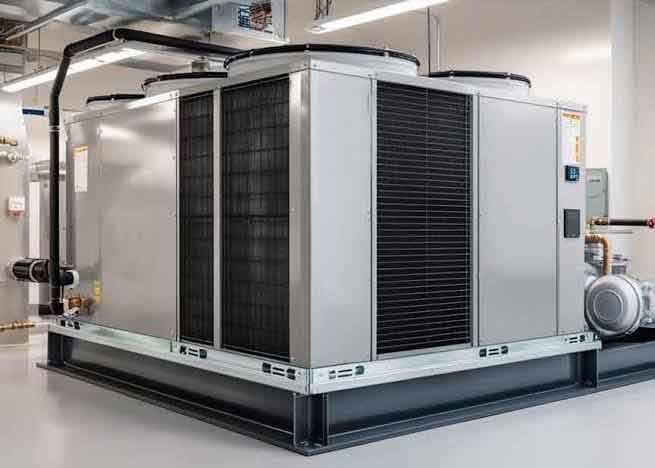

Commercial buildings in the UAE depend heavily on reliable cooling to maintain comfortable indoor conditions and protect temperature-sensitive operations. When a permanent chiller fails, requires planned maintenance, or cannot provide enough capacity during a period of increased demand, waiting weeks for a replacement is often not practical. Fast-response commercial chiller rental in the UAE provides a temporary way to restore or increase cooling capacity without immediately purchasing and permanently installing another chiller.
A rental chiller is a temporary cooling machine supplied for a defined period. Depending on the application, it can be connected to an existing chilled-water system or incorporated into a temporary cooling arrangement. Rental providers may supply the chiller together with equipment such as pumps, flexible hoses, temporary pipework, heat exchangers, electrical equipment and controls, depending on the site’s requirements.
The main advantage of a fast-response commercial chiller rental is not simply having access to a chiller. The value comes from the ability to assess the cooling requirement, select an appropriate unit, transport it to the site, connect the temporary system and bring the cooling capacity online with as little disruption as practical.
What Is Fast-Response Commercial Chiller Rental in the UAE?
Fast-response commercial chiller rental is a temporary cooling service designed for situations where a commercial facility needs additional or replacement chilled-water capacity quickly.
Instead of purchasing a permanent chiller, the business rents equipment for the period required. This could be a short period during an emergency repair, several weeks during planned HVAC maintenance, a seasonal period of higher cooling demand, or a longer project period while a permanent cooling system is being upgraded or installed.
UAE rental providers commonly position temporary chillers for applications including commercial buildings, industrial facilities, hotels, events, planned shutdowns, emergency breakdowns and temporary capacity requirements.
The word fast-response is particularly important in commercial cooling. A rental chiller is useful only when it can be matched to the site’s requirements and deployed within the required timeframe. A technically suitable machine that cannot be transported, connected or commissioned quickly may not solve an urgent cooling problem.
For this reason, fast-response rental generally involves more than equipment hire. The process can include technical assessment, equipment selection, logistics, installation, commissioning and ongoing support.
How Does a Commercial Chiller Work?
Before understanding rental chillers, it helps to understand what a chiller actually does.
A commercial chiller removes heat from water or another circulating fluid and rejects that heat to the surrounding environment. The chilled water is then circulated through the building to provide cooling through air-handling units or other terminal equipment. Trane describes chillers as a central part of commercial HVAC systems because they cool a liquid that can then circulate through a building’s piping network.
A typical vapor-compression chiller follows four main stages.
1. Heat is transferred to the refrigerant
Warm return water from the building enters the evaporator. Refrigerant inside the chiller absorbs heat from this water. As the refrigerant absorbs heat, it changes state and becomes a vapor.
The result is cooler water leaving the evaporator and returning to the building’s cooling system.
2. The compressor raises refrigerant pressure
The refrigerant vapor passes through the compressor. The compressor increases the refrigerant’s pressure and temperature.
Different chillers can use different compressor technologies, including scroll, screw and centrifugal compressors. The appropriate technology depends on factors such as capacity and application.
3. Heat is rejected through the condenser
The hot refrigerant then reaches the condenser. In an air-cooled chiller, fans move ambient air across condenser coils so heat can be released directly into the atmosphere.
In a water-cooled chiller, condenser water carries heat away from the refrigerant. The condenser-water system normally works with a cooling tower or another heat-rejection arrangement.
4. The refrigerant pressure is reduced
After condensation, the refrigerant passes through an expansion device. Its pressure and temperature decrease, preparing it to absorb heat again in the evaporator.
The cycle then repeats.
This basic refrigeration cycle is why a rental chiller can temporarily take over some or all of the cooling function normally provided by a permanent chiller.
Why Do UAE Commercial Facilities Need Fast Chiller Rental?
Cooling failures can have different consequences depending on the type of facility.
In an office building, insufficient cooling can quickly affect occupant comfort. In a hotel, cooling problems can affect guest areas and operational spaces. In a retail facility, indoor temperature can influence customer comfort and business operations. In industrial applications, inadequate process cooling can affect equipment or production.
Temporary chillers are therefore commonly used for more than emergency breakdowns. UAE providers identify applications such as planned maintenance, temporary capacity, seasonal demand, construction, process cooling and emergency replacement.
Emergency Chiller Replacement
A permanent chiller can experience mechanical or electrical problems that require repair. Instead of allowing the building to remain without sufficient cooling while technicians work on the permanent equipment, a temporary rental chiller can provide replacement or supplementary capacity.
Planned Maintenance
Chiller maintenance and major HVAC work can require equipment to be taken offline. A temporary chiller can help maintain cooling during the maintenance period.
This approach allows facility teams to schedule important work without necessarily accepting a complete loss of cooling capacity.
Seasonal Cooling Demand
Cooling requirements can increase during periods of high ambient temperature. A building whose permanent equipment normally meets its design requirements may require additional temporary capacity when operating conditions or loads change.
Permanent Chiller Replacement
When an old chiller is being replaced, there may be a gap between removing the existing equipment and commissioning the new system. Rental cooling can act as a temporary bridge during this period.
Construction and Fit-Out Projects
A temporary cooling system can also support projects where the permanent HVAC system is not yet operational. The exact application depends on the project’s stage and cooling requirements.
How Does Fast-Response Commercial Chiller Rental Work?
Although the exact process varies between providers and facilities, a professional temporary cooling project normally starts with understanding the site’s technical requirements rather than simply choosing a chiller by nominal tonnage.
A typical process includes several stages.
Step 1: Cooling Requirement Assessment
The rental provider first needs to understand what the facility requires.
Important information can include:
- Required cooling capacity
- Existing chiller capacity
- Chilled-water supply and return temperatures
- Required water flow
- Available electrical supply
- Existing pipework
- Connection points
- Available installation space
- Site access
- Operating schedule
- Rental duration
- Environmental conditions
Al Shola, for example, identifies cooling load, leaving-water temperature, ambient conditions, electrical supply, pumping arrangements, pipe routing and operating period as factors involved in assessing a temporary chiller requirement.
Step 2: Chiller Selection and Sizing
The provider then selects equipment appropriate for the expected load and site conditions.
Capacity should not be selected simply because a larger machine appears safer. Oversizing and undersizing can both create problems.
The correct selection depends on the actual cooling requirement, operating temperatures, water flow, ambient conditions and the way the rental equipment will integrate with the existing system.
Commercial rental fleets can include different capacities and configurations. For example, Al Shola currently lists air-cooled rental chillers from 50 TR to 400 TR in its Abu Dhabi offering. Carrier’s UAE commercial chiller range also demonstrates how commercial equipment can span substantially different capacity and compressor configurations.
These figures should not be treated as a universal sizing guide. The correct capacity must be established for the individual project.
Step 3: Site and Connection Planning
Fast deployment does not mean skipping engineering checks.
The team needs to determine where the temporary chiller can be positioned and how it can connect to the building’s cooling system.
Depending on the installation, the rental package can involve chillers, pumps, hoses, temporary pipework, buffer tanks, heat exchangers, air-handling equipment, electrical equipment and controls.
The physical site is also important. Equipment access, lifting requirements, available space, electrical connections and pipe routes can affect deployment.
Step 4: Delivery to the Facility
Once the equipment and installation plan are confirmed, the chiller is transported to the site.
Fast-response providers emphasize logistics and rapid deployment because the usefulness of emergency cooling depends heavily on how quickly the equipment can reach the facility. Andrews Sykes, for example, highlights rapid delivery and a dedicated delivery fleet as part of its rental service, while UAE providers similarly promote rapid deployment for emergency and temporary applications.
Step 5: Installation and Connection
The temporary chiller is positioned and connected according to the approved setup.
For an air-cooled chiller, the system can often be configured as a packaged temporary cooling solution because the refrigeration and heat-rejection equipment are integrated into the unit. Trane notes that packaged air-cooled systems can simplify installation compared with water-cooled arrangements that require additional condenser-water infrastructure.
Water-cooled installations can involve additional equipment such as condenser-water piping, pumps and cooling towers or other heat-rejection equipment.
Step 6: Commissioning
Before the rental system is placed into normal operation, the installation should be checked and commissioned.
This can include checking connections, flow, temperatures, controls, electrical supply and system operation.
A professional rental service should verify that the temporary equipment is operating correctly before relying on it for commercial cooling.
Step 7: Operation and Technical Support
Once operational, the temporary chiller continues providing cooling for the agreed rental period.
Some providers offer monitoring, maintenance and technical support during the rental period. Stout Energy, for example, describes its rental process as site assessment, deployment and installation, followed by operation and support.
Step 8: Removal or Extension
When the permanent cooling system is repaired or the temporary requirement ends, the rental equipment can be disconnected and removed.
If the project lasts longer than originally expected, the rental period may be extended according to the agreement.
Air-Cooled vs Water-Cooled Chiller Rental in the UAE
One of the most important decisions is whether an air-cooled or water-cooled configuration is appropriate.
Air-Cooled Chiller Rental
Air-cooled chillers reject heat directly to ambient air using fans and condenser coils. They do not require a cooling tower or the same type of condenser-water loop associated with water-cooled systems.
This can make them attractive for temporary applications where simpler installation and rapid deployment are important.
Air-cooled chillers can be used for commercial buildings, industrial facilities, retrofit projects and temporary or emergency cooling. Trane specifically identifies portable air-cooled configurations as suitable for temporary and emergency applications.
However, ambient conditions matter. Trane notes that hot weather can reduce air-cooled chiller performance. This is particularly relevant when selecting temporary equipment for the UAE, where high outdoor temperatures can place significant demands on cooling equipment.
Water-Cooled Chiller Rental
Water-cooled chillers transfer heat to a condenser-water system rather than rejecting it directly to outdoor air.
They are commonly used in larger facilities and applications with substantial cooling loads. Water is generally a more effective heat-transfer medium than air, which can provide an efficiency advantage under appropriate operating conditions.
The trade-off is that a water-cooled temporary installation can require additional infrastructure, including condenser-water piping, pumps and cooling-tower or heat-rejection equipment.
For a fast-response application, the installation requirements therefore need to be evaluated alongside the chiller’s cooling capacity.
What Makes a Chiller Rental “Fast Response”?
Fast response is not simply about promising a short delivery time.
A genuinely responsive commercial chiller rental operation needs several elements to work together.
Equipment Availability
The provider needs suitable equipment available for deployment. A rental fleet containing different capacities and configurations provides more flexibility than a one-size-fits-all approach.
Technical Assessment
The equipment must match the facility’s cooling requirements and connection conditions.
Logistics
Large commercial chillers require suitable transport and site access. Delivery planning can become particularly important for facilities with restricted access or limited installation space.
Installation Capability
Having equipment available is only one part of the solution. The provider must also be able to connect and commission it safely and correctly.
Technical Support
Emergency cooling may operate outside normal working hours. Providers serving critical applications often offer 24/7 support or emergency response arrangements. Andrews Sykes, for example, advertises 24-hour service and emergency call-center support for its chiller rental operation.
For these reasons, fast-response commercial chiller rental in the UAE should be evaluated as a complete service rather than simply as equipment hire.
What Information Should a Business Give a Chiller Rental Provider?
Providing accurate information at the beginning can help the rental provider determine the appropriate equipment more efficiently.
A commercial facility should be prepared to provide information such as:
Cooling load: Explain how much cooling capacity is required and whether the requirement is for the entire building or only part of it.
Existing equipment: Provide information about the current chiller, its capacity and the reason it is unavailable or insufficient.
Operating temperatures: Chilled-water supply and return temperatures can affect equipment selection.
Water flow: The required flow and existing pumping arrangement are important when integrating a temporary system.
Electrical supply: The available electrical capacity needs to be compatible with the selected equipment.
Installation location: The provider needs to know where the temporary chiller will be placed.
Access: Delivery routes, gates, lifting restrictions and site limitations should be identified early.
Rental duration: A short emergency hire may require a different logistical approach from a six-month project.
Operating conditions: Ambient temperatures and the facility’s operating schedule can influence selection and performance.
The more complete the technical information, the less time may be spent clarifying requirements before deployment.
What Affects the Cost of Commercial Chiller Rental in the UAE?
There is no universal commercial chiller rental price because rental projects differ considerably.
HVAC Clinic notes that rental pricing can depend on factors including cooling capacity, rental duration, chiller type, installation requirements, location and technical support.
Other factors can include:
- Transportation distance
- Required pumps
- Temporary hoses and pipework
- Electrical requirements
- Installation complexity
- Site access
- Required operating temperatures
- Emergency response requirements
- Maintenance and monitoring
- Rental duration
A simple temporary setup may require fewer accessories than a complex commercial installation.
For this reason, businesses should compare the complete scope of a quotation rather than looking only at the advertised rental rate for the chiller itself.
When Is Fast Chiller Rental Better Than Buying?
Buying a permanent chiller can make sense when a facility has a long-term, predictable cooling requirement and sufficient capital budget.
Rental becomes more attractive when the requirement is temporary or uncertain.
For example, a business may benefit from renting when its permanent chiller is being repaired, when a replacement plant is being installed, during seasonal demand increases, or when a project requires cooling only for a limited period.
Rental can also avoid committing capital to equipment that may no longer be needed after a project ends.
HVAC Clinic identifies planned maintenance, unexpected breakdowns, seasonal demand, new project ramp-up, construction and fit-out work, and standby backup among situations where temporary chiller rental can be appropriate.
The decision ultimately depends on the duration, cooling requirement, capital budget and long-term plans of the facility.
How Commercial Chiller Rental Helps Reduce Cooling Downtime
The biggest operational benefit of fast-response rental is the ability to bridge a temporary cooling gap.
Suppose a commercial building’s main chiller fails. Permanent repairs may require diagnosis, parts, specialist technicians and commissioning. If the building cannot operate normally without cooling, waiting for the permanent system to return to service may create significant disruption.
A temporary chiller can be deployed as an interim solution while the permanent equipment is repaired.
The same principle applies to planned replacement. Instead of removing an old chiller and leaving the building without sufficient capacity until the new unit is commissioned, a temporary system can potentially bridge the transition.
This is why rental chillers are often described as a temporary or backup cooling solution rather than a permanent substitute for the building’s HVAC plant.
Which UAE Businesses Can Use Commercial Chiller Rental?
Fast-response chiller rental can be relevant to a wide range of commercial and industrial facilities.
Offices
Large offices may require temporary cooling during central plant maintenance, equipment failures or HVAC upgrades.
Hotels
Hotels depend on reliable cooling for guest rooms, public areas and back-of-house spaces. Temporary cooling can help maintain operations while permanent equipment is unavailable.
Shopping Malls
Large retail facilities can have substantial cooling loads. A temporary chiller may provide additional or replacement capacity during plant work.
Hospitals and Healthcare Facilities
Cooling requirements in healthcare environments can be critical, although the temporary system must be properly engineered and integrated with the facility’s specific requirements.
Data Centres
Data centers have sensitive thermal requirements. Temporary cooling solutions may be considered during maintenance, expansion or equipment failure, subject to the facility’s engineering and redundancy requirements.
Industrial Facilities
Industrial operations may need chilled water for process cooling as well as building comfort.
Events and Temporary Facilities
Temporary cooling systems can also be used where permanent HVAC infrastructure is unavailable or insufficient.
The suitability of rental equipment depends on the individual facility and its technical requirements.
What Are the Main Benefits of Fast-Response Commercial Chiller Rental?
Faster access to temporary cooling
The central benefit is access to cooling capacity without waiting for permanent equipment procurement and installation.
Reduced capital commitment
A business can obtain temporary cooling without purchasing a permanent chiller for a short-term requirement.
Flexible rental duration
Rental arrangements can be structured around short-term emergencies, maintenance windows, seasonal requirements or longer projects. UAE providers advertise both short-term and long-term rental arrangements.
Support during maintenance
Temporary equipment can allow planned work on permanent cooling equipment to proceed while maintaining temporary capacity.
Backup during emergencies
A rental chiller can provide an interim solution after an unexpected cooling-system failure.
Scalable cooling capacity
Businesses can potentially add temporary capacity when demand increases rather than permanently expanding the cooling plant for a temporary requirement.
What Should You Check Before Renting a Commercial Chiller?
Before accepting a rental proposal, businesses should confirm more than the chiller’s nominal capacity.
Check whether the quoted equipment is suitable for the expected ambient conditions, chilled-water temperatures and operating load.
Confirm what is included in the rental package. A quotation may cover the chiller but exclude pumps, hoses, electrical equipment, transportation or installation.
Check the required electrical supply and connection arrangements.
Confirm who is responsible for installation, commissioning, monitoring and maintenance.
Review the rental duration and extension terms.
Finally, make sure the provider understands the site’s access limitations and installation conditions.
These checks can help prevent a situation where the equipment arrives but cannot be connected or operated as planned.
Why UAE Climate Conditions Matter for Temporary Chiller Selection
The UAE’s hot climate makes ambient conditions an important consideration for cooling equipment.
Air-cooled chillers reject heat directly to outdoor air, so higher ambient temperatures can affect their operating performance. Trane specifically notes that hot weather can reduce air-cooled chiller performance.
This does not mean that air-cooled equipment is unsuitable for the UAE. Rental providers offer equipment designed for high-ambient conditions, and the correct selection depends on the specific project.
The important point is that a chiller should be evaluated against the actual operating environment rather than selected solely by its nominal capacity.
Fast-Response Chiller Rental as a Temporary Bridge
A useful way to understand commercial chiller rental is to view it as a bridge between a cooling problem and a permanent solution.
If a permanent chiller breaks, rental equipment can potentially provide temporary capacity while repairs are completed.
If a facility is replacing its chiller plant, rental equipment can bridge the period between removal of the old system and commissioning of the new one.
If cooling demand temporarily increases, rental equipment can provide supplementary capacity without requiring a permanent plant expansion.
This bridge approach is one of the main reasons temporary chillers are used across commercial, industrial and critical facilities. UAE rental providers specifically position temporary cooling for emergency breakdowns, planned shutdowns, temporary capacity and project requirements.
Conclusion
Fast-response commercial chiller rental in the UAE provides businesses with a flexible way to maintain or increase cooling capacity when a permanent system is unavailable, insufficient or undergoing maintenance.
The process normally begins with a technical assessment of the required cooling load, temperatures, water flow, power supply and site conditions. The rental provider then selects suitable equipment, plans delivery and connections, installs and commissions the temporary system, and provides support during the rental period.
Air-cooled and water-cooled chillers can both serve commercial applications, but their installation requirements and operating characteristics differ. Air-cooled systems can simplify temporary deployment because they do not require the same cooling-tower infrastructure as water-cooled systems, while water-cooled chillers can be advantageous for large, sustained cooling loads when the necessary infrastructure is available.
For UAE businesses, the most important consideration is not simply finding a chiller for rent. It is finding a properly sized, suitable and deployable temporary cooling solution that can work with the facility’s existing infrastructure and operating conditions.
When cooling downtime can affect occupants, equipment, production or business continuity, a well-planned commercial chiller rental can provide the temporary capacity needed while the permanent cooling system is repaired, replaced, upgraded or expanded.
Frequently Asked Questions
What is fast-response commercial chiller rental in the UAE?
It is a temporary cooling service in which a commercial-grade chiller is supplied and deployed quickly to replace or supplement existing cooling capacity. It can be used during emergencies, planned maintenance, seasonal demand increases, construction and permanent chiller replacement projects.
How does a rental chiller provide cooling?
A chiller removes heat from circulating water through a refrigeration cycle. The cooled water is then circulated through the building’s chilled-water system to provide cooling. The refrigerant releases the extracted heat through an air-cooled or water-cooled condenser.
How quickly can a commercial chiller be installed?
The actual deployment time depends on equipment availability, cooling capacity, site access, connection requirements, transport, electrical arrangements and installation complexity. Providers offering rapid-response services advertise fast delivery and emergency support, but businesses should confirm the expected response and installation timeline for their specific project.
What is the difference between air-cooled and water-cooled rental chillers?
Air-cooled chillers reject heat directly to outdoor air and generally do not require a cooling tower. Water-cooled chillers transfer heat to a condenser-water system and typically require additional equipment such as pumps and a cooling tower or another heat-rejection system.
Can a rental chiller replace a failed commercial chiller?
Yes, a suitably sized temporary chiller can be used as an interim cooling solution while a permanent chiller is repaired or replaced. The temporary system must be correctly sized and compatible with the site’s chilled-water, electrical and connection requirements.
Can commercial chillers be rented for planned maintenance?
Yes. Planned maintenance is one of the common applications identified by UAE rental providers. A temporary chiller can help maintain cooling while permanent equipment is taken offline for servicing or upgrades.
What determines the size of rental chiller required?
Sizing depends on the required cooling load, water temperatures, flow requirements, ambient conditions, existing system configuration and application. A technical site assessment is preferable to selecting equipment based only on the size of the building.
Does chiller rental include installation?
It depends on the rental agreement. Some providers offer complete temporary cooling packages that include delivery, installation, commissioning and ongoing technical support, while other quotations may separate equipment rental from installation and accessories. The scope should therefore be confirmed before the rental begins.
How long can a commercial chiller be rented?
Rental periods can range from short emergency or maintenance periods to seasonal and long-term project arrangements. The appropriate duration depends on why the temporary cooling system is required and how long the permanent solution will take.
What affects commercial chiller rental cost in the UAE?
Capacity, rental duration, chiller type, transportation, installation complexity, accessories, site conditions and technical support can all influence the final rental price. There is therefore no single price that applies to every commercial chiller rental project.